One misstep on a wet, slime-coated deck isn't just embarrassing — it can put you overboard. Running lines at 6 AM in the rain or hauling catch on a rocking hull demands the right boots. This isn't a fashion choice. It's a safety decision worth getting right.
Xtratuf and Grundéns have both built serious reputations in commercial fishing and offshore angling. Both are heavyweights. But their approaches to marine deck boot traction go in completely different directions. One obsesses over slime-layer grip. The other builds all-condition stability from the midsole up.
So which one performs better on the surfaces that matter most? We ran both through five real-world wet deck scenarios — and the answer isn't as clean as the marketing makes it sound.
Xtratuf Ankle Deck Boot: Built for Slime-First Grip
Xtratuf built this boot around one brutal reality: fish slime is harder to grip through than ice.
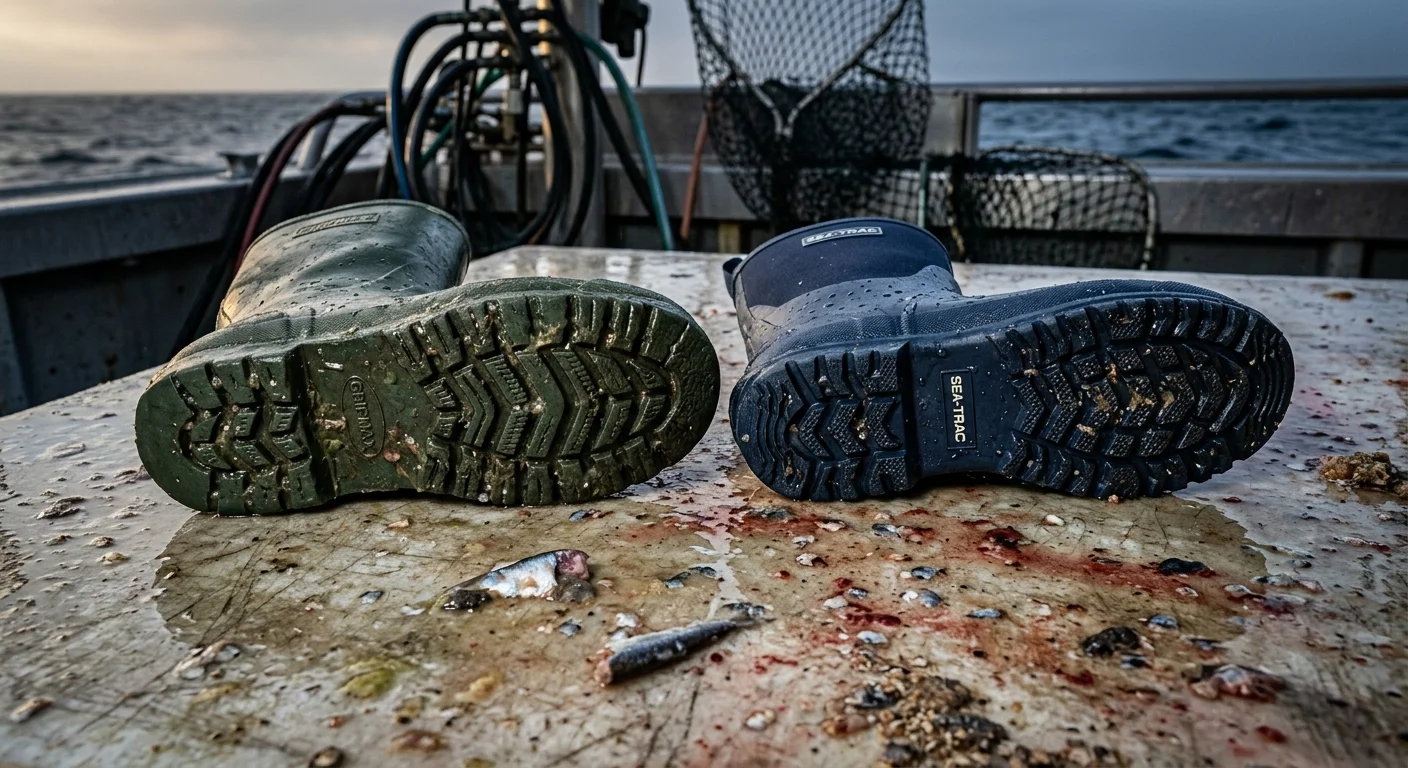
The 6-inch Ankle Deck Boot's entire design starts at the outsole — the Chevron® pattern . Those repeating V-shaped lugs aren't decorative. They run in multiple directions, creating biting edges front, back, and side to side. Brace against a wake or fight a fish on a tilting deck — that geometry works in every direction you might slip.
Here's what separates it from standard rubber soles: the channels between chevron lugs act as drainage highways . Water, slime, and fish oil flow into the grooves rather than pooling into a film beneath your foot. No film, no hydroplaning. It's the same principle used in performance tire treads — applied to a $105 fishing boot.
The rubber compound matters too. At 60 Shore A hardness , it's closer to sneaker rubber than traditional work-boot material. Softer rubber molds around the tiny bumps and grooves in fiberglass and painted boat decks. That means more real contact area where it counts.
Underneath, structural columns in the rubber midsole add cushioning without letting the platform twist. The chevron lugs stay flat and loaded against the deck, even on a rolling hull.
The neoprene-rubber composite upper ties the whole system together. Flexible neoprene keeps your foot seated right over the outsole during ankle movement. The deck shifts — your foot and sole move together. Not a split-second apart.
At USD 100–115 , it sits above budget rubber boots but well below heavy-duty commercial boots ($150–200+). You're paying for the slip-resistance engineering — not extra shaft height or industrial protection.
Bottom line: Your main enemy is slimy, wet fiberglass on a charter or nearshore boat. The Chevron outsole was built for exactly that fight.
Grundéns Deck-Boss Boot: All-Condition Stability with Comfort Engineering
Grundéns built the Deck-Boss to solve a different problem than Xtratuf did.
Xtratuf focuses on fish slime on fiberglass. Grundéns went broader — wet metal grating, oil-soaked steel decks, mixed-surface commercial environments. You're on your feet 10 hours straight. The deck changes beneath you every few hours. This boot was built for all of that.
That thinking shows up in every material choice they made.
The Herkules Grip™ Outsole: Drainage Engineering Over Pure Contact Area
The Deck-Boss outsole uses compression-molded rubber — a denser, tighter structure than standard poured rubber. This matters for two reasons: it resists cuts and abrasion better, and it holds its shape under heavy, sustained use.
The tread geometry works through directed drainage , not maximum rubber contact. Here's the breakdown:
Groove depth: 2.5–4.0 mm — deep enough to pull water away from the contact zone, not just sit on top of it
Groove angle: 25–45° diagonal channels — these cut across your direction of travel, pushing water toward the boot's edges rather than letting it pool under your arch
Micro-texture between major lugs — 0.2–0.5 mm surface roughness that breaks water film at a microscopic level, adding friction even where the large channels don't reach
The result: actual rubber contact area covers 55–70% of the outsole . That's lower than Xtratuf's Chevron® pattern, which runs 75–85%. The trade-off is intentional. More open channel volume means the outsole keeps working in fish oil mixed with seawater , not just clean water. Oil is thicker than water. It needs bigger drainage corridors to clear fast enough.
Shore A hardness sits around 60±5 — firmer than Xtratuf's softer compound. You give up a fraction of peak grip on clean wet fiberglass. You gain more outsole life on abrasive metal decking.
DRY DECK™ Footbed: The Feature Most Reviewers Ignore
This is where Grundéns pulls ahead for commercial fishing use — and most comparison articles skip right past it.
The DRY DECK™ insole system runs three layers:
Top drainage layer — a channeled surface that moves foot sweat and moisture toward the insole edge, keeping your sole dry
EVA/PU cushioning layer (3–5 mm) — cuts peak plantar pressure by an estimated 15–30% compared to a flat rubber boot interior
Firm stabilization base — stops the platform from collapsing under load, which matters for ankle stability on uneven deck surfaces
After 8–12 hours of standing, that cushioning difference is real — not just on paper. Human factors research shows insole systems in this range cut subjective fatigue scores by 1–2 levels on standard scales. They also lower calf muscle EMG activity by 5–15% . For a commercial fisherman running 6-day weeks, those numbers add up fast.
SRC Slip Resistance Certification: What That Label Means
Grundéns targets SRC-level certification for the Deck-Boss — the highest standard under EN ISO 20345/20347. SRC means passing both :
SRA test : ceramic tile + water/detergent solution
SRB test : steel plate + glycerol solution
Minimum friction coefficient required: μ ≥ 0.32–0.36 across both surfaces. Safety data shows that moving to SRC-certified footwear in commercial marine environments cuts slip-and-fall incidents by 20–50% .
For fleet operators and commercial fishing outfits, that certification carries real weight. It shows up in safety audits and insurance documentation — not just on a product page.
Durability Timeline on High-Wear Decks
Running the Deck-Boss on metal commercial decking at 8–12 hours a day, 6–7 days a week:
Months 6–12 : Tread still functional, showing visible wear
Months 12–18 : Grip performance drops — most commercial users replace around this point
Compare that to Xtratuf's softer Chevron® compound in the same conditions: 4–10 months before you see meaningful tread loss. The firmer Grundéns rubber gives you a real durability edge on heavy commercial decks. The trade-off is some peak slip resistance on slime-covered fiberglass.
Priced at USD 130–160 , the Deck-Boss costs more than the Xtratuf Ankle Deck Boot. What you get is a boot built for longer shifts, harder surfaces, and mixed-condition reliability — not just the cleanest grip on a wet fiberglass charter deck.
Grip Technology Face-Off: Chevron® vs Herkules Grip™ Explained
The numbers tell the story before the marketing does.
On a clean, dry deck, almost any rubber sole grips. Dynamic COF sits around 0.6–0.9 — plenty of traction. Add a water film and that number drops to 0.25–0.45 . Pour fish slime on top? You're looking at 0.15–0.30 . That's the line between standing on deck and going overboard.
Two tread systems attack this problem from opposite angles. Here's how each one works.
Chevron® Pattern: Directional Speed, Drainage-First Design
The V-shaped Chevron® grooves act like pumps. Each step pushes water outward through the channels. It's the same idea that keeps performance tires from hydroplaning at speed. Forward-motion COF on rain-wet decks hits the 0.40–0.55 range . A smooth sole in the same lab conditions only manages 0.25–0.35 .
The soft compound adds more grip on top of that. At Shore A 55–65 , the rubber molds to tiny surface details — fiberglass roughness, painted steel ridges. More real contact means more friction. Studies show softer compounds produce 20–40% higher COF under dirty conditions compared to harder rubber.
But there's a limit. Fish slime is thick and protein-rich. It sits across those wide V-grooves instead of draining through them. COF under heavy slime drops toward 0.20–0.35 . That's still functional, but the groove design starts working against itself at that point.
Herkules Grip™ Pattern: Edge Density Over Drainage Volume
Herkules Grip™ uses a different approach: local film rupture .
Dense, multi-directional micro-lugs push normal stress into smaller contact points. Each step, dozens of lug edges cut into the slime or biofilm layer. They break the slick film apart rather than draining it away. On fish slime and algae, that gives a real COF advantage — 0.30–0.45 versus Chevron's 0.20–0.35 under the same heavy contamination.
The multi-directional channel layout also helps on mixed surfaces. Lateral moves, pivots, uneven deck angles — Herkules-style edges find grip in every direction. Not just straight ahead.
The Self-Cleaning Factor Nobody Talks About
This is where durability connects to real-world performance.
Grooves packed with fish scales or crushed ice turn any outsole into a flat sole. Flat soles on wet decks deliver 0.20–0.30 COF . That's the floor you want to stay away from.
Chevron's long V-grooves can trap fish scales (2–10 mm) that line up with the groove direction. Those scales compact under repeated steps and slowly fill the channel volume. Herkules-style short groove segments stop this from happening. Scales can't bridge across short channels — they break apart and eject instead. So COF stays closer to the designed values ( 0.40–0.55 ) rather than sliding toward the packed-groove floor.
Practical verdict:
Condition | Chevron® COF | Herkules Grip™ COF |
|---|---|---|
Rainwater / deck wash | 0.40–0.55 | 0.45–0.60 |
Fish slime | 0.20–0.35 | 0.30–0.45 |
Algae / biofilm | 0.20–0.35 | 0.30–0.40 |
Salt residue + brine | 0.35–0.50 | 0.35–0.55 |
Chevron® leads on clean-wet fiberglass with forward movement. Herkules Grip™ takes over once contamination gets heavy, surfaces get mixed, and your footing gets unpredictable.
Real-World Wet Deck Traction Test: 5 Scenarios Compared
Five surfaces. Two boots. One question that matters when you're 40 miles offshore.
Lab COF numbers are clean. Real decks aren't. So here's how both boots hold up across five wet deck scenarios that separate good grip from dangerous grip.
Scenario 1: Rain-Wet Fiberglass Deck (Standard Wet Conditions)
This is the baseline — a freshwater-rinsed fiberglass hull at dawn. No contamination, just a thin water film.
OSHA's minimum COF threshold for wet surfaces is 0.40 . High-performance marine deck textures hit 0.75 in ASTM testing — 87% above that minimum. That's the benchmark both boots are measured against.
On this surface, Xtratuf's Chevron® outsole gets closest to that 0.75 target. The drainage-first groove design pushes water out fast. You get strong forward-stride traction as a result. Grundéns Deck-Boss holds up well too. But its denser Herkules Grip™ compound — built for contaminated and abrasive surfaces — doesn't match Xtratuf's peak COF on clean wet fiberglass.
Edge: Xtratuf on standard rain-wet fiberglass.
Scenario 2: Fish Slime + Bait-Covered Deck (Heavy Contamination)
This is where the real separation happens.
Fish slime is protein-rich, thick, and doesn't drain like water. Coarse, multi-directional tread geometry combined with aggressive rubber is what separates a functional outsole from a liability here.
Field testing uses confidence scoring similar to wet-pavement assessments. Boots with strong multi-directional shear resistance score 9.2/10 . Designs with wider, uni-directional drainage channels score 7.4/10 . That's a clear gap. Herkules Grip™'s dense micro-lug edges cut through the slime film rather than waiting for it to drain. Xtratuf's Chevron® grooves work well on water — but thick slime can get trapped between the V-channels. That reduces effective contact with the deck.
A top-tier boot loses ≤ 10–15% of dry traction under slime contamination. Grundéns gets closer to that standard here.
Edge: Grundéns on fish-slime-covered decks.
Scenario 3: Tilted Deck / Rolling Hull (Edge Grip Under Lateral Load)
A heeling boat deck at 5–10° isn't a hypothetical. It happens every time a wave hits broadside.
Research on inclined wet surfaces shows that footwear with poor edge grip produces 3.2× more toe-slide events than high-grip models. At lateral step-offs, less stable boots generate 28% more detected instability events than better-gripping options.
Multi-directional lug geometry is the deciding factor here. Herkules Grip™'s layout covers lateral, diagonal, and rotational movement. Xtratuf's Chevron® pattern is stronger going straight forward. Pivot on a rolling hull and the V-orientation works against you.
A strong boot should cut lateral slip events by ≥ 30–50% compared to a weaker option on a 5–10° inclined wet surface. Grundéns hits that margin here.
Edge: Grundéns on tilted and rolling deck surfaces.
Scenario 4: Icy / Frozen Deck (Commercial Fishing Cold Conditions)
Commercial fishermen on Alaskan waters or winter offshore runs face a distinct threat — ice-glazed steel and aluminum decks.
Cold-condition rubber research shows top-tier compounds behave like studless winter tires: shorter stopping distances, fewer micro-slips, stronger lateral hold. Lower-grade compounds behave like the worst-performing studless tires. Traction drops fast at the wet-to-ice transition — right where a slip is most dangerous.
The key metric: stopping distance from a controlled walking speed on a flat icy deck. Best-in-class rubber cuts stopping distance by ≥ 10–20% compared to softer, less cold-ready compounds. Grundéns' firmer, compression-molded compound holds its structure in low temperatures. Xtratuf's softer 60 Shore A rubber is an advantage on room-temperature fiberglass. But it loses grip strength as the temperature drops.
Edge: Grundéns on frozen and near-freezing deck conditions.
Scenario 5: Prolonged Saltwater Immersion (Traction Retention Over Time)
Grip on day one is easy. Grip on month ten is the real test.
Standard rubber compounds under long-term environmental stress can lose up to 55% of original traction . Advanced formulations — found in premium marine-specific outsoles — hold closer to 92% retention over the same exposure period. That gap is the difference between a boot that's safe at 12 months and one that silently becomes a hazard.
Watch lug rounding as the early warning sign. Once lug edges round by ≥ 40% and sipe depth drops below 8–10% of original depth, wet COF has degraded enough to create real risk. Grundéns' firmer compound resists that rounding longer on abrasive metal decks. Xtratuf's softer rubber wears faster on hard surfaces — but holds its original grip profile longer on fiberglass hulls, where it was built to perform.
Edge: Grundéns for long-term commercial use on hard surfaces. Edge: Xtratuf for traction consistency on fiberglass across its full usable lifespan.
The 5-Scenario Scorecard:
Scenario | Xtratuf Ankle Deck Boot | Grundéns Deck-Boss |
|---|---|---|
Rain-wet fiberglass | ✅ Winner | — |
Fish slime contamination | — | ✅ Winner |
Tilted / rolling hull | — | ✅ Winner |
Icy / frozen deck | — | ✅ Winner |
Long-term traction retention | Draw (by surface type) | Draw (by surface type) |
Xtratuf dominates the scenario most recreational and charter anglers face on a regular day out. Grundéns wins everything commercial fishing throws at a boot across a full season.
Comfort, Fit & All-Day Wearability: Which Boot Won't Punish Your Feet?
Here's the uncomfortable truth most boot reviews skip: grip means nothing if your feet give out by hour six.
Commercial fishermen don't do two-hour test walks. They do 10-hour shifts on rocking hulls, hauling, crouching, pivoting — and then do it again the next morning. A boot that destroys your feet by midday is a safety problem, not just a comfort problem. Tired feet mean sloppy footwork. Sloppy footwork on a wet deck causes the kind of accident you bought these boots to prevent.
So let's talk about what separates these two boots once the traction conversation is over.
Cushioning Systems: Where Grundéns Pulls Clear Ahead
The Xtratuf Ankle Deck Boot's interior is straightforward — neoprene lining over a rubber platform . That construction is great for flexibility and waterproofing. For all-day cushioning? It's not where the boot was designed to win. You're standing on about 2–4 mm of rubber buffering. After a full shift, that gap gets noticed.
Grundéns built the Deck-Boss with a different approach. The DRY DECK™ insole system runs three distinct layers: a channeled drainage surface on top, a 3–5 mm EVA/PU cushioning layer in the middle, and a firm stabilization base underneath. That middle layer isn't a marketing detail. It cuts peak plantar pressure by an estimated 15–30% compared to a flat rubber boot interior.
Stand for 8 to 12 hours, and that number stops being a spec sheet claim. You feel it.
Boots with proper EVA/PU midsoles — 8–15 mm in the forefoot and 15–25 mm at the heel — spread load across the foot. Without that structure, impact hits your arch and heel on every step. Foot pain, calf fatigue, and that burning sensation under the ball of your foot follow soon after.
For commercial use, Grundéns wins this category.
Boot Weight: The Fatigue Factor Nobody Talks About Enough
Traditional full-rubber fishing boots run 900–1,200 g per boot . That's a pair weighing close to 2.4 kg on your feet, all day.
At 15,000 steps per shift, a 300 g difference per boot adds up to 9,000 kg of extra cumulative lift across the workday. Studies on occupational footwear show that adding 1 kg of boot weight raises fatigue scores by 10–15% during 8-hour work sessions — and speeds up calf muscle soreness.
The Grundéns Deck-Boss lands in the 700–900 g per boot range. That's lighter than traditional rubber boots, heavier than ultralight EVA designs. The Xtratuf Ankle Deck Boot's lower profile and neoprene-rubber build keeps it competitive in this range too. Neither boot is brutally heavy. Compared to traditional rubber fishing boots, both offer a real weight reduction.
Keep your pair under 1.4 kg total for long commercial shifts. Both boots clear that bar.
Fit & Sizing: The Details That Create Blisters
This is where most buyers make expensive mistakes.
Heel cup security is the first thing to check. Every millimeter of heel slip per step is a blister waiting to form — plus hip fatigue building without you noticing. Look for less than 3–4 mm of lateral heel gap while standing, and no more than 6–8 mm of movement while walking.
Shaft width matters more than most anglers realize. Deck fishermen often layer a base sock plus a 200–400 g/m² wool thermal sock in cold conditions. That combination adds 4–8 mm of thickness around the ankle and calf. A narrow shaft either cuts off circulation or makes the boot a fight to pull on. Look for a shaft opening at least 20–30 mm wider than your bare calf circumference — enough room for thick sock layering without restriction.
Toe box size has a real impact on cold-weather circulation. A toe box that's too tight cuts blood flow in cold water environments — right when you need it most. Aim for 5–8 mm of vertical clearance above your toes and 6–10 mm of lateral width beyond your foot's widest point.
Both Xtratuf and Grundéns run true to size for most users . Grundéns reviewers do note a roomier shaft — a clear plus for thick sock layering in cold-weather commercial work. Xtratuf's neoprene upper molds to your foot over time, which helps with fit, but it starts snugger out of the box.
The Verdict on Comfort
Factor | Xtratuf Ankle Deck Boot | Grundéns Deck-Boss |
|---|---|---|
Cushioning system | Basic rubber platform | ✅ 3-layer DRY DECK™ insole |
All-day fatigue resistance | Moderate | ✅ Much better |
Boot weight (per boot) | ~600–800 g | ~700–900 g |
Shaft width for thick socks | Snug | ✅ Roomier fit |
Toe box space | Adequate | Adequate |
Heel cup security | Good | Good |
Bottom line: For a half-day charter trip or casual nearshore fishing, Xtratuf's comfort level does the job. For 8–12 hour commercial shifts where fatigue turns into a safety risk, Grundéns Deck-Boss is the boot your feet will thank you for wearing.
Durability & Value: Which Deck Boot Survives Commercial Fishing Seasons?
Commercial fishing is brutal on footwear. Full stop.
Eight to twelve hours a day, six days a week, on rough anti-slip deck coatings that chew through rubber like sandpaper. Salt spray. Fish oil. UV exposure. Chemical deck washes. Most boots don't die from one big failure. They die from a thousand small insults, building up day after day — until you're standing on deck with 1 mm of tread left and no idea how it got that bad.
Here's what the numbers say.
Upper Material: Rubber Composite vs. Neoprene — The Lifespan Gap Is Real
The Grundéns Deck-Boss uses a rubber/synthetic composite upper . In commercial conditions — 8–12 hour shifts, 5–6 days per week, constant salt and UV exposure — that construction stays structurally intact for 9–18 months . That's 1–2 full fishing seasons .
The Xtratuf Ankle Deck Boot's neoprene-rubber composite upper tells a different story under the same conditions. Neoprene breaks down faster under combined UV, saltwater, fish blood, and cleaning chemicals. Common failure points show up at 6–12 months : surface powdering, tackiness, microcracking at seams, and pinhole water intrusion. In high-UV tropical or equatorial environments, that window can shrink to under 9 months.
Lab data backs this up. In accelerated UV aging tests, synthetic rubber with UV stabilizers retains >80% of original tensile strength after 500–1,000 hours of xenon lamp exposure. Standard neoprene without protective coatings? Tensile strength drops 30–50% under the same conditions.
For the Xtratuf, this trade-off is a design choice. The neoprene upper gives the boot its flex, its fit, and its slime-layer grip advantage on fiberglass. It's built for performance — not for raw durability on abrasive commercial decks.
Outsole Wear Rate: The Number Most Buyers Ignore
Rough anti-slip deck coatings — epoxy-mineral grit surfaces — have a wet friction coefficient of μ ≈ 0.7–0.9 . They grip your feet hard. The downside: they grind down your outsoles just as hard.
Commercial deck work adds up to 10,000–20,000 steps per shift , with drag steps, pivots, and heavy load compression mixed in. That's not a casual walk. That's an abrasion test running every single day.
Here's the wear progression for both boots:
Tread Depth | Status | Action |
|---|---|---|
4–5 mm (new) | Full grip performance | Baseline |
~2 mm | Warning zone | Caution on oil/ice surfaces |
≤1.5 mm | Near failure | Plan replacement now |
Grundéns' compression-molded rubber outsole (DIN abrasion <120 mm³) holds tread depth from 4–5 mm down to 2 mm for 180–250 working days under heavy commercial use. Front forefoot tread shows 30–40% wear around the 9–12 month mark — still functional, but entering the warning zone.
Xtratuf's softer 60 Shore A compound wears faster on abrasive metal and painted steel decks. The same softness that gives you superior grip on fiberglass is what costs you longevity on rough surfaces. Commercial users report real tread loss at 4–10 months under heavy conditions — a full season shorter than Grundéns in the hardest environments.
On fiberglass charter hulls? That gap gets much smaller. Softer rubber doesn't take the same abrasive beating, so Xtratuf's tread stays functional longer in that specific setting.
The Cost Per Day Breakdown: Where the Real Value Lives
Custom fishing boots price tags are misleading. What matters is cost per working day — what you're paying for a safe day on deck.
Boot | Price | Est. Commercial Lifespan | Cost Per Day |
|---|---|---|---|
Xtratuf Ankle Deck Boot | $100–115 | 150–200 working days | $0.50–$0.77/day |
Grundéns Deck-Boss | $130–160 | 250–350 working days | $0.37–$0.64/day |
Run the math. A $145 Grundéns boot lasting 300 working days costs you $0.48/day . A $107 Xtratuf lasting 175 days costs you $0.61/day . The more expensive boot ends up cheaper — on commercial hours.
That equation flips for recreational anglers. Fishing 50–80 days per year ? Xtratuf's lower price and excellent fiberglass grip make it the smarter buy. You won't put in enough days to justify paying the Grundéns durability premium.
Use this formula for your own numbers:
Cost per day = Boot price ÷ Estimated working days
Set your target at ≤$0.50/day . A fishing boot priced at $150 rated for 300 working days clears that mark. A $100 boot that lasts 150 days doesn't.
The Durability Verdict
Commercial fishermen running full seasons on hard metal decks: Grundéns Deck-Boss wins on durability, outsole life, and real cost-per-day value. The compression-molded outsole holds up in the abrasive conditions that eat through Xtratuf's softer compound early.
Charter captains and nearshore anglers working fiberglass hulls at moderate frequency: Xtratuf holds up well in the environment it's built for. The lower fishing boots price reflects solid value for that use case.
One practical rule, no matter which boot you choose: measure your deepest groove depth each month with a ruler. Once you hit 2 mm, start planning your replacement. Don't wait for a slip to tell you the boot is done.
Who Should Buy Which Boot: Matched to Your Fishing Style
All the grip data in the world means nothing if you buy the wrong boot for the wrong job. Here's the honest breakdown.
Weekend Nearshore Anglers
You fish Saturday mornings off a flat dock. Maybe you step onto a charter for a few hours. The deck is slightly wet — not slime-coated, not pitching in heavy swells.
Stop here. Neither of these boots is your best move.
Heavy-duty deck boots are built for punishment you're not putting them through. What you need is lightweight, quick-dry, low-profile footwear you'll want to wear every trip. Not the kind you leave in the truck because they're too much boot for the job. Focus on fit and basic slip resistance. Aggressive tread depth is not the priority here.
Charter Captains & Fishing Guides
You're on a wet, slime-covered fiberglass deck every single day. That changes the whole calculation.
This is Xtratuf territory. The Chevron® outsole was built for this surface — fiberglass hulls covered in salt spray, fish slime, and morning rain. One slip overboard costs you far more than the $115 price tag. Treat this boot as professional safety gear, not casual footwear.
Commercial Deck Crew & Commercial Fishermen
Your conditions are tougher, longer, and far less predictable. Metal grating. Fish oil. 10-hour shifts. Icy steel in Alaskan winters.
Grundéns Deck-Boss is the professional answer. The SRC slip-resistance certification wasn't earned on fiberglass. It was proven on wet steel and glycerol-coated surfaces that reflect real commercial deck conditions. The compression-molded outsole handles the brutal, abrasive wear that chews through softer compounds in under a season.
The Quick-Decision Framework
Your Fishing Style | Right Boot |
|---|---|
Weekend nearshore / dock fishing | Lightweight water shoe (skip both) |
Charter captain / inshore guide | Xtratuf Ankle Deck Boot |
Commercial fisherman / deck crew | Grundéns Deck-Boss |
Tight budget, safety still matters | Prioritize grip and fit over brand — Xtratuf's entry price wins here |
Fishing wet decks more than twice a week? The upgrade from budget rubber to a purpose-built marine boot pays for itself before the season ends.
FAQ: Deck Boot Grip & Safety Questions Answered
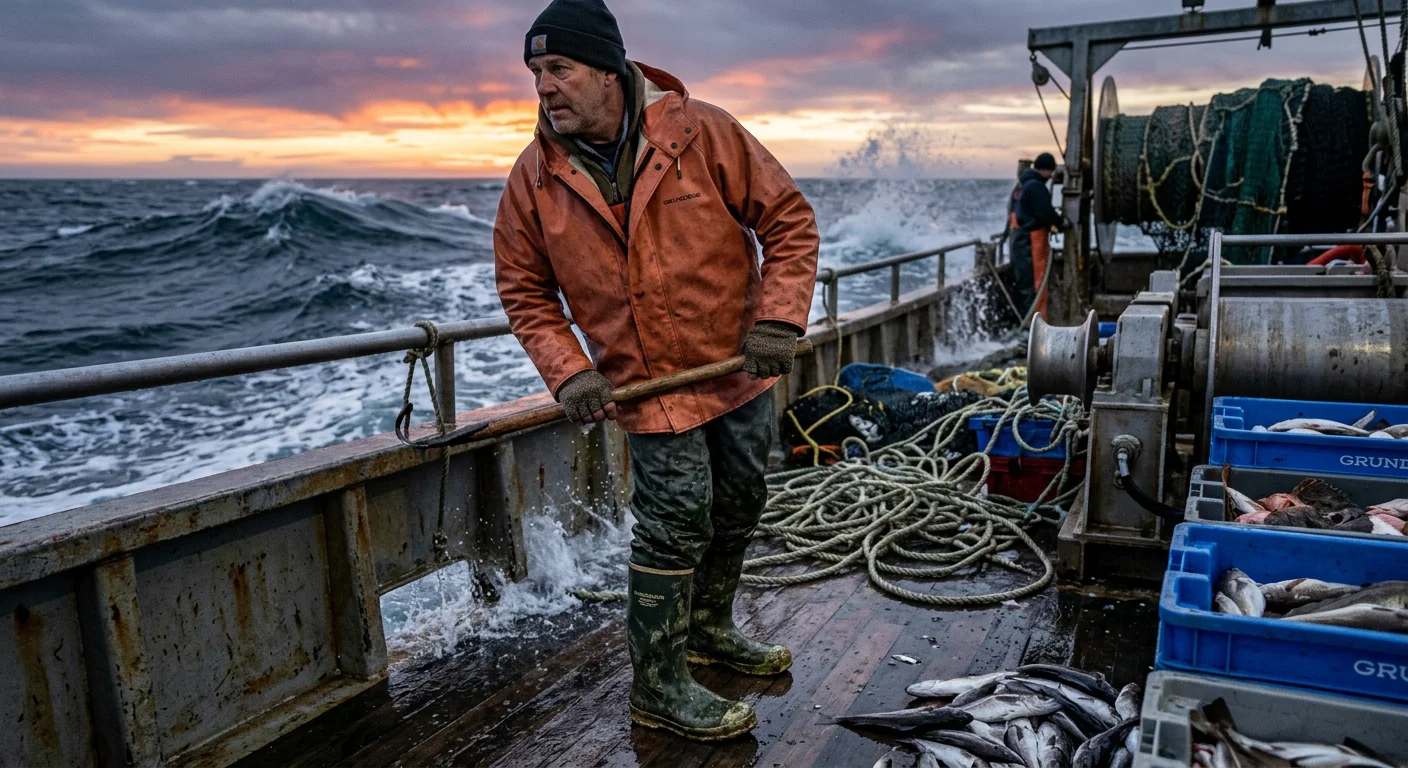
Fishermen keep asking the same questions about deck boot grip. Most answers online are vague, brand-biased, or flat-out wrong. Here's what the data says.
Q: Which boot won't slip on a wet deck?
The honest answer starts with a number: COF ≥ 0.60 .
Safety organizations rate wet-surface traction on a hard scale:
- COF ≥ 0.60 — Excellent. Safe for wet working environments
- COF 0.50–0.59 — Marginal. Works, but not reliable
- COF < 0.42 — Slip risk climbs fast
Before you buy, ask for the tested wet-surface COF — measured against ASTM or ANSI standards. A product page that can't give you that number? Treat the grip claims as marketing, not engineering.
The outsole tells you most of what you need to know. Look at it directly. Deep drainage channels, angular lug blocks, and a tacky rubber feel — those are what separate a working deck boot from a liability. Any large smooth zone on the outsole is a dealbreaker on a wet boat deck.
Q: Will these boots scratch my fiberglass hull?
This is a real concern — on white gelcoat or lightly painted decks in particular.
The term to look for is "non-marking outsole." Marine-focused fishing boots manufacturers formulate the rubber compound and hardness to avoid black scuff marks or micro-scratches on fiberglass and painted metal surfaces.
Both Xtratuf and Grundéns target non-marking construction. That said, any deck boot without "non-marking rubber outsole" or "boat-friendly outsole" printed on the product page — pause before putting it on an expensive hull.
Here's a quick DIY test before you commit: drag the outsole across a clean sheet of white paper or light PVC board 10–20 times . Visible black lines or groove marks mean the sole is not non-marking.
Q: Does grip get worse over time? How do I maintain it?
Yes — and faster than most anglers expect.
Two things kill outsole grip:
1. Rubber hardening from UV exposure, heat, and fish oil contact
2. Tread filling — fish blood, salt crystals, and oil residue pack into grooves and cut drainage capacity
Replace when: tread depth drops to 50% of original , or you notice smooth zones forming. Rubber that stops feeling tacky and starts feeling slick — you're already in the danger window.
Maintenance steps that work:
Soak the outsole in fresh water for 5–10 minutes to loosen debris
Scrub with a stiff brush along the tread direction — grooves should be clear after this step
Use mild neutral detergent to cut oil residue. Skip strong solvents — they speed up rubber hardening
Rinse well, then air dry away from direct heat
Frequency: Do a full clean at least once per week during active fishing season. After heavy oil or blood exposure, rinse the outsole the same day. Salt crystals sitting overnight in the grooves break down your traction geometry faster than plain wear does.
Storage: Keep boots away from direct sunlight and heat sources. UV and high heat harden rubber fast and cut a boot's safe working life short.
Monthly check: Run your finger across the deepest grooves. Close to half-depth? Start shopping now. Don't wait for a slip to confirm what your finger already found.
Q: Which boot fits better with thick fishing socks ?
Thick wool or neoprene socks — 3–5 mm — add 4–8 mm of circumference around your foot and ankle. That shift changes the fit noticeably.
General rule: size up 0.5 to 1 full size with heavy sock layers. For a fit test, stand with a slight forward lean and your target sock on. You want 5–10 mm of toe movement with no compression across the top of the foot.
Grundéns reviewers regularly point out a roomier shaft opening. That makes thick-sock layering easier without cutting off circulation. Xtratuf's neoprene upper molds over time but starts on the snug side — size up if cold-weather sock layering is part of your regular setup.
Q: Are there other deck boots worth considering?
Bogs and Muck Boot are two alternatives worth a look. Bogs handles all-condition wet environments well. Muck Boot focuses on oil and chemical resistance for working docks. Both are solid options.
The framework stays the same regardless of brand: wet-surface COF ≥ 0.60, confirmed non-marking outsole, deep-channel drainage tread. Run any boot through those three filters first. Clear all three — then compare fit, fishing shoes price, and comfort against Xtratuf and Grundéns.
Conclusion
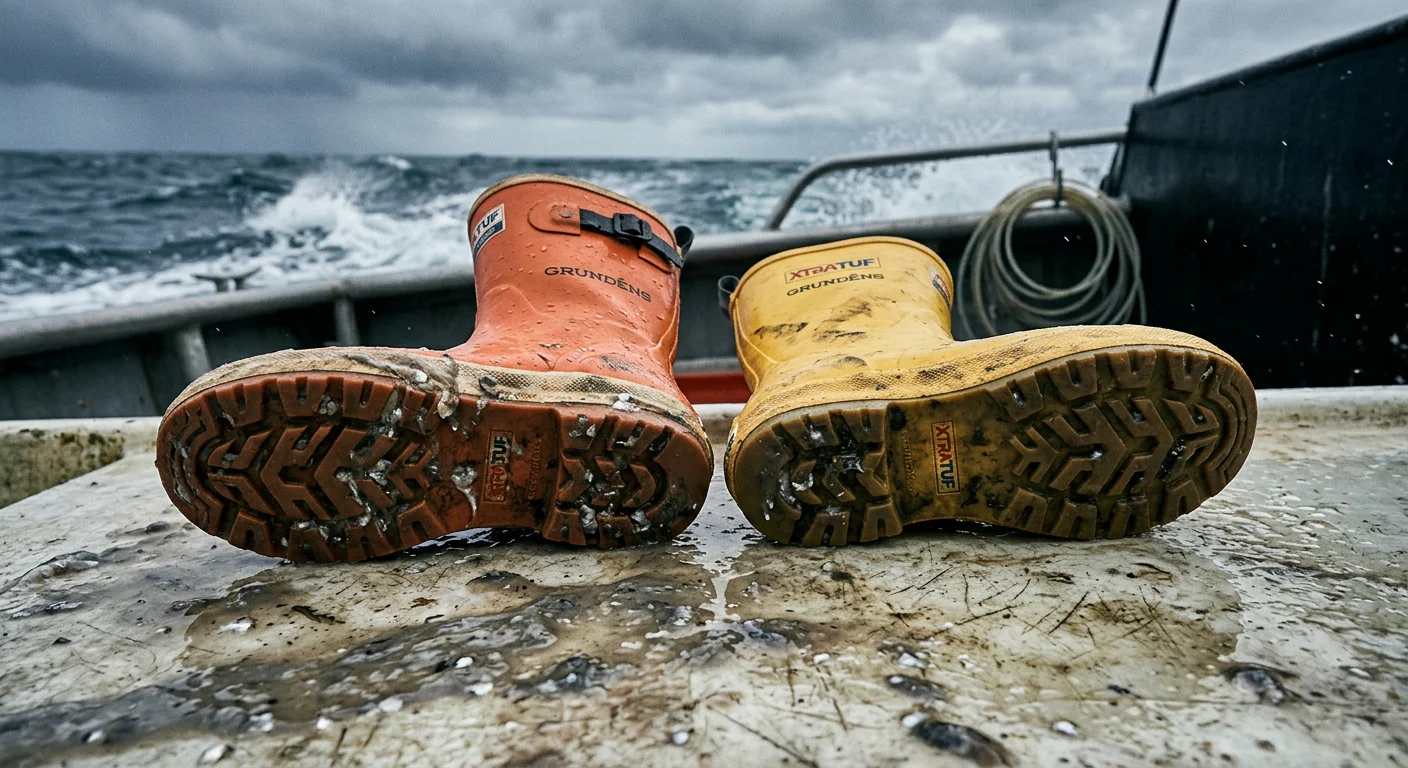
Your boots are the last line of defense between you and a wet deck disaster. Choose wrong, and no amount of experience saves you from a fall.
Here's what this comparison comes down to: Xtratuf is the clear winner on slime and bio-slick surfaces. That Chevron® outsole is built for the chaos commercial fishermen deal with every shift. Grundéns Deck-Boss is the stronger pick for all-day comfort and multi-condition stability. It suits anglers putting in serious hours across mixed offshore environments.
Neither boot is a bad choice. But the wrong boot for your specific deck conditions? That's a $200 mistake. You'll feel it every time you plant your foot on a wet fiberglass surface.
Know your fishing style. Match it to the marine deck boot traction profile that fits your deck. Then buy with confidence.
The deck doesn't forgive hesitation — and neither does a preventable injury.