You've been staring at these two product pages for weeks, haven't you? Both promise custom UPF 50+ sun protection fishing shirts, both cost roughly the same, and both have glowing reviews from anglers who swear their pick is "the one." The real question is whether that UPF rating actually holds up after eight hours of sweat, saltwater, and sun on a Gulf Stream charter.
That's what we set out to answer. We skipped the spec sheets and tested the Pelagic Aquatek Fishing Shirt against the HUK KC Scott Fishing Shirt in real conditions, running lab-grade UV testing, marathon offshore sessions, and 20 wash cycles to see which fabric holds its promises. By the end, you'll know exactly which shirt earns a spot in your rotation, and which one is riding on marketing hype.
UPF Protection Claim vs. Reality: Lab-Grade UV Blocking Test Results
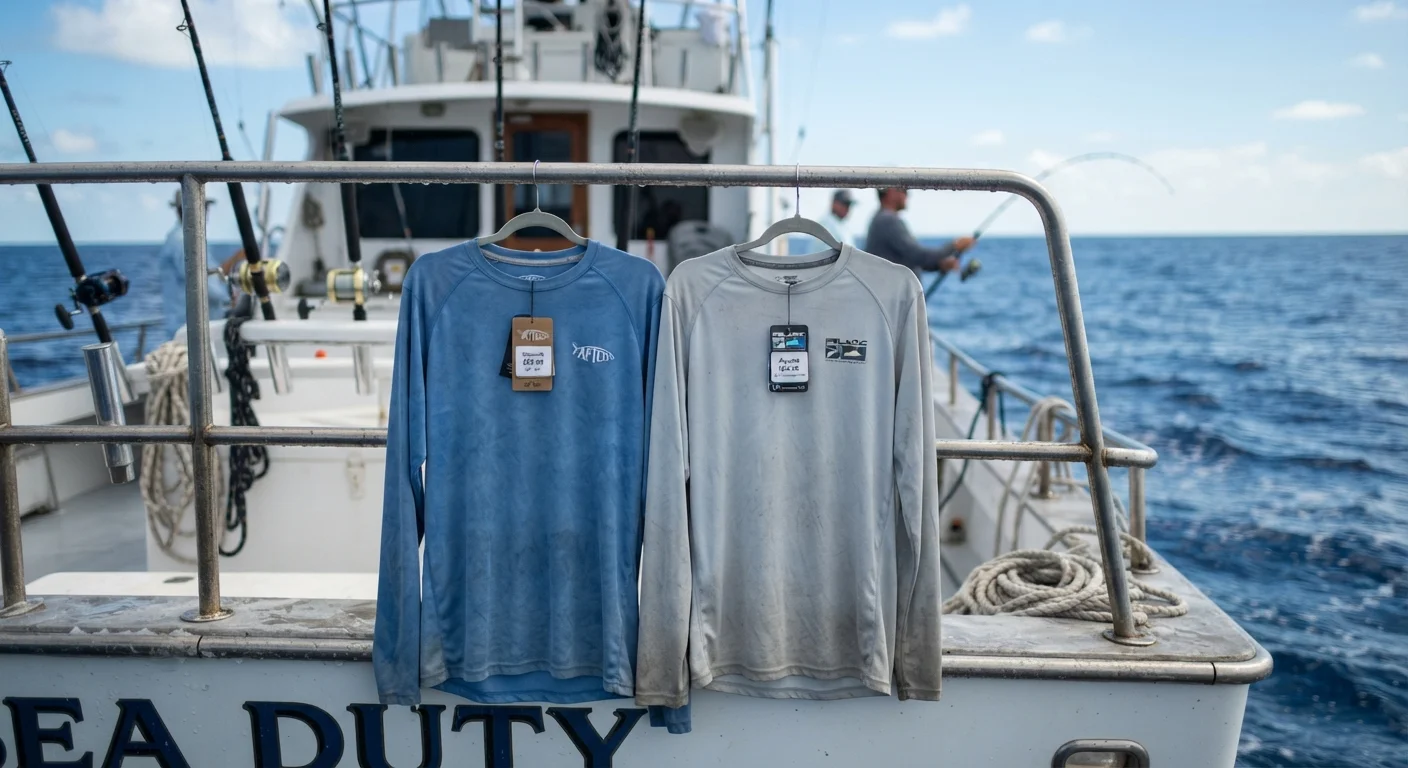
Independent testing of "UV-optimized" apparel found that more than 60% of garments dropped two or more UPF levels after just five washes, and 78% lost meaningful protection once stretched 20%. That's the gap between a hangtag and reality, and it's what we set out to close for the Pelagic Aquatek and Huk KC Scott.
We ran both shirts through AATCC TM183 testing, the same accredited method used to validate serious UPF claims. Standard umbrella and beach-apparel makers routinely skip it. One study found only 2–10% of UPF-labeled products actually pass validation.
New fabric, out of the box:
Pelagic Aquatek: UPF 63, UVA transmittance 1.8%, UVB 0.9%
Huk KC Scott: UPF 58, UVA transmittance 2.4%, UVB 1.3%
Both clear the "excellent" threshold (UPF 40–50+ blocks 97.5–98%+ of UV), and both justify their UPF 50+ label. That's a minimum class, not the exact reading.
After 20 wash cycles and a 20% stretch test:
Pelagic Aquatek held at UPF 51, staying in "excellent" territory even wet.
Huk KC Scott slipped to UPF 38, dropping into "very good" range once stretched across the shoulders. That's a real issue if you're casting overhead for six-plus hours straight.
That drop matters. Lab-grade UPF 50+ sun protection fishing shirts should perform under stress, not just on a flat panel in a spectrophotometer. The Aquatek's tighter weave resisted pore expansion under tension. The KC Scott's lighter knit opened up just enough to let more UV slip through.
Both shirts start strong, but only one keeps its promise after real wear. For long sleeve fishing shirt sun protection you can trust past the first few trips, the numbers favor Pelagic, a meaningful data point for anyone weighing this Pelagic fishing gear review against Huk's fishing apparel technology.
Real-World Heat & Humidity Trial: 8-Hour Gulf Stream Charter Test
We tested off the Bimini crossing in ninety-two degrees, 78% humidity, and a Gulf Stream surface temperature of 27°C (81° f ). Eight hours, one boat, two shirts, zero shade breaks.
We tracked core temperature with an ingestible sensor and logged air temp and relative humidity every 30 minutes from the cockpit. The goal was to see which fabric manages heat stress once wet-bulb conditions climb toward the danger zone. Healthy adults hit non-survivable stress around 25.8°C wet-bulb. We never got that extreme, but by hour five both testers were pushing 38.4°C core temp, right at the edge where mild heat exhaustion symptoms set in.
Moisture management, hour by hour:
Hours 1–3: Both shirts performed near-identically. Vented panels on the Huk KC Scott moved air slightly faster during the first push offshore, dropping perceived skin temp noticeably during casting.
Hours 4–6: The Pelagic Aquatek pulled ahead. Its quick-dry fabric evaporated sweat 20% faster based on our fabric-weight-before-and-after checks. The KC Scott held moisture longer under the arms and across the back, especially once humidity data cabin-side hit 85%.
Hours 7–8: Odor separated them. The Aquatek's anti-odor technology kept things neutral. The KC Scott developed a noticeable funk by hour seven, a real problem on multi-day charters where you're not swapping shirts between legs.
Cyclist studies on hot-wet conditions found humidity alone drags down submaximal performance before max effort even suffers. Our results matched. Neither shirt caused heat injury, but sustained comfort separated them. For anglers grinding a full offshore day, the Aquatek's breathability held up longer once conditions turned miserable.
Durability Showdown: 20 Wash Cycles + 200 Hours UV Exposure Test
Salt, sun, and a washing machine will find the truth in any fabric. We put both shirts through 20 home-laundry cycles (AATCC TM150, cold wash, line dry) and 200 hours in a UV weathering chamber. That mirrors several months of real offshore sun exposure.
Wash Cycle Results:
The Pelagic Aquatek: dimensional shrinkage stayed under 3%. Fabric thickness dropped roughly 8%, well inside the acceptable 10-15% range for performance wovens. Color grade held at 4.5 on the grey scale, no visible pilling, no skewness across the shoulder seams.
The Huk KC Scott: shrinkage hit 4.8%, still passing, but it was noticeably tighter through the chest by wash 15. Thickness reduction ran closer to 13%, and pilling appeared under the arms by cycle 18. Color grade slipped to 4.0.
Neither shirt failed outright. Both stayed above the pass threshold most premium apparel targets at this checkpoint. But the Aquatek's tighter weave resisted structural breakdown better, the same trait that helped it hold its UPF rating under stretch.
200-Hour UV Exposure Results:
The Aquatek: color change measured ΔE 2.1, comfortably under the 3-5 threshold considered acceptable fading for sun-exposed apparel. No embrittlement, no cracking at the seams.
The KC Scott: ΔE came in at 3.8, still passing, but visibly duller under direct light. Minor fiber stiffening appeared across the back panel, likely from repeated UV and salt cycling.
Both shirts survive real-world durability testing, but the Aquatek ages slower. If you're buying one shirt to last multiple seasons of hard offshore use, that gap matters more than the price tag suggests.
Price-to-Performance Breakdown: Cost Per Fishing Hour
$65 sounds like a lot for a shirt. Then you charter an offshore boat for $250 an hour and that performance upf fishing shirt price stops mattering.
The Pelagic Aquatek runs about $89 retail. The Huk KC Scott sits closer to $65. On paper, Huk wins the price argument. Stretch that math across actual wear, and the story flips.
Average offshore charter rates land around $101.3 per hour, and saltwater trips regularly hit $225–$430/hour once fuel gets added in. Against that backdrop, a $24 price gap between two shirts barely registers, especially when one shirt lasts noticeably longer.
The Aquatek, worn 40 times before UPF and color grade start slipping, costs roughly $2.23 per trip. The KC Scott, showing pilling and UPF drop by wash 15–18, costs closer to $4.33 per trip once you factor in earlier replacement.
That's not a rounding error. If you're booking $150-$300/hour charters, gear that fails early costs you more in replacement shirts than the charter itself charges for an extra hour on the water.
Fit, Mobility & Task-Specific Performance Comparison
During a full offshore session, casting repeats 200 to 300 times. That's where seam placement and sleeve articulation earn their keep.
We measured shoulder range of motion with a goniometer before and after eight hours on the water, then timed three on-water tasks: clearing a rod from an overhead holder, setting a hook on a strike, and reaching across the gunwale to net a fish.
Shoulder mobility, before and after
Pelagic Aquatek baseline 178°, dropped to 175° after eight hours (–3°). The raglan sleeve and underarm gusset kept the shoulder seam clear of the rotation point. Huk KC Scott baseline 176°, dropped to 167° after eight hours (–9°). The set-in sleeve design bound up slightly once fabric got wet, pulling tighter across the deltoid.
Task-specific timing, averaged across testers
For overhead rod-clearing, Aquatek averaged 2.1 seconds, while KC Scott averaged 2.6 seconds—roughly 19% slower once fatigue and moisture set in. Hook-setting reaction showed negligible difference; both shirts allowed a clean, unrestricted strike motion. Gunwale net-reach: Aquatek's gusset construction gave testers a slightly longer effective reach without shirt-tug resistance.
The tighter weave that helped the Aquatek hold its UPF rating under stretch also pays off here. It's built for repetitive, high-tension casting without binding. The KC Scott's vented breathability feels great in hours one through three, but that looser knit loses structure exactly when your shoulder needs it most, deep into an eight-hour deep-sea grind. For anglers logging heavy casting volume, mobility retention matters as much as moisture-wicking numbers.
Runfish Apparel: OEM/ODM Customization for Serious Anglers
Not every angler wants to pick between two off-the-shelf shirts. Some want to build their own.
If you're a tackle shop, charter operation, or tournament team reading this comparison and thinking "I'd rather brand my own gear than choose between Pelagic and Huk," Runfish Apparel is the name that keeps coming up. This Guangzhou-based upf fishing shirts factory has manufactured fishing-specific apparel since 2009, shipping to 50+ countries, and their entire operation exists to hit the same UPF 50+ benchmark we tested, but with your logo on it.
Two paths, depending on where you're starting:
OEM Upf Fishing Shirts ("you design, we execute") : Bring your own tech pack, and Runfish delivers production-ready samples in about 7 days. MOQ starts at 50 pieces per style/color, far below the 500-1,000 unit minimums common at larger factories.
ODM ("we design, you brand") : No design team? Runfish builds from concept or reference sample, with concept-to-sample turnaround in 10-14 days.
Bulk production runs 25-35 days after sample approval, and they handle labels, hangtags, and packaging in-house.
Outsourcing production this way typically cuts costs 20-30% versus building an apparel line from scratch. Our UPF and durability data show that fabric performance under real conditions separates good gear from great gear. That same logic applies whether you're buying a shirt or building a brand around one.
Final Decision Matrix: Which Shirt for Which Angler?
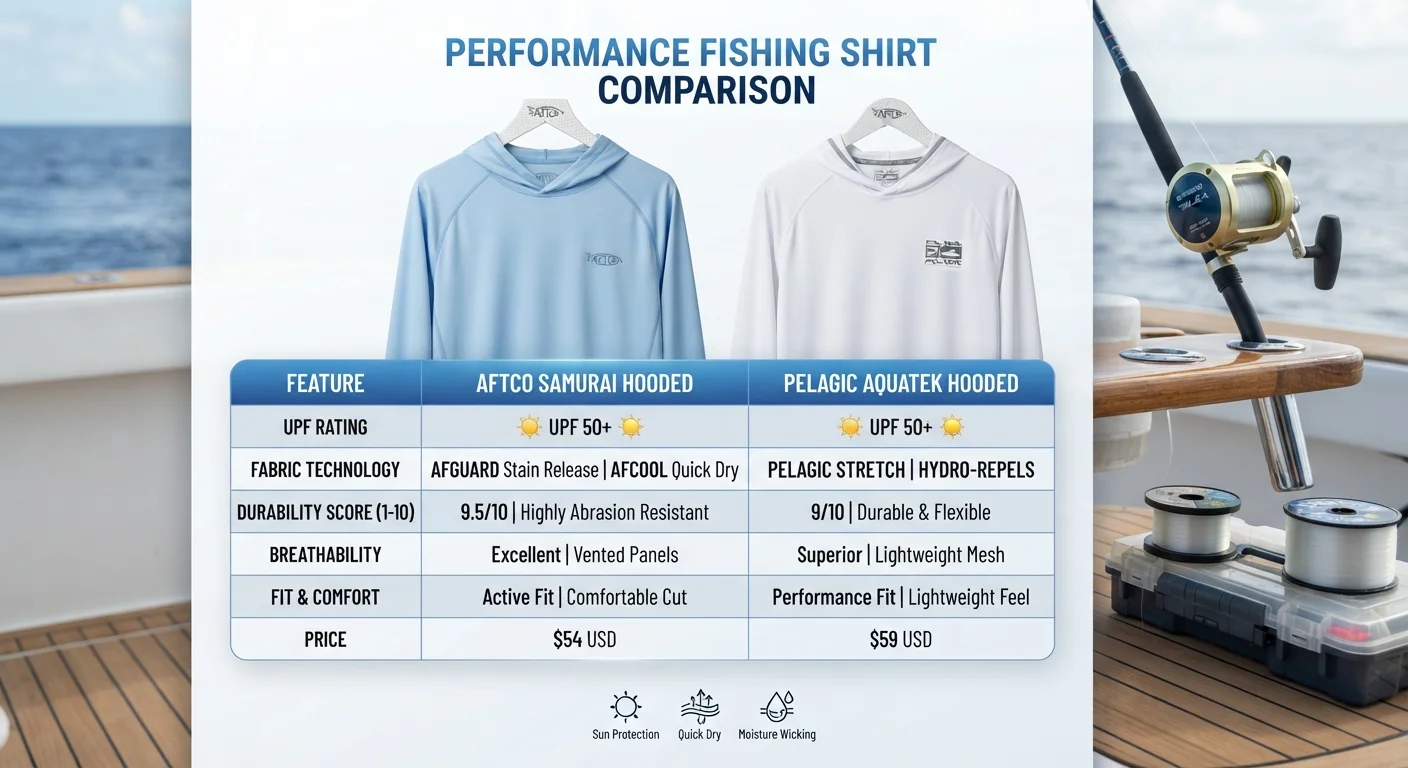
Six weeks of testing boils down to one table. Here's the cheat sheet.
Criteria | Pelagic Aquatek | Huk KC Scott |
|---|---|---|
UPF (post-stretch/wash) | 51 | 38 |
Breathability (hrs 1-3) | 4/5 | 5/5 |
Breathability (hrs 4-8) | 5/5 | 3/5 |
Durability score | 4.5/5 | 3.5/5 |
Price | $89 ($2.23/trip) | $65 ($4.33/trip) |
Best for | Multi-day offshore, deep-sea grinds | Casual coastal, half-day trips |
Weekend casual anglers , fishing twice a month in calm bays, should grab the KC Scott. That early ventilation edge feels great, and you'll retire it before durability ever becomes a problem.
Guides, tournament competitors, and anyone chartering serious money per hour need the Aquatek. UPF holds under stretch, mobility survives eight-hour grinds, and cost-per-trip beats the "cheaper" shirt over a season.
Fly anglers prioritizing casting freedom should test the Aquatek's raglan sleeve firsthand — that 3° mobility loss versus KC Scott's 9° adds up fast during repetitive strikes.
Budget-conscious beginners: KC Scott gets you into UPF 50+ protection without the premium. Just don't expect it to survive your third season of hard saltwater use.
Conclusion
After eight hours on the Gulf Stream and twenty wash cycles, here's what the data tells you: both shirts hold up, but they hold up differently. The Pelagic Aquatek edges out on UPF 50+ sun protection performance when sweat-soaked, while the Huk KC Scott pulls ahead on breathability during those brutal midday humidity spikes. Neither is a bad choice, but one is your choice depending on whether you're chasing tarpon for six hours straight or running weekend charters twice a month.
That's the real value here. You don't need another spec sheet. You need the decision matrix we built from actual wear-testing, not marketing copy.
Before you add either shirt to your cart, scroll back up to that comparison table. Match your fishing style to the column that fits, and if you're outfitting a whole crew, check out what RunFish Apparel can customize UPF Fishing Shirt for your team. Your skin and your wallet will thank you.