Your team's jerseys looked perfect on the rack. Then came hour six of a summer tournament—someone's hunched over the trolling motor, another's mid-cast for the hundredth time, and half the roster is complaining that the fabric feels like a wet towel stuck to their back. Sound familiar? That's where most procurement decisions go wrong.
This guide skips the marketing fluff you'll get from most mills. It covers how 4-way stretch polyester and spandex blends perform under real stretch-recovery testing, what GSM range keeps a jersey breathable without turning see-through, and which abrasion numbers separate a jersey that survives one season from one that survives five. You'll get hard specs to hand your Tournament Fishing Jerseys supplier, plus a comparison sheet built for the actual buying conversation.
Mobility: 4-Way Stretch Recovery & Elongation Standards
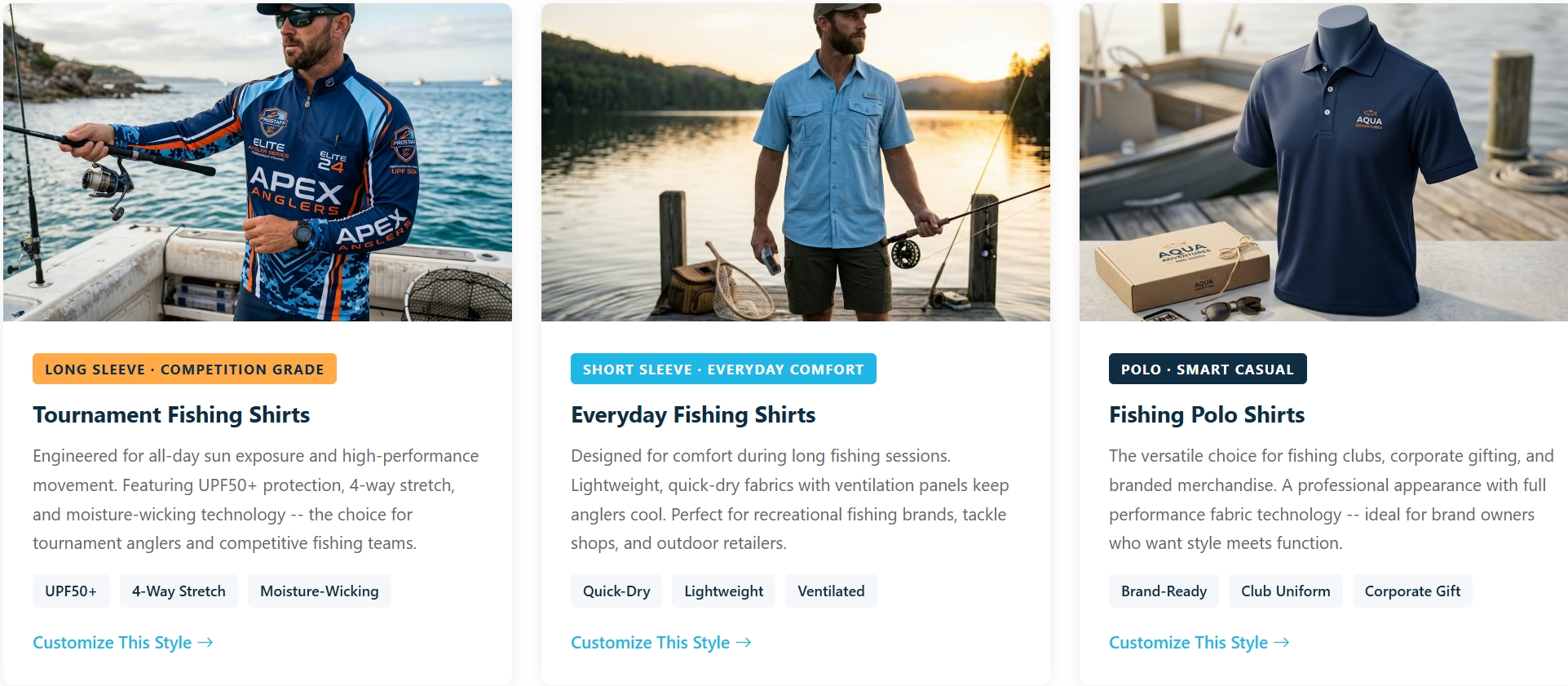
Not all "4-way stretch" labels mean the same thing. Procurement teams often take a Tournament Fishing Jerseys supplier's word for it instead of asking for the number.
A fabric needs at least 8% elastane to deliver true 4-way stretch across both warp and weft. Drop to 5% and you're getting 2-way stretch, no matter what the tag says. For fitted tournament jerseys, you want a 5–10% elastane range in a spandex blend jersey. That's the fitted-activewear tier—not casual (0–3%) and not full compression (15–25%).
Elongation matters just as much as fiber content. A jersey built for casting motion and boat-side bending should hit 50–75% minimum stretch in both directions. Anything lower, and your anglers will feel the fabric fighting them mid-cast.
Recovery Is Where Cheap Fabric Fails
Stretch is easy to sell. Recovery is where budget 4-way stretch polyester falls apart—literally. A jersey that stretches 60% but only recovers 80% will bag out by week three of a season. Set your acceptance line at ≥90% recovery for fitted activewear, with premium sportswear pushing toward ≥95%.
But single-cycle recovery numbers can lie. Ask for ASTM D3107 data, a 50-cycle stretch-recovery test that simulates a full season of casting, reeling, and bending:
Standard tier: >90% recovery after 50 cycles is fine for club-level jerseys
Premium tier: >95% recovery after 50 cycles is what you want for multi-day tournament rotation
Here's a practical sourcing spec to hand your Tournament Fishing Jersey manufacturer:
Elastane: 8–12%
Stretch: 50–70% (warp and weft, tested independently)
Recovery: ≥90% after 1 cycle, ≥92% after 5 cycles at 30–50% extension
ASTM D3107: ≥90% after 50 cycles minimum
One more number: permanent growth. Anything above 3% growth after wear means the jersey's fit stability is already compromised. No amount of good elongation data fixes that.
Comfort: Moisture Wicking, UPF 50+ & Antimicrobial Finishes
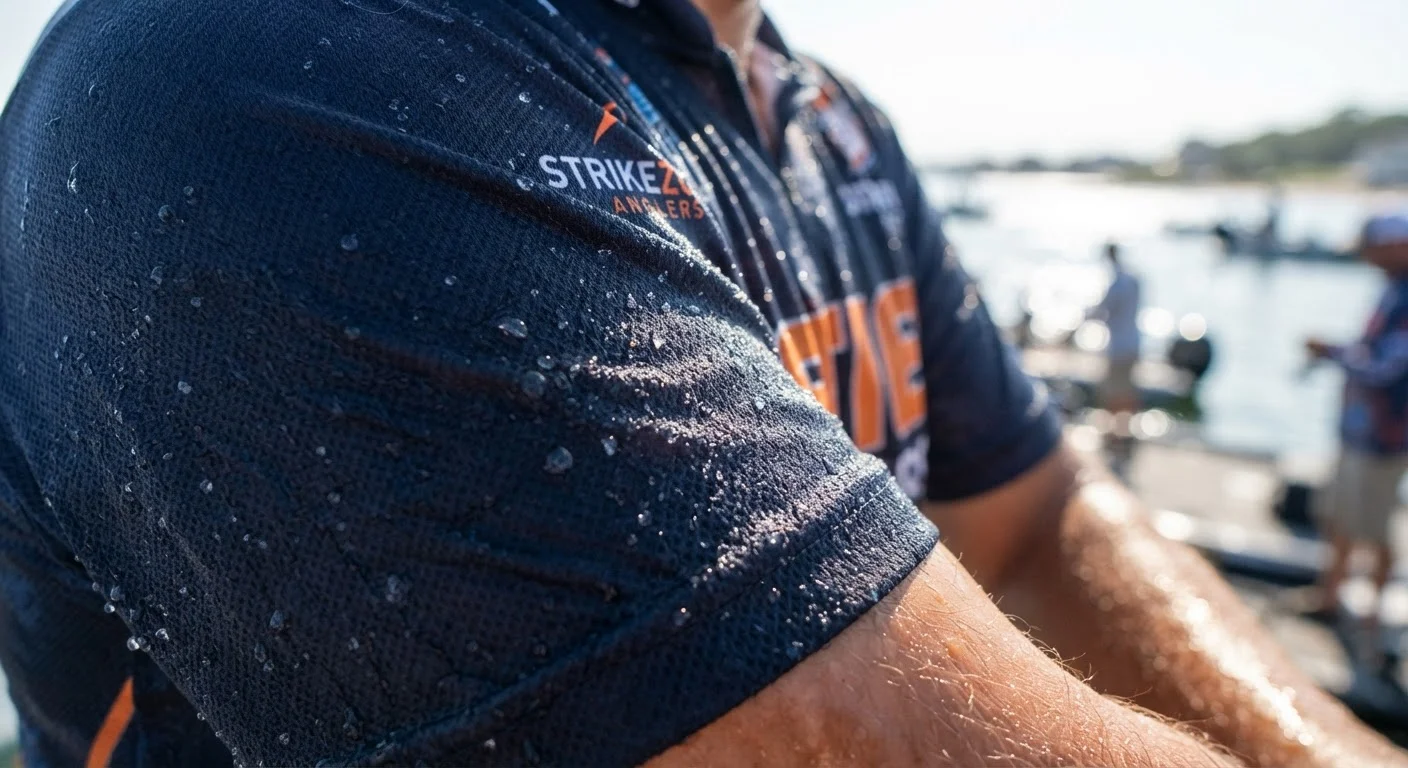
Sweat doesn't care about your budget. Six hours under tournament sun, and any fabric that can't move moisture off skin turns into a heat trap—stretch specs won't save you there.
Moisture Wicking: The Numbers That Predict "Dry Feel"
Marketing copy loves the word "wicking." Ask for the wetting time instead. A high-performance moisture-wicking fabric should show a wetting time of ≤3 seconds. Drop water on it, and it disappears almost instantly. That's the standard "3-second droplet test" mills use for quick QC checks.
Beyond that first drop, you want proof the moisture keeps moving. Vertical wicking height should hit ≥100mm in 30 minutes, tested per AATCC 197/198. On the outer surface, absorption rate should run ≥0.2–0.3%/s, and the overall moisture management capacity (OMMC) should land at 0.5–0.7 on a 0–1 scale, which brands call an MMT grade of 4–5 out of 5.
Drying speed closes the loop. 5ml of water should evaporate within 30 minutes at 25°C. Compare that to cotton, which needs 45+ minutes just to start drying and holds roughly 7% water by weight versus synthetic's 0.5%. That gap is the entire reason a breathable athletic fabric outperforms cotton on the water.
UPF 50+ and Antimicrobial Finishes: Ask for the Number, Not the Label
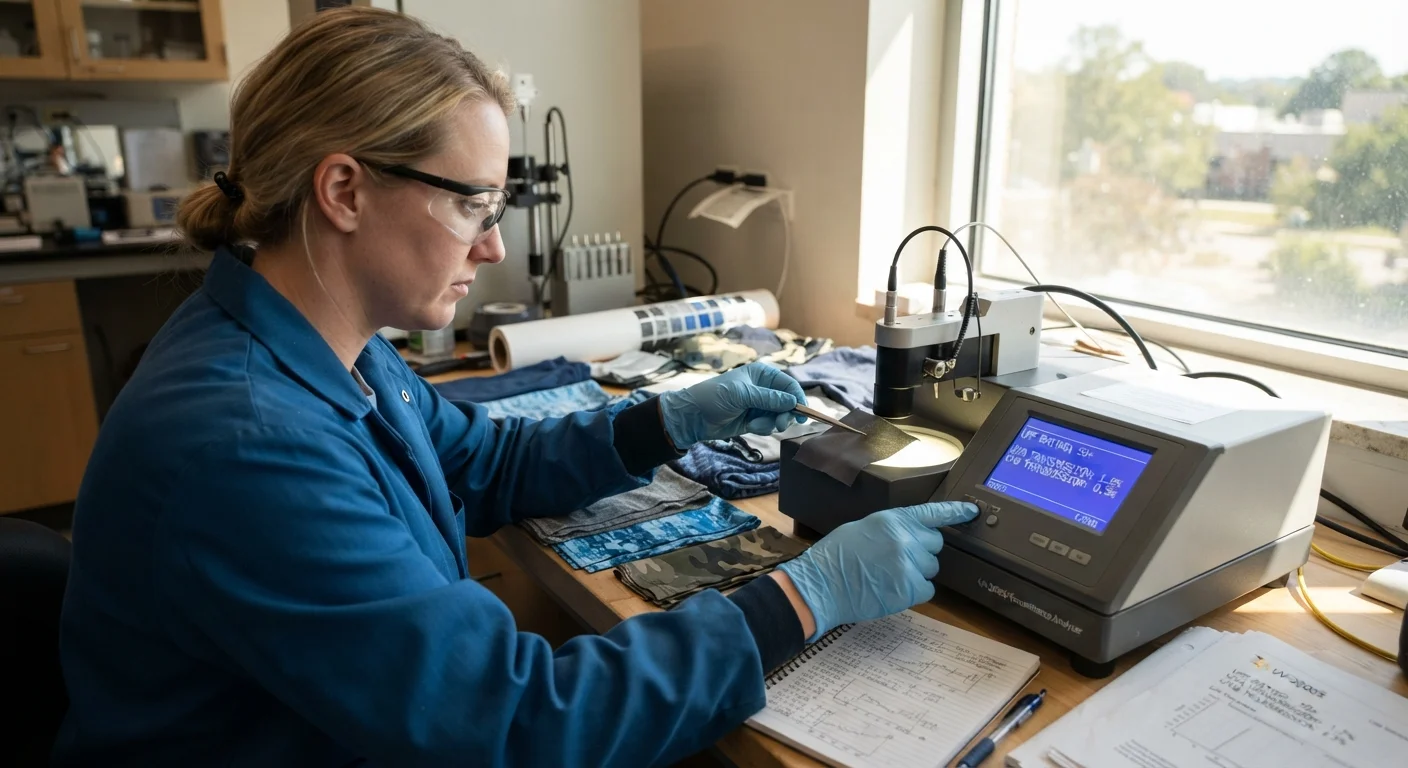
UPF 50+ means the fabric blocks at least 98% of UV radiation, UV transmission at or below 2%. Don't accept the label alone. Ask for the measured UPF value and the number of wash cycles it was validated at, typically 40–50 washes under AATCC 183 or AS/NZS 4399.
For odor control, request AATCC 100 test data. Look for ≥99% bacterial reduction (2–3 log) after 24 hours, with efficacy retained above 90–95% after 20–50 wash cycles. Anything less, and antimicrobial claims fade before season two starts.
Durability: Martindale Abrasion, Colorfastness & Elasticity Retention
Fabric that looks flawless on day one tells you nothing. Durability only shows up after months of boat seats, tackle boxes, and sun exposure grinding against the same seams. Martindale abrasion cycles, colorfastness grade, and elasticity retention after repeated loading separate a jersey built for one season from one built for five.
Martindale Abrasion: Cycle Counts That Match the Season
Martindale testing (ISO 12947 or ASTM D4966) rubs a fabric sample against an abradant in controlled cycles until it breaks down. For general domestic apparel, 20,000–30,000 cycles is the baseline. That's fine for a casual club jersey worn a few weekends a year.
Tournament rotation is a different animal. Anglers lean against boat rails, drag gear across their sides, sit for hours in the same spot. For that wear pattern, push Tournament Fishing Jersey wholesalers toward ≥30,000–40,000 cycles , the same range used for heavy-duty contract textiles. Anything lower, and you'll see pilling and thinning at the shoulders and forearms by mid-season.
Colorfastness: Sublimation Printing Under Sun and Sweat
Team logos and sponsor graphics rely on sublimation printing fabric holding color through UV and sweat exposure. Ask for gray-scale ratings:
Dry rubbing: grade 4–5
Wet rubbing: grade ≥3–4
Washing: grade ≥4
Lightfastness (blue wool scale): grade 5–6, given full-day sun exposure on the water
Drop below grade 4 on any of these, and colors shift or bleed before the season ends.
Elasticity Retention: The Long-Game Recovery Test
Beyond single-cycle recovery, ask for cyclic extension data per ISO 20932: fabric stretched to 30% strain for 5,000 cycles. Acceptable thresholds:
Permanent growth: ≤5%
Tensile strength loss: ≤10–15%
Dimensional change after washing: ≤3–4%
Pair this with GSM in the 180–220 range for sportswear, light enough to breathe and dense enough to hold shape through hundreds of casts.
Fabric Selection Matrix: Polyester-Spandex vs Nylon-Spandex vs Interlock vs Mesh
Four fabric families dominate tournament jersey sourcing, and each one trades off differently between stretch, airflow, print clarity, and hand-feel. Picking blind means picking wrong for at least one dimension your team actually cares about.
Polyester-Spandex vs Nylon-Spandex: Sweat-Proof Stretch vs Compression Feel
Both blends typically run 80–90% base fiber / 10–20% spandex , but they perform differently on the water:
Attribute | Polyester-Spandex | Nylon-Spandex |
|---|---|---|
Stretch | Best among poly jerseys | High-maximum (compression) |
Moisture-wicking | Excellent, sweat-proof | Good, slower drying |
Sublimation printing fabric quality | Very good | Weakest — poly% dilution hurts color |
Abrasion resistance | Excellent | Highest |
Cost | Lower-mid | Medium-high |
Rule of thumb: high sweat exposure plus sponsor graphics points to polyester-spandex. Compression fit fabric with a premium hand-feel points to nylon-spandex.
Interlock vs Mesh: Print Sharpness vs Ventilation
Attribute | Polyester Interlock | Polyester Mesh/Micro-Mesh |
|---|---|---|
Airflow | Low-medium | Best (open knit) |
Print detail | Best, smooth face | Fair-good, texture interrupts artwork |
Wear life | High | Low-medium |
Best fit | Standard/semi-fitted | Loose, athletic |
Interlock stays the safest all-around pick for a spandex blend jersey needing sharp logos and structure. Mesh wins when a breathable athletic fabric matters more than opacity — but keep spandex under 8–10% in mesh builds, or you sacrifice the ventilation you added it for.
Across all four fabrics, more airflow always costs some print sharpness, and more spandex always costs some breathability. There's no fabric that maxes out both.
Procurement Checklist: Key Specifications for Tournament Fishing Jerseys
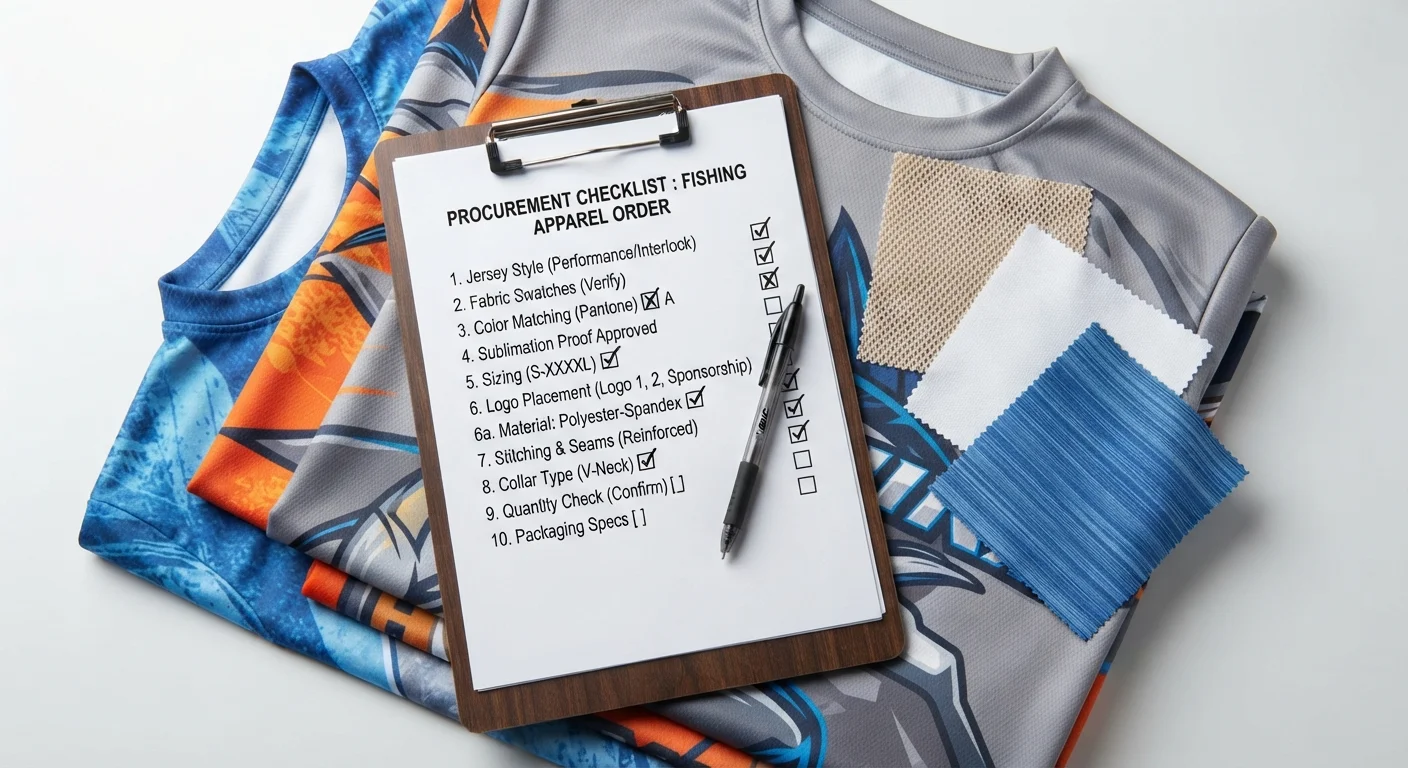
Every spec above means nothing if it doesn't make it onto paper. This checklist turns fabric knowledge into a purchase order your supplier can't misread.
What Goes Into the RFQ
Put these lines into the request for quote, not into a verbal conversation:
Fiber composition: 100% polyester for sublimated jerseys, or 92% polyester / 8% spandex for stretch panels. Use exact percentages, never "poly blend."
GSM: 130–160 gsm for hot-weather tournament weight. Expect US$4–8/piece FOB for straight polyester knit, US$6–11 for polyester-spandex blends, and US$7–13 for recycled polyester.
UV protection fishing apparel rating: UPF 50+, backed by a third-party AATCC 183 report, not a factory claim.
Moisture management: vertical wicking ≥50mm in 30 seconds, full garment dry time ≤30–40 minutes, one-way transport index confirmed via AATCC 195.
Shrinkage: under 3% after standard wash/dry cycle.
Construction and QC Terms
Lock these into the tech pack before sampling starts:
100% polyester thread. Cotton-wrapped thread degrades under UV and salt.
YKK Vislon zippers on any zip-neck style, salt-resistant elastics at cuffs and hem.
AQL defect limits: major defects reject at 11+, minor defects reject at 15+ per lot.
Lead Time and Sampling
Confirm 10–14 business days from Artwork approval to dispatch, tied to a fixed ship date ahead of tournament week. Before bulk approval, verify fabric composition, GSM, and UPF documentation against the pre-production sample, not the original proto.
Supplier Verification: Questions to Ask Before Placing a Fabric Order
Great specs on paper mean nothing if the Tournament Fishing Jersey factory can't back them up. Before you commit budget to any fabric — 4-way stretch polyester, spandex blend jersey, or otherwise — run a verification pass. Fraud in fabric sourcing usually hides in mismatched paperwork, not bad fabric.
Legal Identity and Payment
Ask for the full legal entity name, registration number, and tax ID, then check it against the business registry. Payment beneficiary — bank or PayPal — must match that same legal name. If a custom Tournament Fishing Jersey supplier asks you to wire funds to a personal account or a name that doesn't match the invoice, walk away. Request time-stamped photos or live video of the warehouse showing fabric rolls and labels this week, not stock images from three years ago.
Fabric Specs and Testing Proof
Push for a spec sheet before ordering: exact fiber composition (e.g., 92% polyester / 8% spandex), GSM with tolerance (±5%), usable width, shrinkage rate, and colorfastness grade. Ask which lab tested the fabric and to which standard — ASTM, ISO, or AATCC — and request a batch-specific report, not a generic one from a different production run. Get their AQL defect rate in writing, along with the remedy if defects exceed it: refund, reweave, or credit.
Capacity, Lead Time and Certifications
Confirm real monthly capacity for your fabric type, not total factory capacity. Ask for lab dip lead time (typically 7–10 days), CFA before bulk cutting, and bulk lead time (30–45 days ex-factory). Request certification numbers for OEKO-TEX or GOTS if antimicrobial sportswear fabric claims matter to your buyer, and verify them directly against the issuing body's database.
Pricing, References and the Trial Order
Clarify pricing at your actual volume, incoterms, and payment staging — 30% deposit, balance before shipment is standard. Ask for two or three redacted shipment records from the past year matching similar order size. Then, before committing to a full season's jerseys, place a trial order at 5–10% of projected volume. It's the cheapest insurance against a supplier who talks a good game but can't deliver at scale.
Conclusion
The difference between a jersey that survives one tournament season and one that lasts three comes down to the specifications. Once you know that 4-way stretch polyester needs 90%+ elongation recovery, that moisture-wicking performance fabric should hit specific CFM breathability ranges, and that anything under 20,000 Martindale cycles won't survive a full circuit season, you stop guessing and negotiate from knowledge.
Ask wholesale Tournament Fishing apparel suppliers to prove the fabric meets the specs with a scorecard. Pull out the checklist, run your next three fabric quotes through the comparison matrix, and watch how fast vague answers turn into real data.
Print the framework. Bring it to your next supplier call.