A upf fishing apparel supplier’s spec sheet can say “UPF 50+” in bold letters, and that number still might not survive a single customer complaint.
I’ve seen fishing apparel brands eat six-figure return costs because they trusted a fabric mill’s word instead of the actual AATCC 183 UPF testing report—only to find out the “50+” rating applied to raw fabric, not the finished, dyed shirt customers actually wore under the sun.
If you’re comparing quotes and swatches right now, trying to figure out which supplier is telling the truth and which one is just good at marketing copy, this guide skips the fluff. You’ll get a technical checklist covering wash durability, GSM range, breathability data, and MOQ terms—plus the exact questions that expose fake UPF claims before you place a bulk order.
Step 1: Decode the UPF Test Report—Measured Value, Wash Durability, and Validity Period
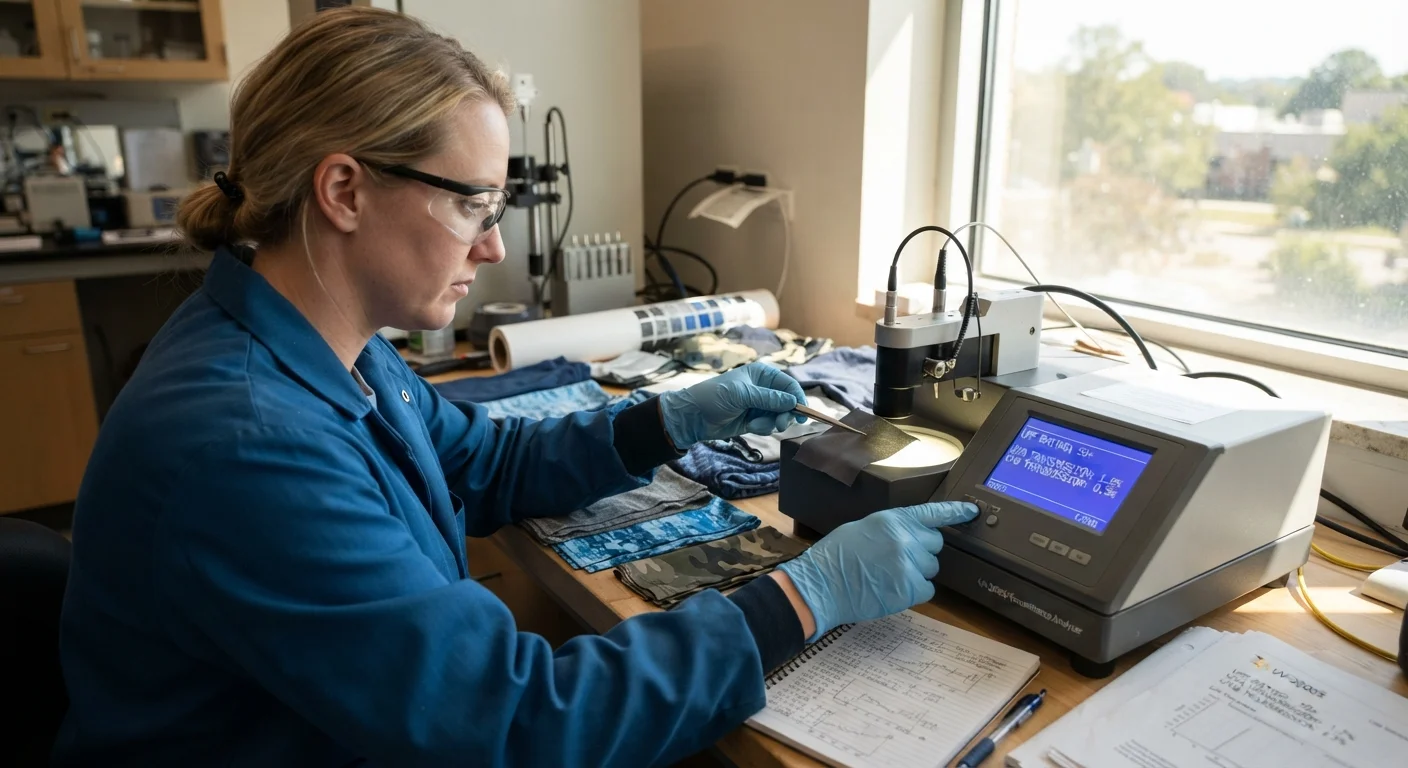
UPF is a ratio, not a fixed grade. It measures how much UV gets through the fabric compared to bare skin. UPF 30 blocks about 96.7% of UV. UPF 50 blocks 98%. That 1.3% difference matters when you're marketing "maximum sun protection" to anglers spending 8 hours on open water.
Check the math behind the number.
Labs calculate a "mean UPF" from multiple fabric specimens, then apply a 95% confidence limit, subtract a statistical safety margin, and round down to the nearest multiple of 5. A mean UPF of 57 often gets reported as UPF 50 on your tag. If your upf fishing clothing supplier's report shows a mean UPF but no "rated UPF" field, ask why—that's the number that matters for compliance.
Wash durability is where most fake claims collapse.
A legitimate report states something like "UPF 50+ after 40 wash cycles" and specifies the wash standard used (ISO 6330, for example). If the report only says "as received" or "unwashed," you're looking at the fabric's day-one performance—not what happens after your customer runs it through the laundry 15 times. For fishing apparel that gets washed constantly (sweat, sunscreen, saltwater), I'd require test data showing performance after at least 20-40 wash cycles. Anything less is a gamble.
Validity isn't about a calendar date—it's about matching conditions.
UPF reports don't technically "expire," but they're lot-specific. The report is only valid if your fabric's GSM, composition, dye, and finish match what was tested. Change any of those, and the old report is worthless. Build this into your tech pack: "Supplier must re-test upon any material or process change, and reference the current AATCC 183 or AS/NZS 4399 standard version."
Step 2: Evaluate Fabric Physical Specs: GSM Range, Breathability, and Color Fastness Against Supplier Samples
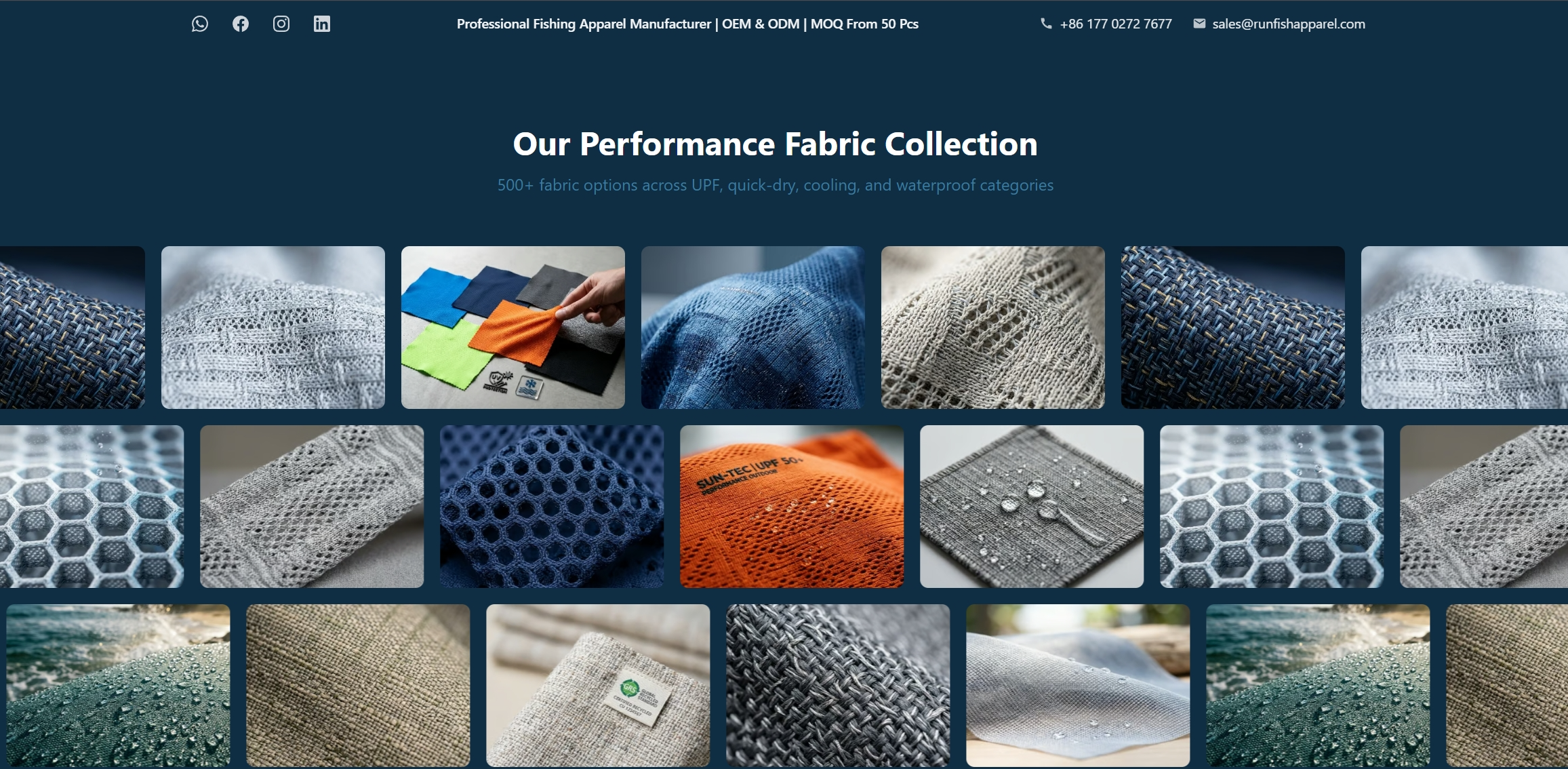
GSM numbers on a spec sheet mean nothing until you weigh the actual sample yourself. I've watched brands approve fabric based on a sun protection fishing apparel supplier's claimed "180 GSM" only to receive production rolls at 210 GSM—and wonder why their "lightweight" fishing shirt feels like a sauna suit on the water.
Target GSM by fishing apparel type:
Garment Type | Target GSM Range | Why |
|---|---|---|
Long-sleeve fishing shirts (hot climate) | 130–160 GSM | Maximizes airflow, keeps UPF fabric quick-dry |
Standard performance fishing shirts | 160–190 GSM | Balances durability and breathability |
Heavier technical/layering pieces | 190–240 GSM | For cooler-water or early-season use |
If your polyester UPF fabric sample lands above 200 GSM for a "breathable" summer shirt, that's a red flag—not a feature.
Measure GSM yourself. Don't trust the tag.
Cut a 10cm × 10cm swatch from the actual sample (not the tech pack photo). Weigh it in grams. Multiply by 100. That's your GSM. A 1.6g swatch equals 160 GSM. This takes five minutes and catches suppliers who round down their numbers by 15-20%.
Breathability data separates real moisture wicking fabric from marketing copy.
Request air permeability results tested under ISO 9237. For mesh panels or high-breathability zones, look for readings above 1,500 mm/s. For standard woven polyester or nylon UPF fabric, a lower GSM combined with an open weave structure typically signals better airflow—ask for the weave density spec, not just the marketing description.
Color fastness protects your brand colors through real fishing conditions—sunscreen, saltwater, repeated washing.
Require a minimum Grade 4 on ISO 105-C06 after 30 washes at 60°C. Anything below Grade 3 means your logo color or dye lot will fade before season's end. If the upf fishing apparel manufacturer can't produce this report, that's your answer.
Accept the sample if:
- Measured GSM falls within ±10% of your tech pack target
- Air permeability data confirms breathability claims
- Color fastness report shows Grade ≥4 after 30 wash cycles
Reject and request retest if any of these are missing.
Step 3: Audit Supplier MOQ Flexibility and Lead Time Commitments for Custom Fabric Orders
MOQ isn't one number—it's three separate minimums stacked on top of each other. Miss this, and your "low MOQ" fishing apparel supplier turns into a 5,000-yard commitment before you print a single logo.
Break the MOQ into its real components:
Base fabric construction: 1,000–3,000 yards for custom weaves/knits
MOQ per color: 300–500 yards per dye lot
Printing/finishing MOQ: 500–1,000 yards per design
Stock program fabrics run far lower—often 50–100 meters per color. Custom color, pattern, or construction MOQs rarely dip below 2,000 yards total. If a mill claims "flexible MOQ" without specifying which layer they're talking about, push back.
Ask these three questions before signing anything:
Is MOQ per construction, per color, or per total PO?
Can I split total MOQ across colors (e.g., 1,000 yards = 4 colors × 250 yards)?
Do you offer greige goods so I can dye smaller runs later?
Lock down lead time by phase, not by guess.
Lab dip/color approval: 5–10 days
Sample development: 10–18 days
Bulk fabric milling/dyeing: 30–60 days from lab dip sign-off
Bulk garment production: 20–35 days after sample approval
Ask whether lead time starts at PO date, deposit receipt, or lab dip approval. Suppliers quote from different starting points, and that gap causes most missed deadlines.
Verify before committing. Request on-time delivery rate (aim ≥95%). Check reorder rate (>30% signals reliability). Run a paid sample order first. Use that real timeline—not their sales deck—to negotiate bulk MOQ terms.
Step 4: Calculate Total Fabric Cost Including Yardage Yield, Shipping, and Duty
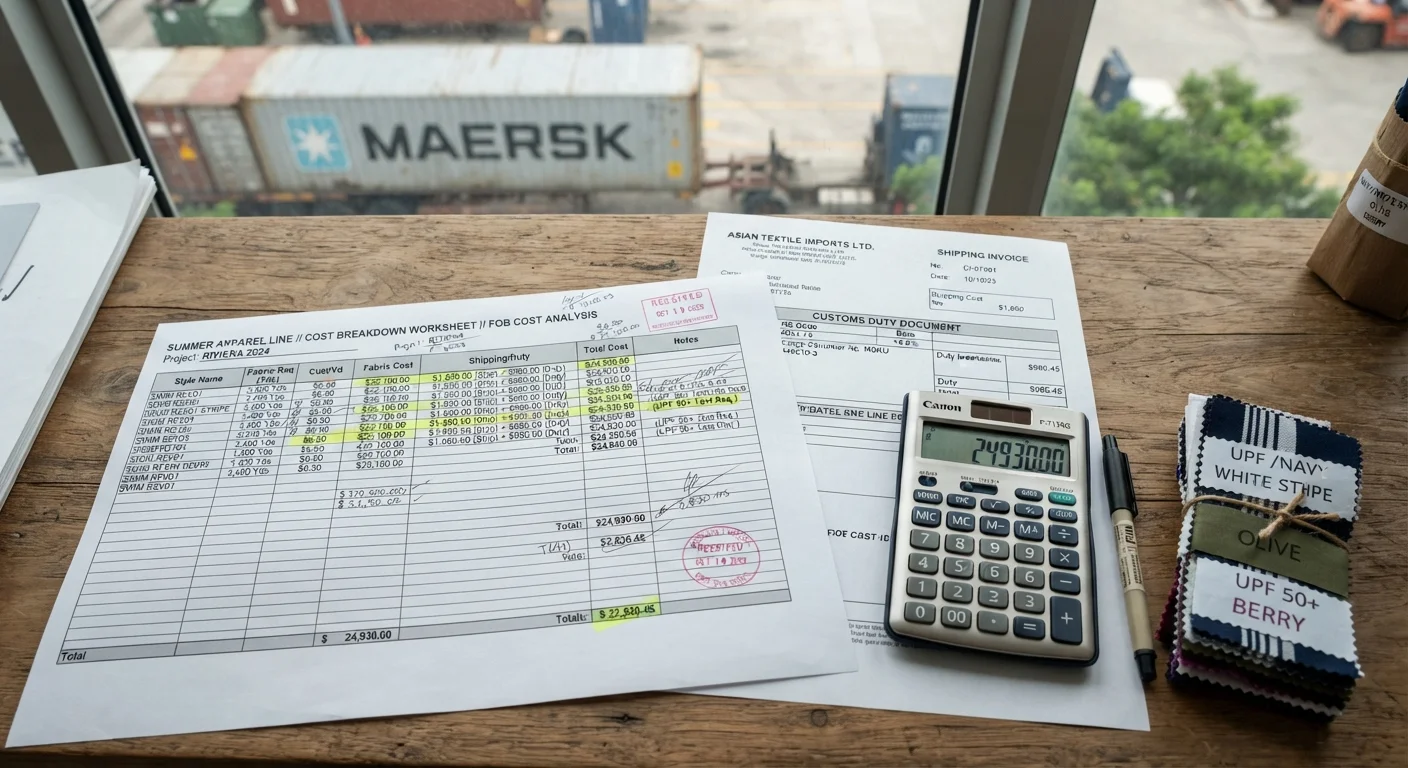
A quoted fabric price per yard tells you almost nothing about your real cost. I've watched brands lock in "cheap" fabric at $3.50/yard, then get blindsided when wastage, shipping, and duty push the landed cost 65% higher than the quote sheet suggested.
Start with true fabric cost, including wastage.
Marker efficiency runs 85–95% on most cutting layouts. That gap is fabric you pay for but don't use. The formula:
True Fabric Cost = (Usage × Cost per yard) ÷ (1 − Wastage%)
Example: 1.60 yd/garment usage, $3.50/yd price, 10% wastage allowance → adjusted yardage of 1.76 yd, costing $6.16 before finance charges. Add a 2% finance charge and you're at $6.28 per garment – already 20% above the raw quote.
Convert shipping into a per-garment number, not a lump sum.
Take total inbound freight on the fabric PO ($600 ocean + $80 inland + $20 insurance = $700), divide by total yards ordered (2,000 yd), and you get $0.35/yd. Multiply by your adjusted yardage (1.76 yd) and you get $0.62 shipping cost per garment .
Duty follows the same logic.
Total fabric duty ($8,000 FOB value × 12% duty rate = $960) divided by total yards (2,000 yd) gives $0.48/yd duty. Applied per garment: $0.84 .
Add it up. $6.28 + $0.62 + $0.84 = $7.74 landed fabric cost per garment – not the $6.16 you thought you were paying. For 1,000 pieces, that's $7,740 in total fabric spend. Run this math before you sign, not after.
Step 5: Build a Technical Parameter Comparison Table to Rank Candidate Suppliers
Three UPF fabric quotes on your desk look identical until you force them into a scoring grid. That's when the "cheap" fishing apparel supplier suddenly costs more than the one you almost passed over.
Skip gut-feel comparisons. Build a spreadsheet with one row per supplier and one column per parameter, then let the numbers rank your candidates.
Core columns to include:
Supplier Name
Unit Price (USD/yard)
MOQ
Lead Time (days)
UPF Rated Value (post-wash)
Yield / Defect Rate (%)
GSM Compliance Score (1–5)
Weighted Technical Score
Overall Rank
Stick to 3-5 parameters for the technical portion. More than that, and you're drowning in noise instead of making a decision.
Assign category weights before you score anything:
Technical performance (UPF durability, GSM accuracy, breathability): 45%
Cost/commercial terms: 35%
Delivery reliability: 15%
Risk/sustainability (audit history, cert validity): 5%
Scoring formula:
Total Score = Σ (Score × Weight) ÷ 100
Say Supplier A scores 5/5 on UPF durability (weight 30%), 4/5 on yield (weight 20%), 5/5 on lead time (weight 20%), 4/5 on GSM accuracy (weight 20%), and 4/5 on quality system maturity (weight 10%):
(5×30 + 4×20 + 5×20 + 4×20 + 4×10) ÷ 100 = 4.5/5, or 90/100.
Run the same math for cost, delivery, and risk categories. Then combine using your category weights:
90×0.45 + 80×0.35 + 85×0.15 + 75×0.05 = 84.25 overall score.
Alternative for fast comparisons: rank-based scoring. Assign rank 1 to the best upf fishing apparel supplier per parameter, rank 4 to the worst (for four candidates). Multiply each rank by a priority factor -- 1 for high priority, 2 for medium. Lowest total score wins, same logic as golf.
For fishing apparel brands juggling AATCC 183 UPF testing reports, GSM ranges, and moisture wicking fishing fabric claims across multiple mills, this table turns subjective sales pitches into a defensible, numbers-based purchase order decision -- one you can justify to your finance team.
Step 6: Three Questions to Expose Marketing Hype in UPF Claims
"UPF 1000+" on a hangtag isn't a superior product. It's a red flag.
Under GB/T 18830-2009, a textile can only be labeled "UV-protective" if UPF exceeds 40 and UVA transmittance stays below 5%. The highest allowed grade is UPF 50+. Anything advertised beyond that—UPF 80, UPF 500, UPF 1000+—is not a stronger rating. It's promotional language with no regulatory backing.
The number stops mattering past 50+ because UPF 50+ already blocks about 98% of UV radiation. Once you hit that ceiling, there's almost no room for meaningful improvement. A supplier claiming "UPF 1000" can't explain what percentage of UV that blocks beyond 98%, because the math doesn't support a proportional gain. It just sounds bigger.
Ask these three questions before you accept any UPF claim:
1. "Which lab and test method measured this UPF value?"
Vague answers like "lab tested" or "scientifically proven" without a named standard (AATCC 183, AS/NZS 4399, GB/T 18830-2009) mean there's no substantiated basis behind the number.
2. "If you reference GB/T 18830-2009, why market grades above 50+?"
The standard caps labeling at UPF 50+. A supplier citing this standard while selling "UPF 1000+" fabric contradicts their own compliance claim.
3. "Can you provide the test report showing both UPF and UVA transmittance?"
Valid UV-protective labeling requires UPF > 40 and UVA transmittance < 5%. A real report lists both. If you get a UPF number with no transmittance data, you're not looking at a compliant test. You're looking at a marketing sheet dressed up as one.
Benchmark grading table to reference during supplier calls:
UPF Rating | Protection Category | % UV Blocked |
|---|---|---|
15–24 | Good | 93.3–95.9% |
25–39 | Very Good | 96.0–97.4% |
40–50+ | Excellent | 97.5–98%+ |
If a supplier's claim doesn't fit into one of these recognized bands, or if it leapfrogs straight to a four-digit UPF number, you're not evaluating sun protection clothing fabric performance. You're evaluating their copywriting.
For fishing apparel brands sourcing UPF 50+ fabric, this is the fastest gut-check before wasting time on a sample order: no named lab, no test standard, no UVA transmittance figure means no deal. That's not being difficult with your supplier. That's protecting your brand from the same six-figure return costs discussed at the top of this guide.
Conclusion
Choosing the right UPF-rated fabric means verifying the supplier's spec sheet. The brand that lost six figures to returns failed because they never asked for wash-durability data or confirmed whether that UPF 50+ fabric meaning applied to the raw material or only the finished garment after treatment.
Run every candidate through your 7-point checklist: AATCC 183 UPF testing results, GSM range, breathability, colorfastness, MOQ flexibility, report validity, and total landed cost. You'll spot inflated claims before they cost you a season's margin.
Pull your current upf fishing apparel supplier's test report and ask the three exposure questions from Step 6. If they hesitate, that's your answer.