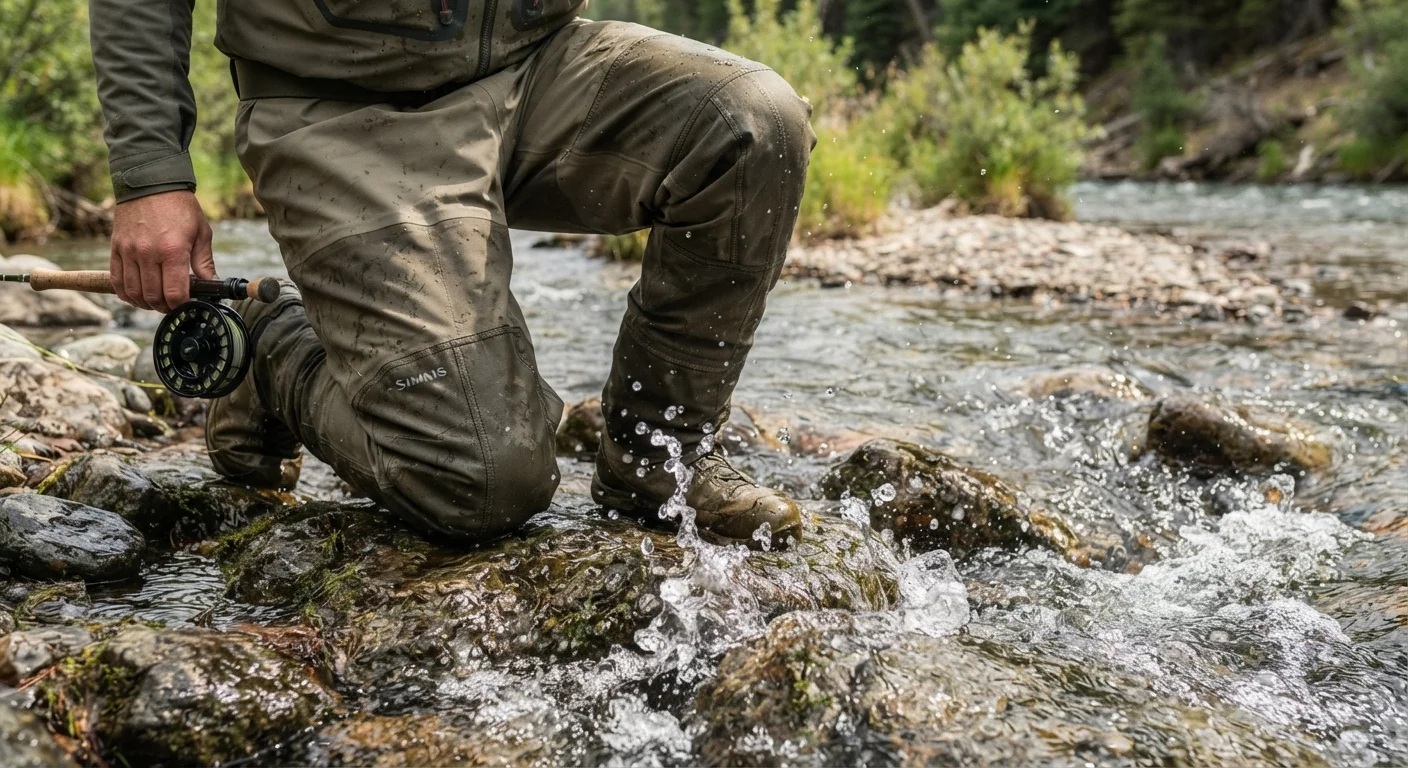
You've felt it happen mid-cast. You drop into a crouch to tie on a new leader, and your knee fabric pulls so tight you can hear the stitching complain. Or you're climbing back into the boat after wading a gravel bar, and that same knee panel has already worn thin from a season of kneeling on rocks. It's a construction problem, and most anglers never figure it out before buying their next pair of pants.
Three approaches dominate the market right now—articulated knee panels that pre-curve to your leg's natural bend, reinforced overlays built for abrasion in high-wear zones, and stretch-only fabric that has no seams. Each one solves a different problem and fails in a different scenario. This guide breaks down how these knee structures perform under real wading, kneeling, and hard-mobility conditions, so you can match the engineering to how you fish, not just what the tag promises.Custom Performance Fishing Pants can use different knee constructions for specific fishing environments.
Articulated Knee Construction: Pre-Curved Seams for Natural Range of Motion
The human knee doesn't bend in a straight line. It traces a J-curve—forward, then down—as the patella and condyles shift through flexion. Most pants ignore this. Articulated knee panels don't.
Fishing Pants Manufacturers sew darts —small folds of fabric—into the front of the knee panel. These darts push fabric outward, creating extra volume exactly where your knee needs it. Look for a short, near-horizontal seam that runs forward from both the inseam and the outseam, meeting around mid-patella height when you're standing straight. That's the visual cue for real pre-curved knee construction.
Why the Angle Range Matters
Your knee moves through a huge range depending on what you're doing:
Walking : 53–75° flexion during a normal gait cycle
Stair climbing : 78–94° on the way up, 76–90° coming down
Sit-to-stand or crouching : 60–87°
Squatting to tie a leader or dig through a tackle box : up to 117°
Tying your boots : roughly 107°
Well-engineered articulated knee panels use ergonomic knee darts calibrated for 60–120° flexion —the zone where nearly all functional movement happens. That's not arbitrary. The same 0–120° range is the design benchmark for prosthetic and exoskeleton knee joints.
Where This Pays Off on the Water
Articulated construction works best in high-mobility, low-abrasion scenarios like climbing back into a boat, scrambling over slick rock, or dropping into a deep crouch to net a fish. The pre-curved seam means the fabric doesn't fight you at 90° or beyond—it's already shaped for that bend.
But there's a tradeoff. The dart construction adds a seam, and seams are the first thing to fail when they're dragged across gravel or boat decks repeatedly. Pre-curved knee construction optimizes for mobility . If you're kneeling on rocks for twenty minutes tying flies, this alone won't save your knees.
The pattern math also matters. Front panels are cut longer than back panels around the knee, with the differential calibrated to that 60–120° range. Too little differential and you'll feel tightness above 90°. Too much and you get bagging fabric at full extension—useless volume when you're standing at the bow doing nothing but watching your line.
Reinforced Knee Panels Add Abrasion-Resistant Overlays Where Fabric Wears Fastest
Kneel on a gravel bar for twenty minutes tying a rig, and you'll understand what abrasion-resistant knee panels are for. They handle surface contact—repeated, sustained, grinding—that stretch-only fabric can't withstand.
Reinforced knee panels layer a tougher material over the base fabric right where your knee makes contact. Think Cordura, Kevlar, or SuperFabric overlays stitched or bonded onto the primary panel. The base fabric handles mobility. The overlay absorbs the wear. Two jobs, two materials.OEM Performance Fishing Pants production often separates these zones for better durability.
What the Numbers Say
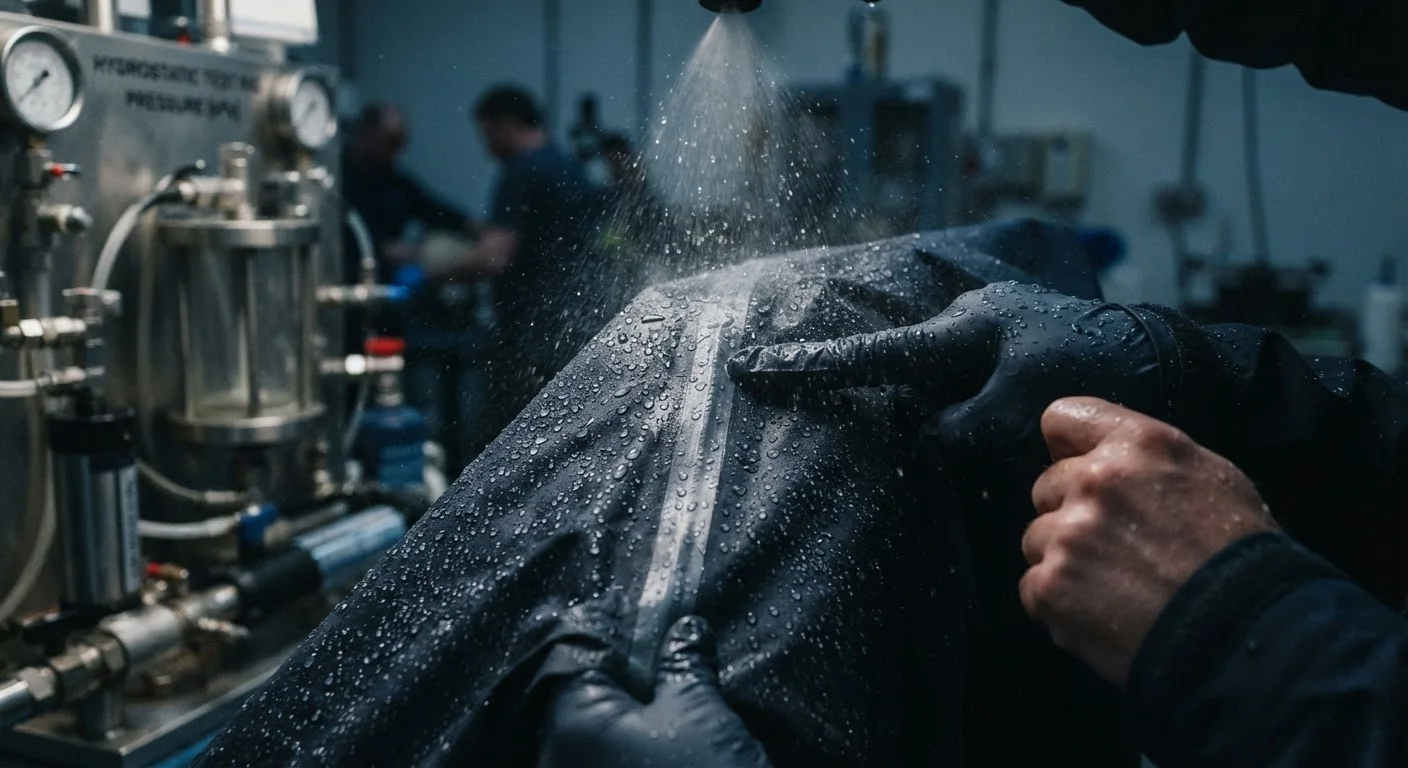
Abrasion resistance gets measured in cycles—how many passes a fabric survives before it wears through, typically via ASTM D3886 or Martindale testing.
Baseline acceptable is about 500 cycles, used for lighter-duty overlays like building panels. The practical minimum for hard-use knees is 2,000–2,500 cycles. The motorcycle-grade benchmark is ARMORTEX KN‑601, a Kevlar/Nylon/PU fabric at 630 g/m², hitting ≥2,500 cycles (ASTM D3886) and EN 388 level 4, certified to EN 17092:2020 AAA Zone 3.
That fabric-weight range is worth checking on a spec sheet: heavier protective overlays sit around 600 g/m², while lighter construction-pant overlays run 200–400 g/m². Higher weight generally means better abrasion life but less flexibility, so some panels blend in Spandex to keep bend intact.
Where Kevlar Shows Up in Wading Gear
Some wading pants use soft military-grade DuPont Kevlar panels across the knees and lower legs. The stated purpose includes puncture protection against submerged rocks and sharp debris, not just abrasion. Anglers who've fished rocky rivers describe these panels as "nearly indestructible" after seasons of kneeling on stone.
The Tradeoff
Overlay panels add bulk and stiffness at the knee. Without articulated knee panels or ergonomic knee darts built into the pattern underneath, that stiff overlay fights you at deep flexion. The best-engineered reinforced knee panels combine both an abrasion-resistant knee panel on the outside and articulated tactical pants knee construction underneath, so the fabric doesn't blow out at the seam when you drop into a crouch.
Stretch-Only Knee Zones: Four-Way Elasticity Versus Durability Trade-Offs
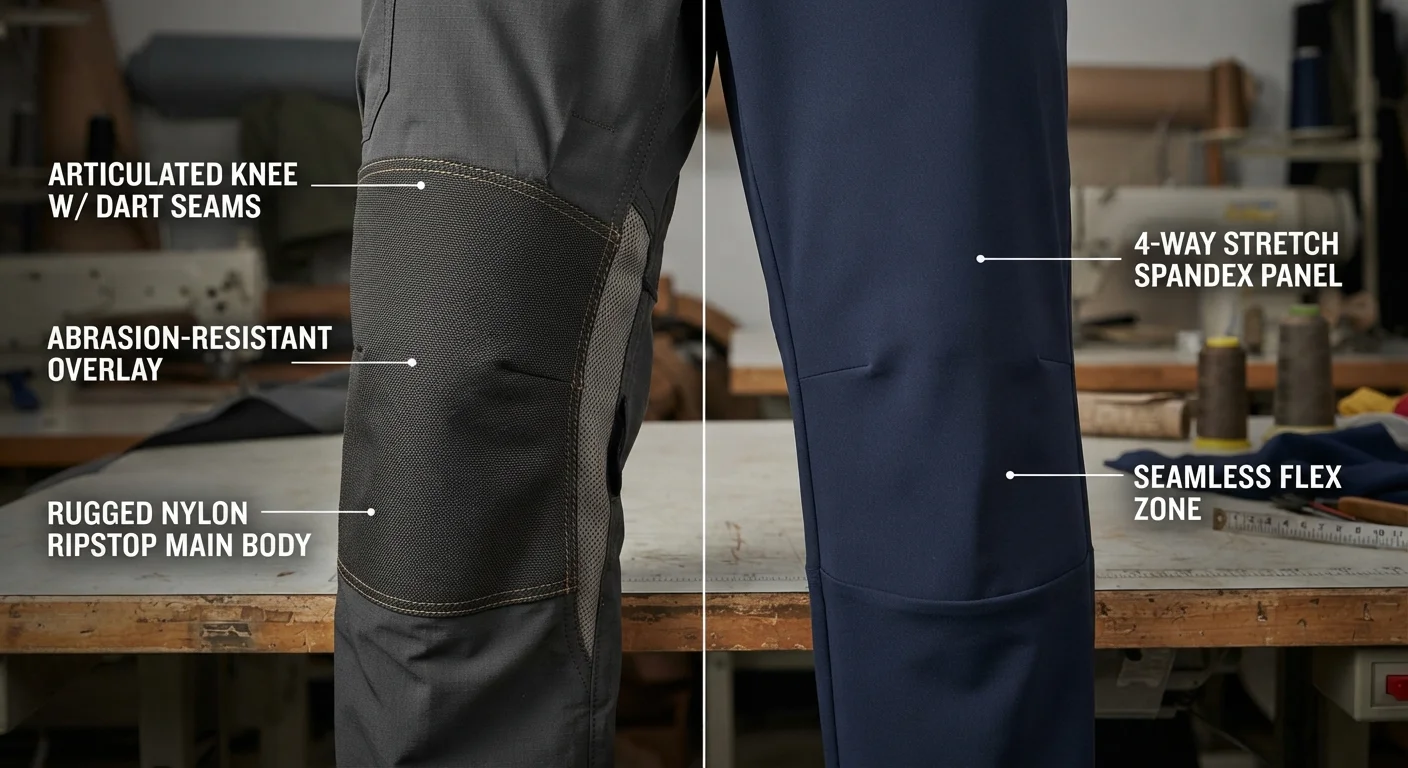
A localized panel of four-way stretch fabric (usually a poly/spandex blend) is sewn into the knee while the rest of the leg stays low-stretch for stability. No seams, no darts, no overlay. It's the simplest fix on paper. It's also the one most likely to fail quietly over months without you noticing until your knees are bagging out.
The Spandex Percentage Determines Everything
An 85/15 poly/spandex blend stretches roughly 120–150% and recovers 95–98% after extension. Drop to 90/10 and you get 80–100% stretch with 90–94% recovery. Below 8% spandex, you're not really getting four-way stretch anymore. It's closer to two-way, horizontal only.
Recovery beats any stretch percentage. A panel that stretches 80% but recovers only 60% will bag out after a handful of wears.Custom wholesale price of fishing pants depends on fabric grade and knee reinforcement options. Quality knee zones target ≥90% recovery after 50 cycles (ASTM D3107); premium panels push toward 98%.A technical fishing pants supplier tests stretch recovery before bulk production.
The Abrasion Penalty
Adding 5% bi-directional elastane to bull denim raises cost by $0.80–$1.50/yard and lowers abrasion resistance compared to 100% cotton. Elastane also degrades faster under heat and chlorine — river water and sun exposure aren't kind to it.
When Vertical Growth Becomes a Problem
Four-way stretch elongates vertically under kneeling, sometimes 5–10%, causing fabric to pool below the knee if the pattern doesn't compensate.
Stretch-only knee zones win on unrestricted mobility for casting and climbing. They lose on kneeling durability unless paired with an outer abrasion layer.
Performance Comparison: Knee Flexibility, Wear Resistance, and Longevity Under Real Fishing Conditions
Cold water changes how your knee behaves. Drop your core temperature and soak your joints for a few hours on a river, and muscle function drops along with flexibility. This is basic physiology, and it matters because fishing rarely happens in ideal, warm, dry conditions. You're kneeling on wet gravel. You're standing in 50-degree water for four hours straight. Your knee's usable range of motion shrinks right when you need it most.
The Flexion Numbers That Matter
Forget generic athletic range-of-motion charts. Here's what functional flexion looks like when it's cold and wet:
Below 90° gets you walking on flat ground or gentle slopes. 90 to 120° handles stairs, boat ladders, and sitting down in a low chair. 135° is full-depth bath-style flexion, usually not needed on the water. 110° is the practical rehabilitation target doctors use when they want a knee that functions normally in daily life.
That 110° number is worth remembering. It's the threshold where knee construction stops being a comfort issue and becomes a functional one. Pants that restrict flexion below 110° under wet, cold conditions will fight you exactly when you're stepping over a log or climbing into a drift boat with numb legs.
Wear Resistance: Flat Beats Contoured, By a Lot
Independent wear testing on knee components tells a consistent story: flatter, lower-conformity designs outlast highly conforming ones. In one study, custom-flat knee inserts wore at 2.3 ± 0.3 mm³ per million cycles, while lipped, more form-fitting inserts wore at 4.0 ± 1.0 mm³ per million cycles. That's a 49% reduction in wear just from flattening the design.
A separate comparison found an even bigger spread. Wear rates ranged from 1.3–1.9 mm³/MC on one setup to 3.5–4.9 mm³/MC on another, meaning the worse-performing design wore through at more than 2.5 times the rate. For fishing pants, this means a knee panel that hugs every contour of your leg tightly isn't automatically the toughest option. Sometimes flatter, less form-fitting reinforcement holds up longer under repeated kneeling.
Longevity Under Real-World Load
Long-term data backs this up. A clinical cohort tracking more than 400 patients over a minimum five-year follow-up found no measurable difference in performance and no mechanical failure in either comparison group. Translated to gear, well-reinforced knee zones built to spec don't degrade the way people assume. They either hold up structurally or they don't. There's little middle ground once you're past the two-year mark.
Material Choice Still Decides the Outcome
None of this matters if the base fabric can't handle wet abrasion and cold exposure. The materials that perform in fishing conditions are quick-drying polyester and nylon shells, waterproof-breathable layers like Gore-Tex, merino wool for warmth retention, UPF-rated synthetics for sun exposure, and neoprene for high-abrasion, high-submersion zones. Pair reinforced knee panels with one of these base fabrics, and you're covering flexibility, wear resistance, and longevity in the same pair of pants. You're not trading one for another.
Decision Matrix: Which Knee Structure Fits Your Fishing Style
Three knee constructions, three completely different failure points. Pick based on what actually happens to your knees on the water.
Start with three questions, rated 0–10 like a real decision matrix:
Deck risk : dry and stable (0) vs. wet, rolling, uneven (10)
Task load : mostly standing and casting (0) vs. constant kneeling, lifting, climbing (10)
Mobility need : stationary (0) vs. frequent crouching, stepping over rails, climbing into boats (10)
Match the Score to the Structure
Low deck risk, high mobility (score 0-3 / 0-3 / 6-9)
Think tournament bass anglers on stable platforms, casting for eight hours. Articulated knee panels win here. The pre-curved seam handles repeated 60–120° flexion without fighting you, and there's no abrasion overlay adding weight for a threat that doesn't exist.
High deck risk, high task load (score 7-10 / 8-10 / 4-7)
For offshore work, rocky riverbeds, and hours of kneeling to tie rigs, abrasion-resistant knee panels earn their keep. Check the fabric weight. Anything under 500 g/m² won't survive repeated gravel contact. Pair with articulated construction underneath so the overlay doesn't crack at deep flexion.
Low load, occasional mobility (score 0-3 / 0-3 / 2-5)
Casual pier or bank fishing, short sessions, minimal kneeling. Four-way stretch fabric alone covers this fine. No need to pay for reinforcement you'll never test.
The mixed case
Wading pants that combine long walks with occasional kneeling on submerged rock need both reinforced panels for puncture resistance and articulated darts for the wading itself. ODM Performance Fishing Pants designs can combine multiple knee technologies in one model.One structure alone leaves a gap.
Conclusion
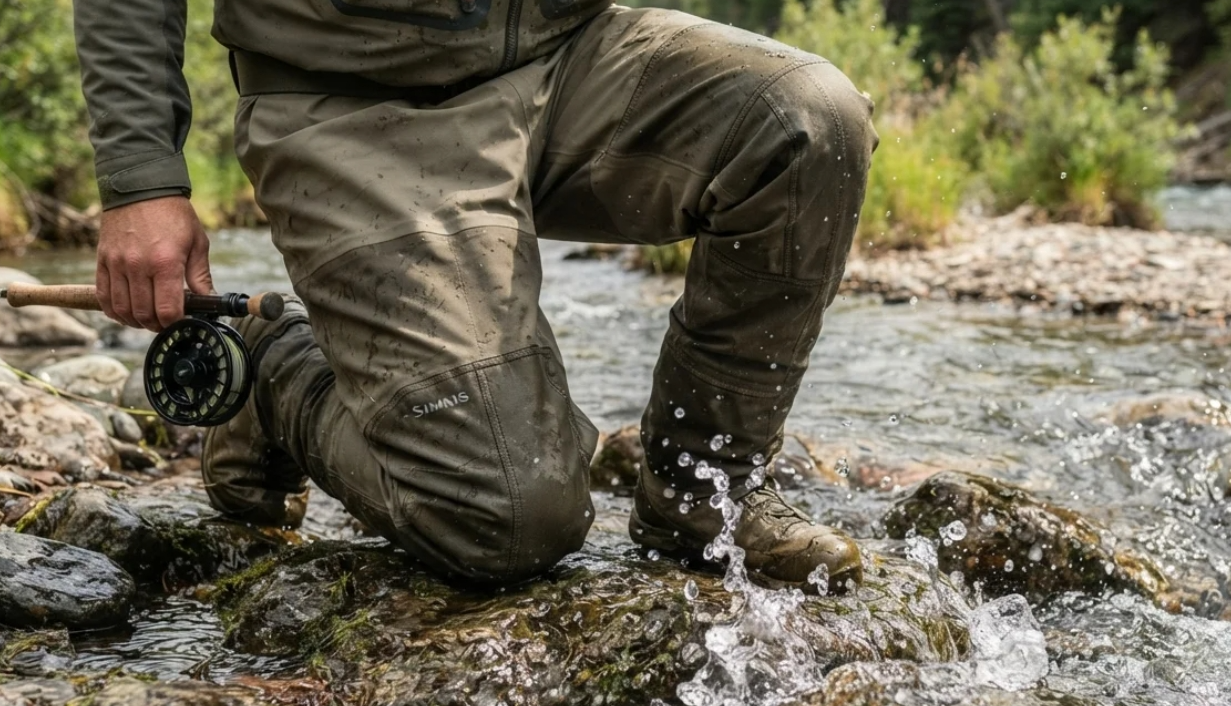
The right knee construction depends on how you fish. If you're kneeling on gravel bars to tie knots or scrambling up wet boat decks all day, articulated knee panels with proper pre-curved geometry will outlast and out-move anything else you try. If your boots see more mud than movement, dense abrasion-resistant knee panels earn their keep. If you're covering miles on foot with light gear, four-way stretch fabric alone might be all the knee you need—don't expect it to survive a season of hard kneeling.
Focus on matching seam angle, overlay density, and fabric weight to your actual fishing style before you swipe your card. Fishing apparel wholesalers often choose reinforced knee construction for premium outdoor collections.Pull up the decision matrix, run through your typical day on the water, and buy accordingly.