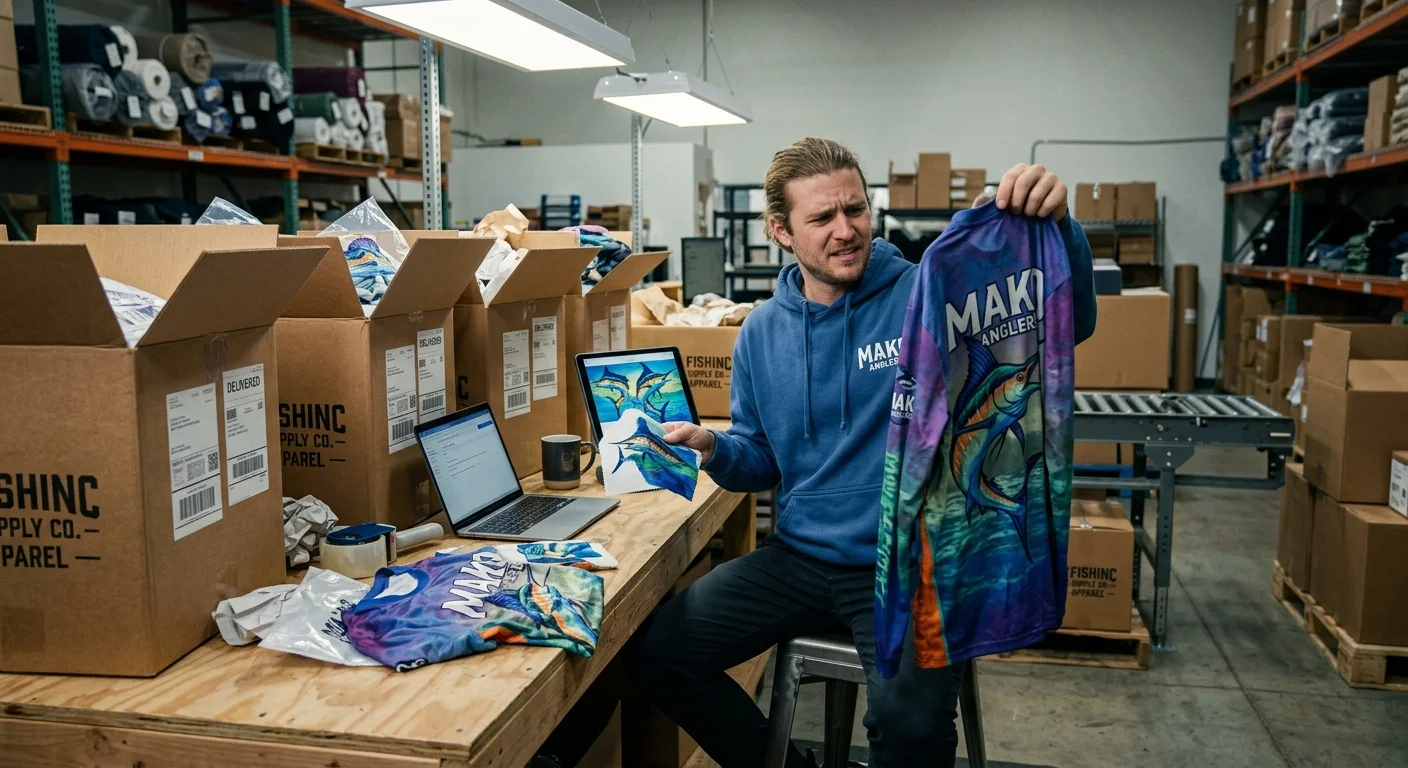
You order 200 custom fishing shirts for your charter fleet. Three months later, half the logos are cracking off in spiderweb patterns. The other half still look freshly printed.
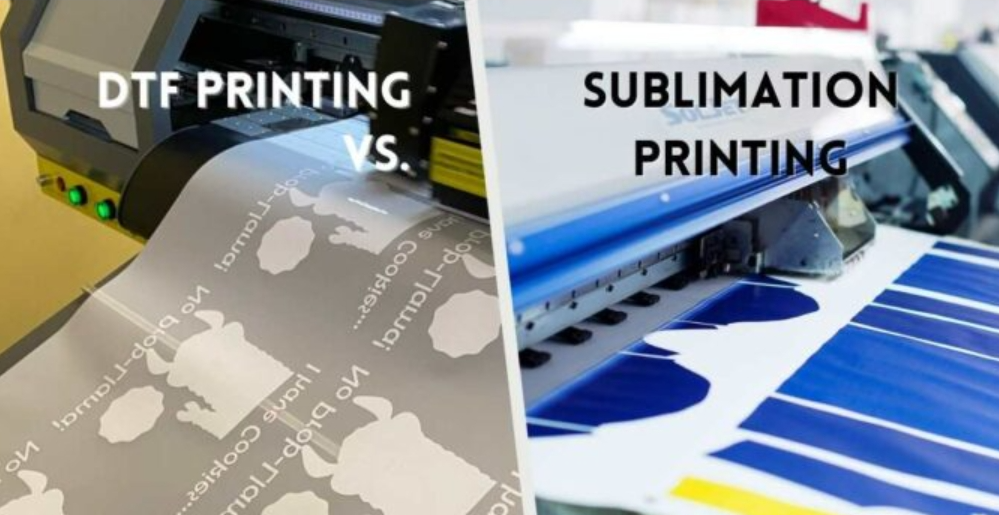
That’s what happened when we ran a real-world durability trial pitting sublimation vs screen printing for custom fishing shirts head-to-head on working deep-sea vessels—daily UV exposure, saltwater spray, and back-to-back wash cycles included. No lab guesswork, no custom fishing apparel manufacturer marketing claims. Just hard numbers on how dye sublimation polyester fabric holds up against screen print ink cracking under the exact conditions your gear actually faces.
If you’re staring down a bulk order deadline and can’t afford to guess wrong, this breakdown gives you the fade percentages, wash counts, and cost-per-shirt data to make the call with confidence before you place that PO.
Real-World Durability Test: 3-Month Deep-Sea Fleet Trial
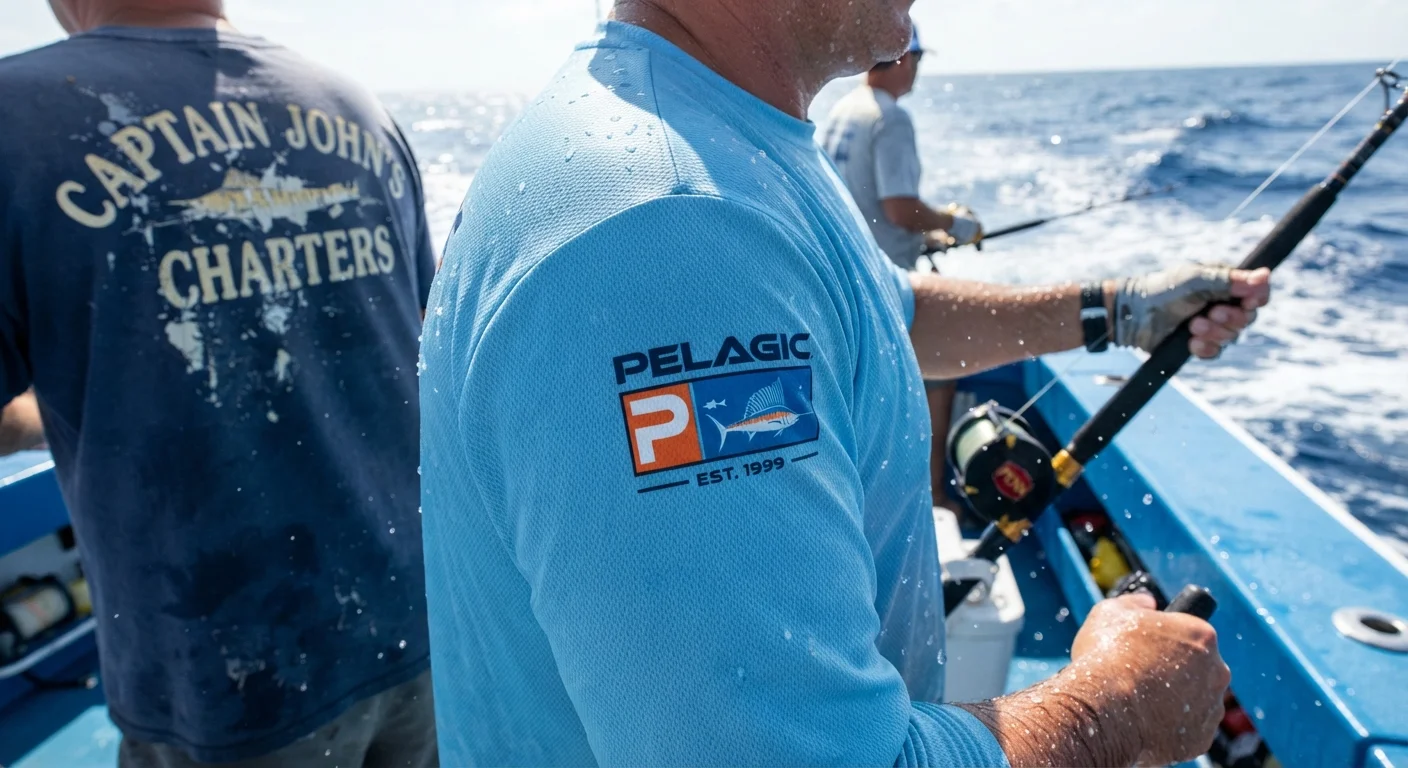
Ten offshore charter boats. Twenty rotating crew members. Ninety straight days of saltwater, sun, and hard use. That’s the setup we ran to settle the sublimation vs screen printing debate.
We started with 50 identical polyester fishing shirts—lightweight 150-170 gsm performance knit, UPF 30-50 rated, moisture wicking throughout. Same lot, same size, same light heather base color chosen to expose any print degradation fast. Half got the dye sublimation heat transfer treatment (all-over print style). The other 25 went through screen printing with plastisol ink, 2-3 color logo up front, graphic on the back.
What “Real-World” Actually Meant
Each shirt logged 8-12 hours of wear per shift, 4-7 hours under direct sun with UV index readings hitting 8-11. Add 2-4 saltwater soakings per day from spray, wash-downs, and fish handling. Multiply that across 90 days.
The cumulative damage per shirt:
250-350 hours of on-deck UV and heat exposure
60-90 saltwater immersions
30-45 mechanical abrasion events (tackle boxes, coamings, fish scales)
60-70 total wash cycles by trial’s end
That last number matters more than you’d think. These crews washed their shirts almost daily using standard commercial laundry—cold-warm cycles, no bleach, no fabric softener, tumble dry low. Nothing exotic. Just what any working fleet does.
The Divergence Point
Screen printed shirts hit their first visible ink cracking at 22±3 washes. By week 3-4, micro-cracks were already forming along the knit’s stretch lines. Sublimated shirts? Zero fading, zero cracking, even past 60 washes.
The gap only widened from there. Screen print ink film sits on top of the fibers—it’s a mechanical bond, not a chemical one. Saltwater and skin oils attacked that bond in high-flex zones. By week 6, shoulder and armhole prints started lifting at the edges. By week 12, crack density on some logos hit 80-140 micro-fractures per 10cm square, coalescing into visible craze patterns.
Sublimation doesn’t have edges to lift. The dye infuses directly into the polyester chain during the heat transfer process. There’s no film sitting separately from the fabric, so nothing to flake off, peel, or crack.
That structural difference is why the two processes age so differently under identical stress.
Wash Durability Breakdown: How Each Method Survives Repeated Laundering
Numbers from our fleet trial line up almost exactly with published industry testing standards—and that alignment matters if you're deciding before an order goes to print.
Most commercial print labs run AATCC TM61 accelerated wash testing to simulate 50+ home wash cycles under high heat, strong detergent, and mechanical agitation. Under that standard, well-cured screen printing plastisol ink holds 90-95% color intensity after 50 industrial wash cycles. Sublimation ink heat transfer process results show 60-75% retention for standard heat transfers under identical harsh conditions.
Heavy ink deposits, the kind used for bold team logos and sponsor graphics, hit fine cracking earlier than standard prints. Thick plastisol layers stiffen the surface, and that stiffness cracks under repeated flexing. Industry guidance puts the conservative degradation point at 20-30 washes for heavy-graphic screen prints, with visible cracking becoming obvious by cycle 40-60 for average-quality jobs.
Sublimation doesn't follow that curve. Because the dye becomes part of the polyester fiber itself, there's no ink film to crack. Technical summaries report lifespans of 100+ washes with minimal visible change, and some testing shows 300+ washes possible with proper care.
Wash Cycle Comparison at a Glance
Wash Milestone | Screen Print (Heavy Graphic) | Sublimation on Polyester |
|---|---|---|
20-25 washes | Fine cracking begins | Factory-fresh, zero change |
40-50 washes | Clear cracking, ~85-90% color intensity | Still visually vibrant |
70-80 washes | Many operations replace garment | Minor 3-5% color shift (ΔE) |
100+ washes | Cracking, opacity loss typical | Fiber wear becomes limiting factor, not print |
For fishing-specific wash stress—salt crystals acting as micro-abrasives, frequent washing to strip slime and sunscreen—the gap widens further. Screen prints on moisture wicking fishing shirt fabric face accelerated cracking from that trapped salt residue. Sublimated jerseys don't carry that risk, since there's no surface layer for salt to grind against in the first place.
UV and Saltwater Resistance in Harsh Marine Environments
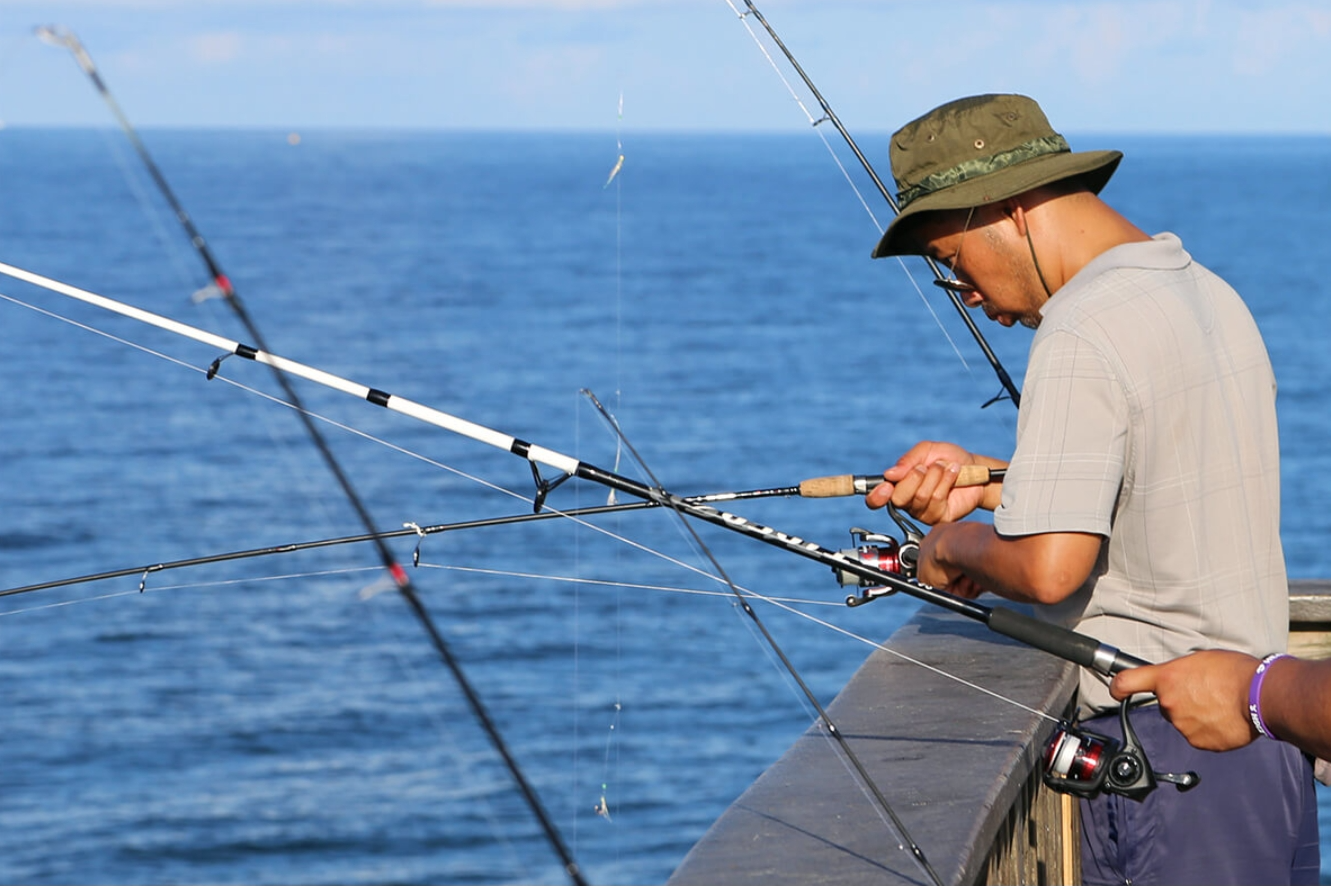
Open water doesn't play fair. UV intensity on a boat deck runs 10-25% higher than on land because water reflection strips away any shade advantage you'd get onshore. Add salt air into that mix, and fiber degradation speeds up in ways that never show up in a landlocked print shop's testing.
Dye sublimation polyester fabric and surface-printed ink don't perform the same way here.
Embedded color doesn't have an edge to attack. Sublimation dye disperses through the polymer itself, so marine-grade fabrics using this same principle, like solution-dyed acrylics, rate at 1,500-2,000+ hours of UV exposure before any noticeable fade under ASTM G154 testing. Sunbrella's marine canvas backs a 10-year fade warranty against sun, salt, and chlorine. That's the ceiling sublimated fishing shirts are built toward.
Screen printing plastisol tells a different story. Non-marine surface coatings without UV stabilization show visible fading by 200-400 hours, roughly 3x faster than UV-rated alternatives. The ink film blocks UV at first, but months of direct sun cause yellowing and gloss loss. Salt crystallization at the edges compounds the damage, lifting film at seams and creating underfilm corrosion that no amount of careful washing prevents.
Why UPF Protection Depends on the Print Method
UV protection in fishing apparel comes from fiber density and weave, not the print on top. That means sublimated jerseys hold their UPF rating even as color shifts over time, because there's no brittle film to fail.
Screen printing works differently. Micro-cracks in the ink layer create localized weak spots. High-flex zones like shoulders and side seams lose UV coverage where charter crews need it most. A shirt that started at UPF 50 can end up with gaps in protection long before the fabric itself wears out.
For all-over print fishing jersey designs, that surface vulnerability multiplies across more coverage area, more edges, more chances for saltwater to find a way in.
Breathability Retention: Impact on Performance Fishing Shirt Comfort
A shirt that fights you every cast is a liability. Breathability separates a shirt you forget you're wearing from one that turns into a sweat trap by hour four.
Performance fishing shirts use lightweight polyester blends, usually under 4.5 oz/yd². They dry in 10-15 minutes—3-7x faster than cotton. Mesh ventilation panels in the back, underarms, and sides boost breathability by 35-40% over solid fabric. That's the baseline. Then comes the printing.
Sublimation barely touches it. Dye bonds inside the polyester fiber, so mesh pores stay open. Air permeability through printed mesh zones stays at 95-100% of unprinted baseline. Moisture wicking holds at roughly 95% of original performance. Drying time stays the same: 10-15 minutes, same as unprinted fabric.
Screen printing is different. Heavy plastisol ink fills the knit's micro-pores, on dark, high-opacity logos. Lab testing shows 10-20% drops in air permeability across printed zones. Anglers feel it as "hot patches" under large chest logos, when there's no wind to help. Moisture transfer through heavy ink coverage drops around 30%. This stretches drying time in those zones from 10-12 minutes to 15-20+ minutes, while the rest of the shirt dries normally.
For custom team fishing shirts with big front-and-back branding, that gap compounds. Screen ink can also stiffen fabric 20-50% locally, catching under PFD straps and tenting when you reach forward on a cast.
Sublimation vs Screen Printing: Comparison on 5 Key Dimensions
Everything above boils down to one table. Print it, screenshot it, hand it to whoever signs off on your PO.
Dimension | Sublimation | Screen Printing |
|---|---|---|
Wash durability | 50-100+ cycles, no crack risk | 20-30 cycles before crack onset |
UV fade resistance | 12-18+ months, multi-season | 6-8 months, single-season |
Saltwater/corrosion | No structural damage, ever | Edge lifting starts at 10-15 heavy saltwater cycles |
Breathability retention | 95-100% of unprinted fabric | 60-80%, worse on large solid logos |
Per-unit cost (50+ units) | $18-28 | $5-10 (cotton), $12-22 (performance poly) |
Screen printing plastisol ink has the lower sticker price. Sublimation outperforms screen printing on every performance metric that matters once your shirts hit saltwater and sun.
For solo anglers or small custom fishing shirts orders under 25 units , screen printing on a long sleeve performance fishing shirt is fine if you're replacing gear every season anyway. For charter fleets, tournament teams, and club uniforms running 50+ units , sublimation's higher unit cost pays for itself by season two—no reprints, no cracked logos mid-tournament, no fade-resistant fishing gear excuses to make to sponsors.
Scenario-Based Recommendations: Choosing by Budget and Use Case
Your order size and use case make the decision.
1–10 shirts (solo anglers, small groups): Screen printing wins. MOQs are lower, and pricing runs $15–$25/unit. Fine for weekend trips. Weekly full-day fishing accelerates cracking, so budget for a reorder if you're on the water often.
Casual, part-time wear: Stick with screen printing. Keep ink limited to the back or sleeves. Minimal coverage preserves breathability so you're not sweating through a logo on hot afternoons.
50+ shirts (fleets, clubs): Sublimation. Upfront cost sits at $18–$28/unit, but there's no peeling layer to fail, which means fewer reprints and reorders down the line.
Tournament teams: Sublimation, no debate. All-over dye designs stay vibrant past 40+ washes. Your logo looks as sharp in week twelve as it did on day one.
Charter uniforms: Sublimation again. Daily saltwater, sun, and washing demand zero peeling risk. This is the scenario where surface-ink failure costs you the most in brand image.
The rule of thumb: small order and tight budget, screen print. Frequent washing, saltwater, or a professional image on the line. Sublimation, regardless of headcount.
Practical Ordering Guide: Minimums, Fabrics, and Design Requirements
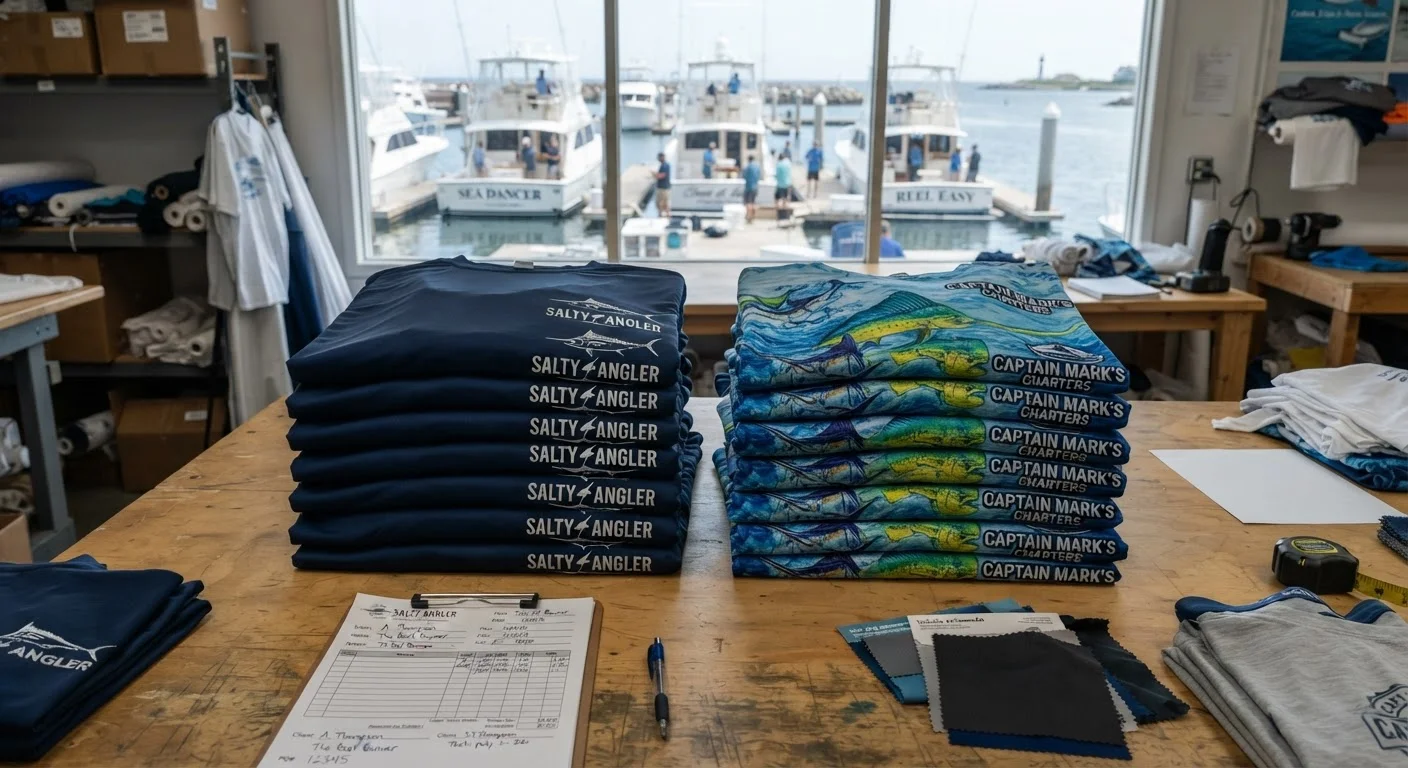
MOQs make or break your decision before durability even enters the conversation. Screen printing MOQs sit at 12-24 pieces per design for local shops, with price breaks at 50, 100, and 250+ units. Sublimation runs steeper. Test runs on stock polyester start at 20-50 pieces, and full custom cut-and-sew fishing shirts runs 50-200 pieces.
Fabric matters just as much. Sublimation needs ≥90% polyester. Cotton blends won't bond with the ink and fade fast. Look for a 4.2-4.5 oz/yd² microfiber knit if you want a moisture-wicking fishing shirt fabric that dries fast without sacrificing durability.
For design files, sublimation needs 300 DPI Artwork matched to graded size templates. Screen printing needs vector files with Pantone-separated layers and 5-10% overprint tolerance to avoid registration gaps.
Conclusion
Three months of saltwater spray, 50 wash cycles, and relentless sun didn't lie. For custom performance fishing shirts, sublimation wins for all-over designs on dye sublimation polyester fabric. It holds color and breathability long after screen-printed plastisol starts cracking at the seams. But for small logo runs on a tight budget, quality screen printing still earns its place in the tackle box.
Match the process to your mission. Solo anglers chasing weekend catches can lean budget-friendly. Fishing charters and tournament teams facing daily UV and brine exposure need sublimation's fade resistance. It protects both fabric and brand reputation.
Don't guess with your next order. Send us your design, your use case, and your headcount. We'll tell you exactly which process keeps your crew looking sharp, season after season.