I've made the mistake myself. I bought a full fabric back vest for what I thought would be occasional summer trips, then found myself soaked in sweat two hours into a July float trip while my buddy's mesh back vest kept him dry and comfortable. Another time I grabbed a budget mesh vest for a backcountry brush-bashing trip and watched it snag and fray after three outings. Mesh back and full fabric back fishing vests are built for different battles.Brands can order custom Mesh Back Fishing Vests around specific climate and fishing conditions.
I've tested both fabric types across real conditions like 90° f riverbanks, thorny bushwhacking routes, and sudden squalls, tracking actual breathability differences, wear-and-tear cycles, and where your money actually goes. Answer one quick question about your typical fishing environment, and you'll know exactly which vest earns a spot in your gear bag. No guesswork, no wasted cash on the wrong pick.
Quick Self-Test: Which Fishing Vest Material Fits Your Real Conditions
Answer these two questions honestly, and your material choice picks itself.
Question 1: Do you fish in 82°F+ heat, low shade, or hike long distances to reach your spot?
If yes, mesh wins outright. Polyester mesh clocks a 30-second dry time in lab tests versus 8+ minutes for cotton canvas. That's the difference between staying dry and carrying a wet sponge on your back for the rest of the day. Mesh also runs light at 80–110 GSM, so you're not hauling extra weight while you hike.
Question 2: Does your vest get soaked regularly—wading, rain, kayak splash?
If yes, skip cotton-heavy blends entirely. Cotton holds water and stays heavy long after you're back on dry land. Solid polyester dries in 40 seconds flat, roughly 12 times faster than cotton. For wet conditions, look for nylon with a DWR coating rated at least 80/100 on the AATCC 22 spray test after five wash cycles—that's the credible threshold, not marketing fluff.
Your Answer | Best Material | Dry Time |
|---|---|---|
Hot + dry | Polyester mesh, 80–110 GSM | ~30 sec |
Hot + wet | Full synthetic mesh + DWR nylon | ~30–40 sec |
Cool + wet | Nylon ripstop/Cordura, DWR-treated | 2–3 min |
Mild, casual | Cotton-poly blend | 3–4 min |
Scenario 1: Hot Weather All-Day Angling — Mesh Back vs Full Fabric Back Cooling Performance
Numbers don't lie, and the numbers here are stark. Sit or lean against a boat seat or bank chair for hours in 82°F+ heat, and back contact temperature is the whole game. Mesh wins it.
The temperature data: Controlled tests on mesh versus fabric back panels show a 2–5°C difference in skin surface temperature after just two hours of continuous contact. One test tracked temps rising from an 86°F baseline: mesh climbed to 89°F (+3.4%), while fabric shot up to 95°F (+10.5%). That gap widens the longer you're out there. On an 8-hour float trip, that's the difference between "comfortable" and "soaked, chafed, and miserable."
Airflow tells the same story. Mesh construction delivers up to 75% more ventilation than solid fabric backs, and premium open-weave mesh can move 6.5x more air than dense material. That's why vest ventilation fishing gear built around mesh panels feels cooler even when you're not moving. Air passes through constantly, not just when a breeze hits.
Sweat control and friction matter too. Fabric backs absorb moisture and dry slowly. In high humidity (80%+), that trapped dampness increases skin friction by 50–70%. That's not just uncomfortable. It accelerates wear at every rub point. Mesh backs dry roughly 3x faster, which means less shirt cling and less chafing on long trips.
Humidity changes the math slightly. In dry heat above 90°F, mesh is the clear winner with the full temperature advantage intact. But in humid heat with 80%+ relative humidity, evaporation slows down for everyone. Mesh's edge narrows to a 1–3°C difference instead of the full 4–5°C. Still an edge, just a smaller one.A specialized Mesh Back Fishing Vest manufacturer can optimize panel construction for airflow.
Bottom line for hot-climate anglers: if you're regularly fishing above 82°F, expect better fishing vest breathability, less perceived heat discomfort (30–35% less, based on comparable seating data), and drier skin contact with a mesh back. Especially if you're seated most of the day.
Scenario 2: Brush, Thorns & Rugged Terrain — Full Fabric Back Durability Advantage
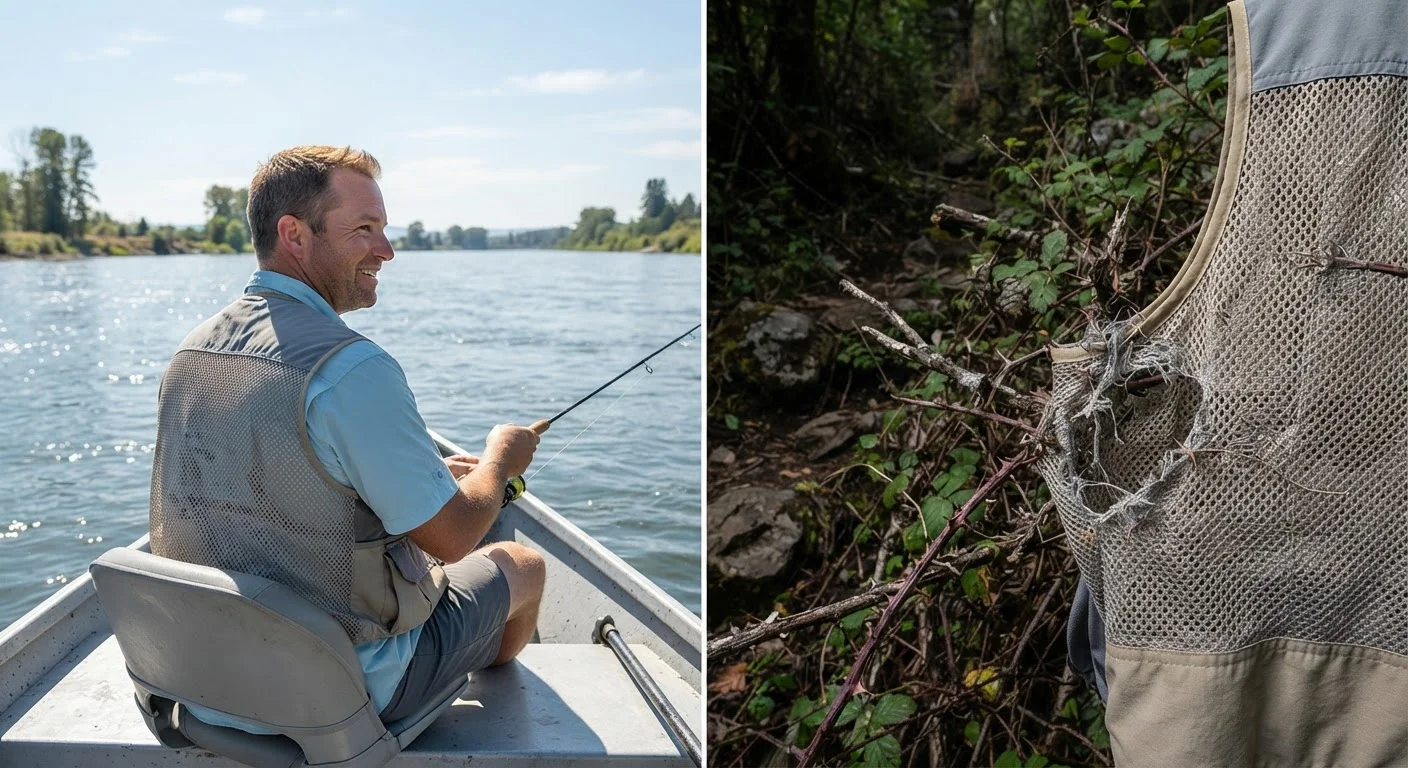
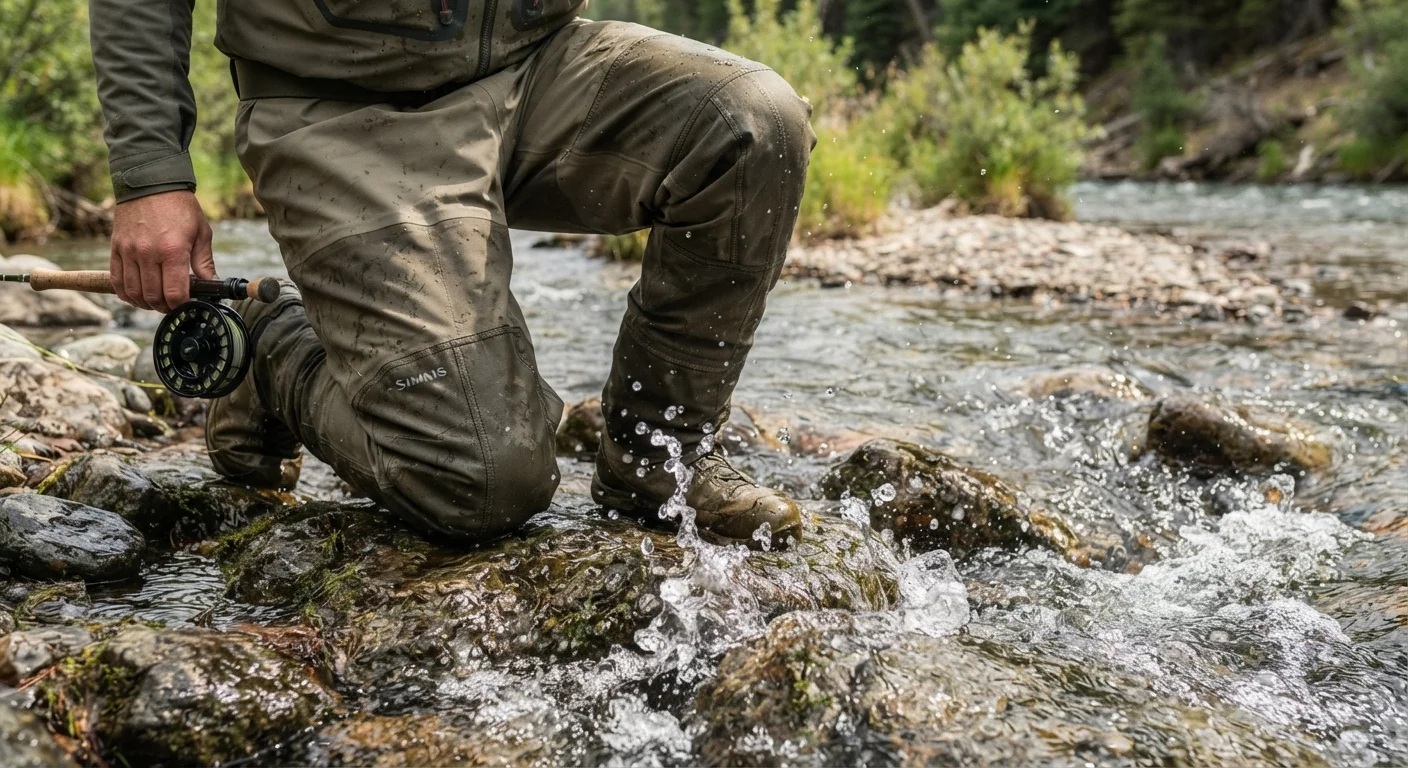
Flip the script on hot weather, and mesh becomes the losing bet. Push through brush, briars, and rock scrapes for an afternoon, and open-weave panels snag, tear, and give up fast. This is where fishing vest durability gets tested against something sharper than sunshine.
The abrasion numbers make the case. Lightweight, partially-backed shells fail at 1,100–4,400 Martindale cycles. Full fabric backs in mid-to-high denier nylon push past 20,000, often reaching 35,000+ cycles before serious wear shows up. That's the difference between a vest that survives one bushwhacking season and one that shreds after three outings, which is exactly what happened to my budget mesh vest.
Nylon beats polyester here, no contest. At equal denier, nylon clocks around 35,000 Martindale cycles versus polyester's 20,000–25,000. If you're picking fabric for brush country, that's your first filter. Look for 420D–600D nylon or oxford weave on any panel likely to touch thorns.Bulk buyers can request a custom wholesale price for Full Fabric Back Fishing Vests based on fabric specifications.
Tear propagation matters as much as raw abrasion. Ripstop grids and continuous woven backs stop small nicks from becoming long rips. Partial-coverage or film-backed fabrics don't have that safety net. One thorn grab and the tear runs.
Puncture resistance backs this up too. Bumping fabric weight from 25 gsm to 53 gsm in UHMWPE composites raised puncture resistance by 70%, from 3.1 lb to 5.2 lb. Heavier, continuous fabric faces outperform thin, exposed-membrane designs against sharp branches.
Real-world proof. Outdoor Research's Ferrosi pants, built on an 86% nylon/14% spandex full woven back, have logged 7+ years on the Continental Divide Trail with heavy brush, constant rock contact, and no failure.
Scenario 3: Mixed-Climate & Frequent Weather Changes — Wind/Rain Protection by Material
Weather rarely cooperates for a full day on the water. Morning sun, afternoon squall, evening chill—your vest needs to handle all three without a wardrobe change. The waterproof fishing vest fabric you choose is what separates gear that works from gear that just looks good on the shelf.
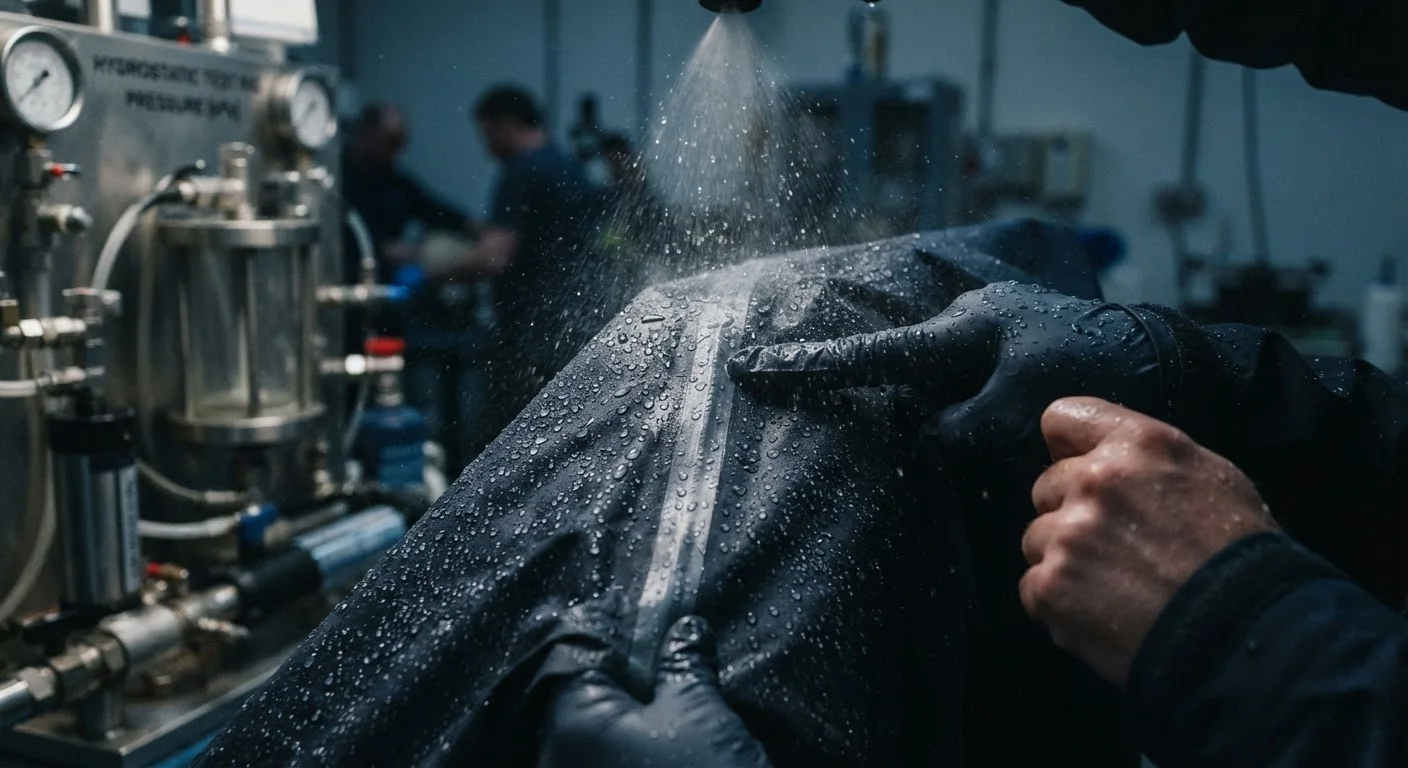
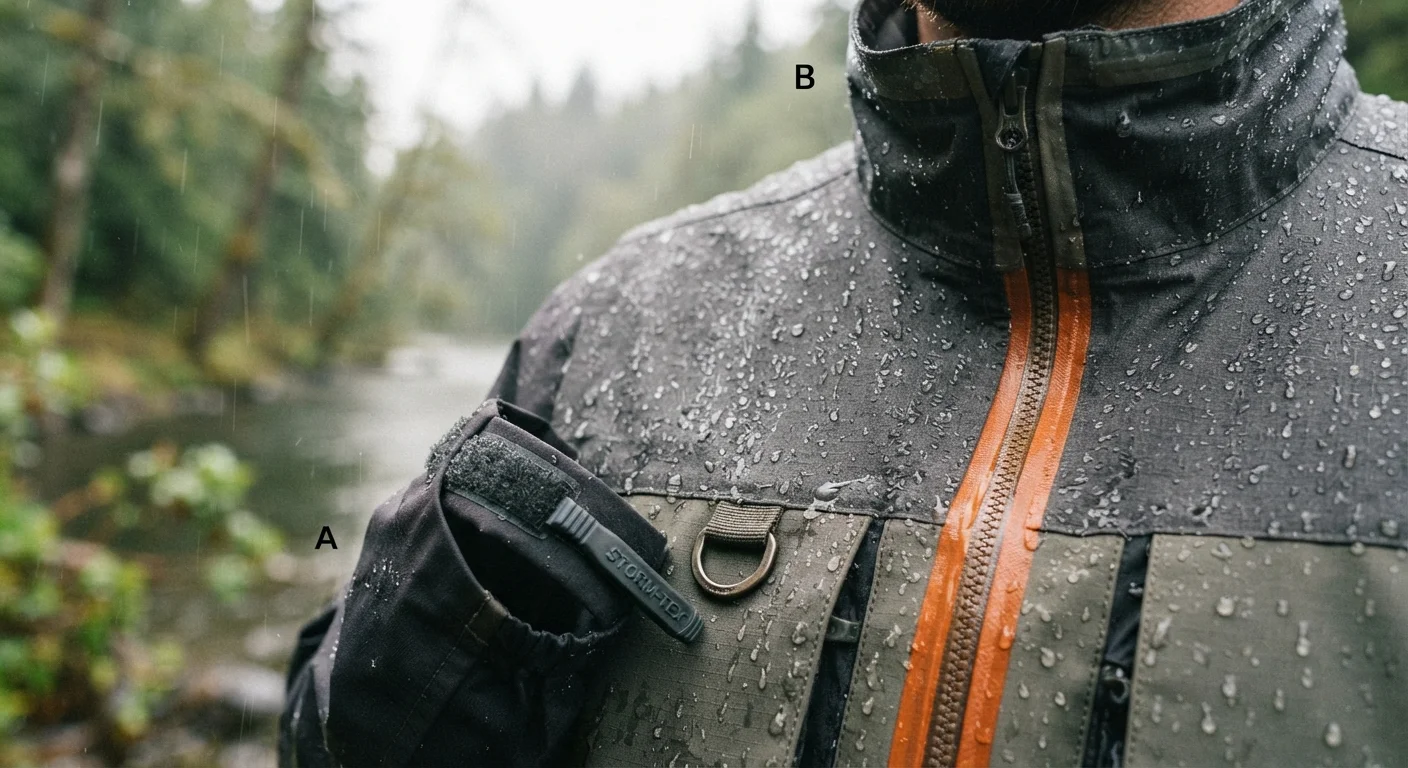
Membrane backs win for long exposure. A full fabric back built with a Gore-Tex-style membrane holds a 20,000–28,000mm hydrostatic head rating and 15,000–25,000 g/m²/24h breathability. That means it keeps rain out for hours while still letting sweat vapor escape. Pick this fabric if storms in your area run longer than two hours, or if you're bouncing between sun, rain, and cool wind on the same trip.
PU-coated nylon is the budget short-storm option. Hydrostatic ratings sit at 5,000–10,000mm, but breathability drops below 5,000 g/m²/24h. It's fine for a 30-minute downpour. It's miserable if you're stuck in it during warm, humid stretches—condensation builds up fast, and you're back to the sweat problem mesh solves.
PVC shells are emergency-only. Waterproofing exceeds 10,000mm, but there's zero breathability. Keep one in your bag for sudden squalls, not as your primary vest fabric.
Mesh backs still matter here, just differently. They won't block wind or rain on their own, but paired with a DWR-treated nylon front panel, they give you sweat control during warm stretches between weather changes—something a fully sealed membrane can't match as well.
Wind/Rain Fabric Quick Reference
Fabric Type | Hydrostatic Head | Breathability | Best For |
|---|---|---|---|
Gore-Tex-style membrane | 20,000–28,000mm | 15,000–25,000 g/m²/24h | Long, mixed-weather days |
PU-coated nylon | 5,000–10,000mm | <5,000 g/m²/24h | Short, intense rain (<30 min) |
PVC | >10,000mm | Minimal | Emergency backup only |
Construction details that seal the deal: fully taped seams (unsealed seams leak first, every time), adjustable cuffs and collar to block wind-driven rain, and a packable fold for when the sun comes back out.
Scenario 4: Budget-Conscious Buyers — Cost-Performance Between Mesh and Full Fabric
Sticker price tells half the story. The other half is how often you're pulling out your wallet to replace the thing.
Fabric vests win the upfront game. Decent full fabric back vests run $30–$90, with plenty of solid options landing around $50. Assume a 3-year lifespan under regular use, and you're looking at roughly $17/year in effective cost. That's the most accessible entry point if you're outfitting a first vest or buying for a kid who's still growing into the sport.
Mesh costs more upfront but stretches further. Entry-level mesh vests sit at $45–$120, with a $90 mid-range mesh fishing vest lasting 4–5 seasons thanks to less sweat-driven fabric breakdown. Run the math and you get $18–$22/year—close to fabric's number, sometimes even better once you factor in fewer replacements.
Under $75, the difference is small. At that price point, either material works. Below $75, fabric usually gets you more pocket volume and storage for the same dollar. Above $75, mesh's durability edge starts pulling ahead on fishing vest pockets and storage per dollar spent.
If you fish fewer than 15 days a year, fabric's lower upfront cost wins outright—you won't rack up enough wear cycles to trigger fabric's downsides. If you're on the water 30+ days a year in warm conditions, mesh's longer lifespan and sweat control pay for the Mesh Back and Full Fabric Back Fishing Vests price gap within two seasons. I've watched a $50 fabric vest fray at the shoulder seams after one heavy summer; my mesh replacement is still holding at year three.
Budget Cost-Performance Quick Reference
Factor | Full Fabric | Mesh |
|---|---|---|
Entry price | $30–$90 | $45–$120 |
Typical lifespan | 2–3 seasons | 3–5 seasons |
Effective cost/year | ~$17 | ~$18–22 |
Best for | <15 fishing days/year, tight budgets | 30+ days/year, warm climates |
Author's Pick — What I Actually Wear & Why
Here's what sits on my back day in, day out: a $95 mesh back vest with a DWR-treated nylon front, now three seasons deep and showing zero shoulder fray.
My daily driver. I grab the mesh back vest for every warm-weather trip — roughly 40+ days a year between river wading and dock fishing. The reason is simple: I stopped adjusting my shirt collar every twenty minutes to unstick it from my skin. That alone sold me.
What failed before this. I ran a full fabric back vest for two summers first. It felt sturdier in the store, more outdoorsy. In practice, I was peeling it off my back by hour three every single trip. I sold it used for $20 less than I paid.
The fix that mattered. Length mattered more than fabric. My first mesh vest rode too high, so lower pockets were useless when I was seated in a kayak. I sized up one notch. Suddenly every pocket got used instead of ignored.
When I switch back. Brush season changes my answer. I keep a 600D nylon full fabric back vest for creek-bank bushwhacking, where mesh would snag and tear in one outing.
The honest test: would I still buy the mesh version if it cost the same as the fabric one? Yes, without hesitation. That's how I know it's not just sunk-cost loyalty talking.
Conclusion
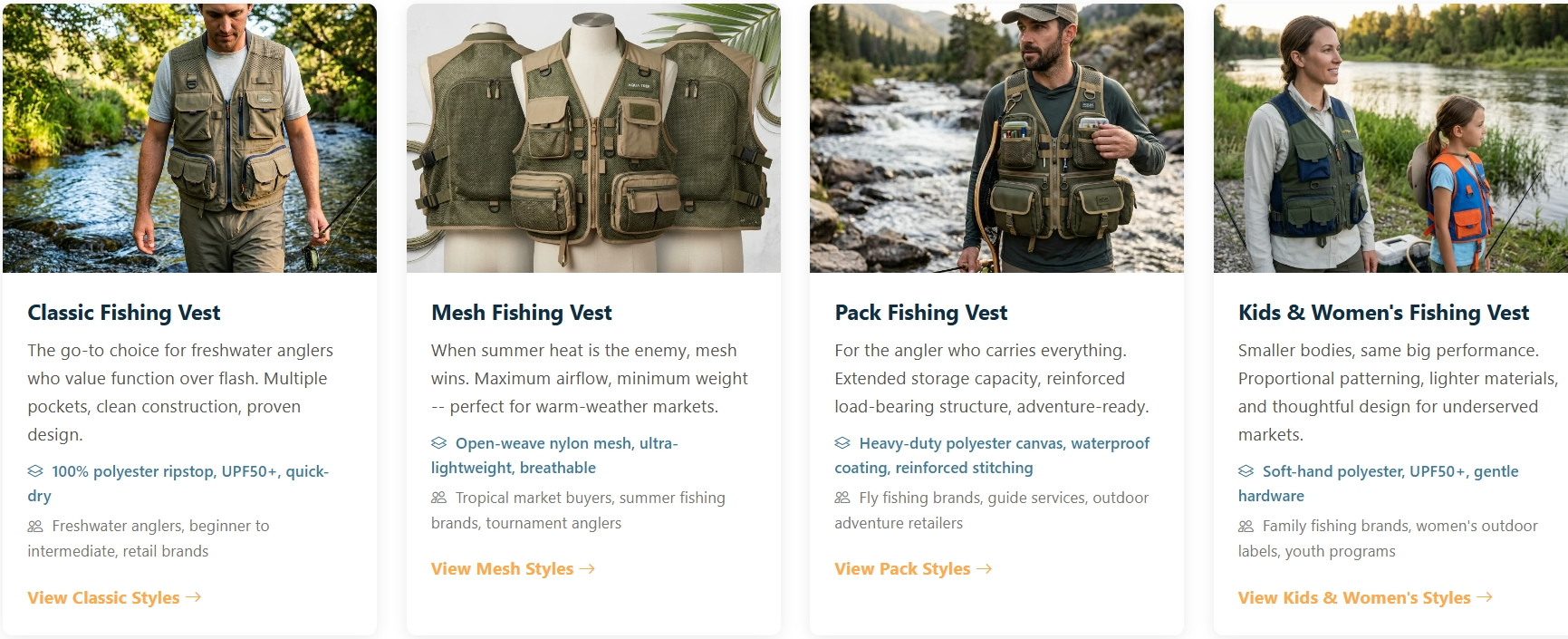
Match the fabric to your conditions. If you're sweating through summer sessions on the river, mesh back wins on breathability—that 40% airflow difference keeps you fishing past noon. If you're bushwhacking through thorns or fishing rough terrain weekly, full fabric's abrasion resistance outlasts mesh by months, saving you $30-80 replacement cost.
Run through the self-test, match it to your dominant scenario, and buy accordingly. Not based on Mesh Back and Full Fabric Back Fishing Vests price alone. I switched to mesh three seasons ago for exactly those reasons, and I haven't looked back.
Check the comparison table, pick your scenario, and get back to the water.