You’ve probably seen the $3.50 quote for a fully sublimated fishing shirt with your logo, moisture-wicking fabric, and UV protection. Your first instinct is to wonder what’s being cut to hit that number—thinner fabric, sketchy labor, maybe a factory that ghosts you after the payment clears.
That price isn’t necessarily a red flag. Import cheap custom fishing shirts from China and you’re tapping into a manufacturing ecosystem most buyers never fully understand, raw material sourcing to finished garment in one tight loop, built specifically to make this math work.
I’ll walk you through what makes these numbers possible, how to tell an efficient factory from one cutting corners you’ll regret, and what questions to ask before wiring a deposit.
Why Custom Fishing Shirts From China Cost So Little
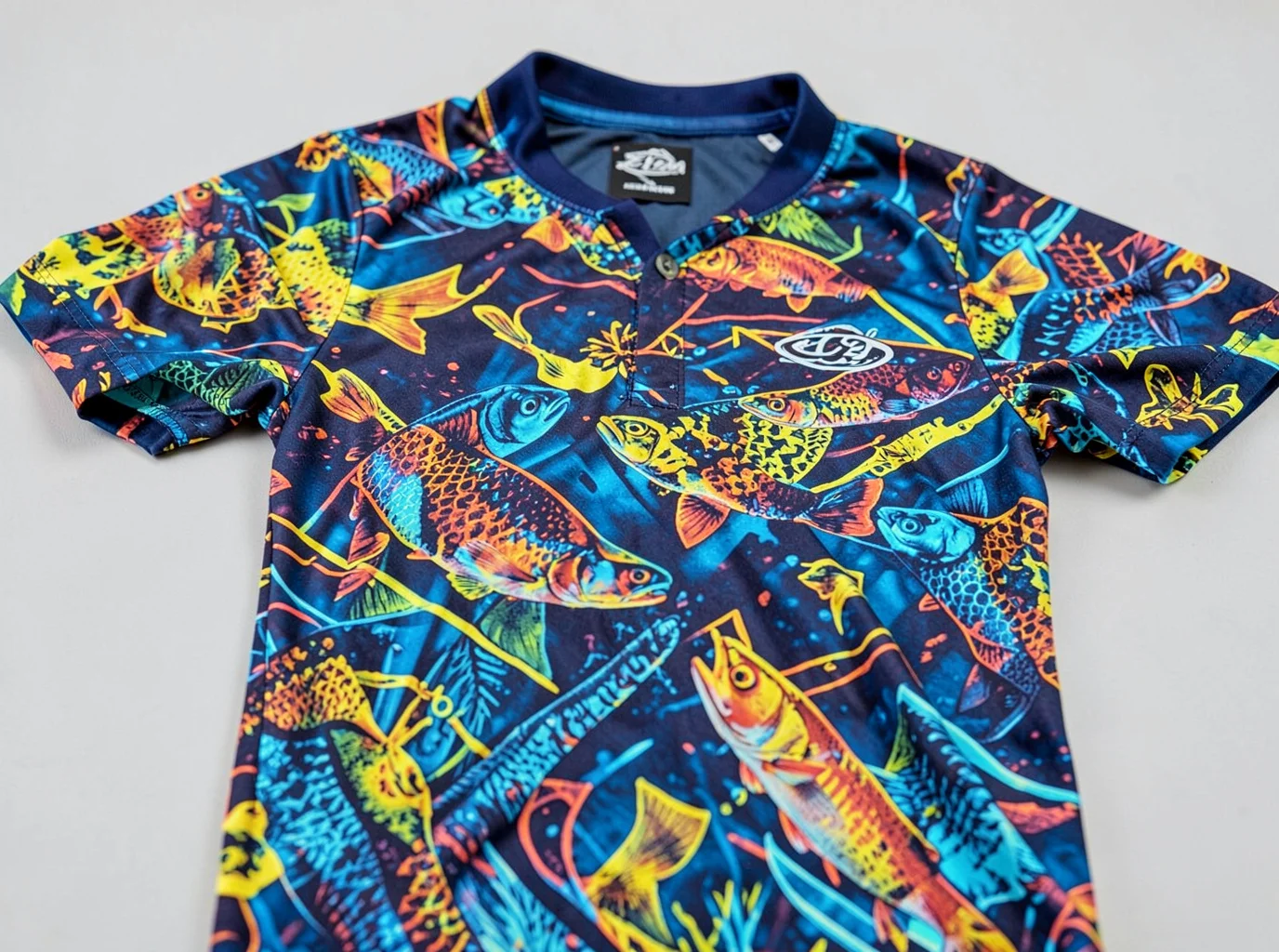
China custom fishing shirt FOB prices at a 100 pcs MOQ for basic polyester styles run US$2.60–6.00. With moderate OEM/ODM fishing shirts customization, you're looking at US$6.50–14.50. UPF50+ or quick-dry branded specs push the range to US$7–15. For small-batch or sample-heavy runs, the price hits US$8.50–20.60. That's why a tiny test order always feels overpriced compared to the advertised numbers.
MOQ is the biggest lever here. One pricing guide breaks it down:
100 pcs: US$3.20–6.80
300–500 pcs: US$3.70–9.24
1,000 pcs: US$2.30–8.74
5,000+ pcs: US$2.00–2.80
The same curve appears for digital-print performance shirts: US$16.80 at 10–49 pcs, dropping to US$10.80 at 100–999 pcs, then US$6.80 once you cross 1,000 units. Fixed costs (sampling, patterning, machine setup) get divided across more units.
Material and process choices add to the savings. Most low-FOB offers use 100% polyester, quick-dry, or UPF50+ fabric—standardized performance textiles rather than specialty blends. Combine that with sublimation printing, where the design goes directly onto the fabric surface instead of requiring separate cut-and-sew decoration steps, and you cut labor overhead per shirt significantly.
Compare that to domestic decorated-apparel pricing. Comparable custom fishing shirts in the U.S. often run US$18–42 per piece, depending on MOQ and print method. That gap comes from OEM/ODM repetition, factory-scale labor rates, and fabric standardization stacking together.
China's Apparel Manufacturing Clusters: Why Guangdong, Dongguan & Quanzhou Dominate Fishing Shirt Production
Location explains half the pricing puzzle. China's textile output concentrates in a handful of coastal clusters, with Guangdong, Zhejiang, and Jiangsu leading. Inside Guangdong, the Pearl River Delta runs the show—Guangzhou, Shenzhen, Dongguan, and Foshan form a dense web of specialized factories that hand off work to each other in days, not weeks.
Each city plays a different role:
Guangzhou is the trade and design hub. Orders land here, then get routed to surrounding factories for production. That "sell in the city, make in the suburbs" model keeps overhead lean.
Shenzhen focuses on brand development and small-batch fishing shirts, high-value work. If your fishing shirt needs custom UPF fishing shirts ratings, specific stretch patterns, or fast design iteration, Shenzhen fishing shirts factories handle that flexibility well.
Dongguan is where knitwear and sportswear cluster hardest. Districts like Humen (womenswear) and Dalang (knitting) built up decades of yarn, fabric, and garment-assembly infrastructure. Public sourcing platforms show Dongguan suppliers listing "Fishing Shirt" as a product category, with ODM/OEM support and delivery in as little as 15 working days.
Quanzhou (Fujian) brings scale. This cluster built its reputation on sportswear and export manufacturing, making it a solid fit for bulk fishing shirts wholesale orders where consistent large-volume output matters more than rapid prototyping.
Why clustering cuts your cost per unit:
Procurement : Fabric, zippers, printed labels, and packaging suppliers sit within the same city or province, so you avoid cross-province sourcing delays.
Subcontracting : Printing, embroidery, heat transfer, and finishing happen within a 30–100km radius, which cuts rework and sample shipping time.
Logistics : Short factory-to-port chains support FOB, DDP, and small-parcel export. Some Guangdong factories quote sample response times under four hours and full delivery inside 15 working days.
A typical one-stop factory workflow looks like this: MOQ 200 pieces per style/color, 1–3 sample pieces, 7–10 day sampling, 2–3 week bulk production, and 24–48 hour quoting turnaround—all supporting FOB or DDP shipping terms.
If you're vetting a fishing apparel manufacturer in China, match the region to your priority. Guangdong (Guangzhou-Dongguan-Shenzhen) suits fast design, quick sampling, and functional fabric integration. Quanzhou suits stable, large-volume production with strong export experience. Dongguan is where you're most likely to find factories already producing fishing shirts at scale, with ODM/OEM capability and short lead times built into their standard offering.
Decoding the Price Signals: What US$1-8 vs US$7-15 Means for Fishing Apparel Quality
Two quotes land in your inbox. One says $3.80. The other says $11.00. Same "custom fishing shirt" description on both. Here's what that gap actually tells you about what you're buying.
The US$1-8 range is entry-level to semi-custom territory. Real-world samples show UPF50+ quick-dry fishing shirts quoted at $3.80-7.80 and $5.35-8.89, typically at 100-300 pcs MOQ. You'll also find rock-bottom outliers around $2.60-3.99 at 100 pcs—strip everything down to bare minimum and that's what you get.
The US$7-15 range signals OEM customization with real functional upgrades. This is where long-sleeve sun protection, color-blocked designs, hooded styles, and heavier fabric weights live. Public pricing samples cluster at $7.00-10.50, $8.00-12.00, and $11.00-15.00, usually at 50-200 fishing shirts pcs MOQ.
Fabric Weight Tells You More Than the Price Tag
-120-150 GSM : Lightweight basics, fast-drying, summer-focused. Some factories still treat this as UPF50+.
-140-160 GSM : The balanced middle ground—factories recommend this for tropical, high-heat conditions where quick-dry performance matters most.
-160-200 GSM : Heavier, more durable. This is where guide workwear and premium sun-protection shirts sit.
What Pushes a Shirt From $5 to $12
UPF50+ certification with verified specs like UV transmittance under 2% and 50+ wash cycle durability
Custom embroidery —commonly available at 100 pcs MOQ, but it moves pricing upward fast
Hooded styles : public samples show hooded fishing shirts running $8.00-12.00
High-performance blends like 88% polyester/12% spandex with moisture-wicking, salt-water tolerance, or vented back panels
Samples at just 5 pcs MOQ can quote $7.00-15.00. That's not bulk pricing—that's sampling cost dressed up as a quote. Don't use it to benchmark your real order.
Comparing Landed Costs for Wholesale Fishing Shirts: China vs Other Sourcing Regions
FOB price is half the equation. The number that matters is landed cost—what you pay after freight, duties, and fees hit your bank account. Skip this math and a cheap quote can quietly eat your margin.
The Import Fees You Pay Beyond the Product Price
Your real cost stack includes tariffs on apparel duties that run 16.5% to 32%, with synthetic fabrics often landing at the higher end. There's also the Merchandise Processing Fee at 0.3464% with set minimums and maximums, the Harbor Maintenance Fee at 0.125%, plus freight, insurance, customs clearance fees, and sampling costs that typically run $50 to $300+ per style across multiple rounds.
China vs Vietnam vs Local Production: The Real Trade-offs
China wins on unit economics. Public pricing samples show standard cotton tees dropping from $4.80–$6.50 to $3.50–$4.20 once orders cross 500 pieces. Heavier styles drop from $7.00–$9.00 to $5.20–$6.50 at the same threshold. Style variety and MOQ flexibility are strongest here too.
Vietnam fits complex or technical builds but comes with tradeoffs. MOQs run around 1,000 pieces per color, sampling takes 2–4 weeks, and production takes 4–16 weeks. Cash flow pressure hits earlier than when sourcing from China.
Local production wins on speed and control. Faster revisions, easier factory audits, and quick reorders all come standard. But unit prices rarely compete with Chinese bulk pricing on fabric and labor.
A Quick Rule of Thumb
If China's FOB beats local pricing by 20% to 40%, most orders still protect margin after freight and duties. Testing 300 to 5,000 units with multiple SKUs? China wins. Need 100 to 300 pieces fast with tight communication? Local production often makes more sense.
How to Vet a China Fishing Apparel Manufacturer Before Placing a Bulk Order
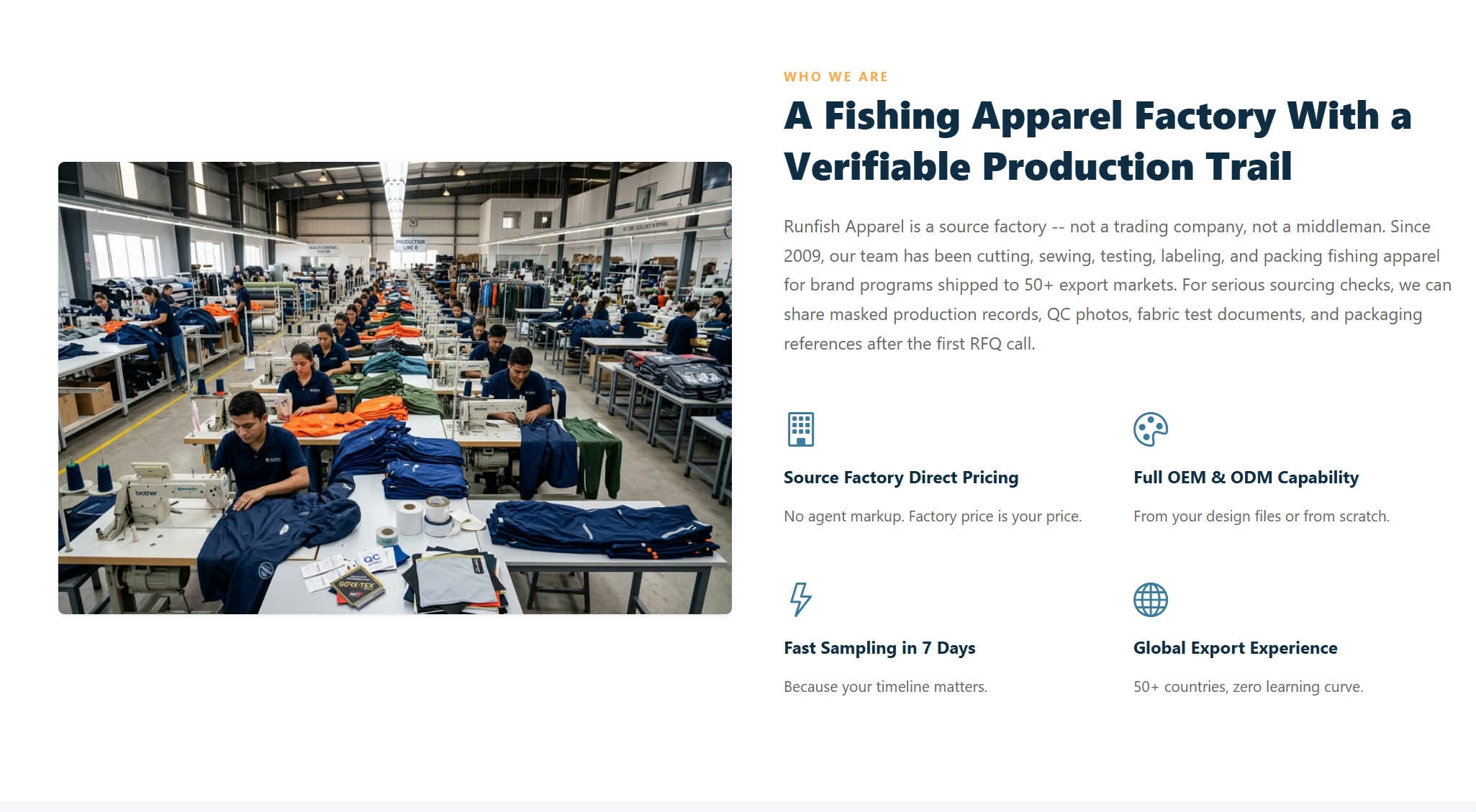
A cheap quote means nothing if the factory behind it can't actually produce what they promised. Before you send a deposit, make sure you're dealing with a real fishing apparel manufacturer. You don't want a trading company reselling someone else's production at a hidden markup.
Verify the Factory Actually Exists
Start with the business license. Check the registered address, establishment date, legal representative, and business scope. The scope should list production, manufacturing, or processing. If it says only wholesale, trading, or import-export, that's a red flag. That one check filters out most middlemen pretending to be OEM fishing clothing factories.
Cross-reference the license against China's official enterprise registry to confirm registered capital, operating status, and any risk flags. Then request a live video walkthrough, not a pre-recorded clip. The camera should move from the front gate into the actual workshop, showing production lines, machinery, workers, and semi-finished goods. Ask for photos with the factory name visible in the frame, plus equipment lists and warehouse shots.
Real factories match their registered address to their production address, usually within the same industrial park or city. If the address points to an office tower, you're likely talking to a trader.
Ask for export records from the last 6 to 12 months: invoices, packing lists, bills of lading. Prioritize suppliers with a history of exporting fishing shirts or similar fabrics. Also confirm that the payment account name matches the business license entity exactly. Personal bank accounts are a hard no.
Inspect Samples Before Committing to Bulk
Request a fabric swatch alongside your sample and verify the composition against the hangtag and wash label. Weigh the fabric to confirm GSM. A ±5% deviation is the standard acceptable range. Check sublimation or digital print edges for bleeding, cracking, or poor adhesion to the base fabric. If UPF or UV protection is claimed, demand the third-party test report. Don't take marketing copy at face value.
Build a QC Checklist Before Bulk Production
Lock in tolerances before production starts:
Dimensions: chest, length, sleeve, shoulder. Typically ±1–2 cm tolerance.
Colorfastness: wash, sweat, rubbing, and sun exposure resistance, especially saltwater tolerance.
Seam strength: pull-testing shoulder seams, armholes, and zipper ends.
Batch consistency: color, weight, print placement, and labeling uniform across the run.
Your pre-order document package should include the business license, live factory footage, equipment list, recent export records, signed sample confirmation, third-party test reports, and written QC standards. Skip any of these and you're negotiating blind.
Common Low-Price Traps When Importing Custom Fishing Shirts From China—And How to Avoid Them
That $3.80 quote you're staring at might grow legs before your bulk order ships. Low-price quotes hide specifics that only surface once you're already committed.
Vague fabric specs top the list. "Polyester" or "UPF50+" sounds precise until you ask for GSM, yarn count, moisture-wicking treatment, and colorfastness grade and get silence. Lock these into your contract, alongside the fabric card and test report, before production starts.
Skipping sample confirmation is another trap. Sample fees typically run $50–230 and only get credited against your order once you hit a minimum quantity. If you order in bulk without confirming that sample first, you'll be stuck negotiating fit or print placement issues after the fact with no room to negotiate.
Ultra-low MOQ claims deserve scrutiny too. "10 pieces, no minimum" grabs attention, but switch to a custom design or new packaging and that number jumps fast. Realistic MOQ for custom fishing apparel sits around 50–100 pieces per style/color, with fully fishing apparel customized runs often landing at 100 pieces.
Hidden Fees That Inflate Your "Cheap" Quote
Three costs rarely show up in the initial number. For logo customization, "free setup" often means printing plates, embroidery digitizing, or per-color charges kick in later, sometimes with a 10-piece minimum just for the logo work. Custom packaging: poly bags are standard; branded boxes, hangtags, and labels usually carry separate MOQs (50–300 pieces) and affect carton dimensions and freight. Design and pattern work: pattern making runs $75–$1,000 per style, tech packs around $300, and multiple sample rounds add up quickly on a first order.
Preventing Delays and Disputes
Sampling takes 7–10 days, bulk production 25–40 days, but delayed color approval or unclear logo files push timelines further. Fix this by locking tech packs, fabric cards, and PPS approval before final production. Quantify everything: size tolerance, AQL, defect rate, delivery penalties. Keep unboxing videos and defect photos ready, and set a claims window and flag issues within 1–3 days of receiving goods.
Quality, Logistics & Compliance for Wholesale Fishing Apparel From China
Buyers get burned by what the quote left out — labeling rules, hidden authorization gaps, or logistics costs nobody mentioned until the invoice landed.
Labeling Compliance Isn't Optional
China's updated textile standard, GB/T 29862-2026, requires fiber identification and permanent labeling on every finished garment. A compliant label needs at least five elements: manufacturer name and address, product name, size/specification, fiber content, and care instructions. Fiber percentages should list from highest to lowest by weight. If you're selling into the U.S., add country of origin and only list fibers making up 5% or more. Taiwan's standard also requires that anything over 5% needs a named percentage, and "100%" claims allow zero tolerance. Everything else typically allows ±3%.
Certifications Explain Price Jumps
"Low price ≠ low quality" holds up once you understand where certification costs sit. ISO 9001, BSCI, OEKO-TEX Standard 100, SGS UPF 50+, and ANSI/ISEA 107 testing all get baked into unit price. Ask for third-party reports covering waterproofing (10,000mm threshold), moisture vapor transmission (≥5,000g/m²/24hr), and tear strength (≥25N) before assuming a higher quote is padding.
Small Orders Carry Bigger Logistics Costs
Low MOQ runs concentrate fixed shipping fees (LCL consolidation, customs filing, last-mile delivery) across fewer units. Typical transit times run 5–7 days by air, 25–35 by sea, 5–10 by express. For landed-cost clarity, compare quotes under DDP terms rather than FOB alone.
Lock IP Authorization Before Production
Get written confirmation on trademark, Artwork , and font usage rights, especially for collabs or fishing association logos, before deposits move.
Get the best deal on custom sublimation fishing shirts without sacrificing quality
Lock a repeatable process before you negotiate. That’s how you get a good deal.
Order samples first. Most suppliers offer 1-piece samples and credit that fee toward your bulk order. Some low-MOQ fishing shirts programs run samples as cheap as $50 EXW. Test hand-feel, print sharpness, seams, and UV/UPF claims under real sunlight and wash cycles before you talk numbers.
Lock one spec sheet, then request three quotes. Same fabric, GSM, UPF level, sublimation coverage, and packaging across every quote. MOQs vary by supplier type: low-MOQ private label fishing shirts programs sit at 10–20 pcs, mainstream custom fishing shirt factories run 100 pcs per style/colorway, and full OEM builds land at 300–500 pcs.
Match Supplier Type to Order Size
-Testing a design? Go low-MOQ fishing shirts(10–20 pcs), negotiate mixed sizes and sample-fee credit.
-Scaling a proven winner? Push for OEM tiered pricing at 300+ pcs, fixed color libraries, and written QC benchmarks.
Require test reports dated within 12 months— AATCC 183, OEKO-TEX 100, ISO 105-B02—before committing capital.
Conclusion
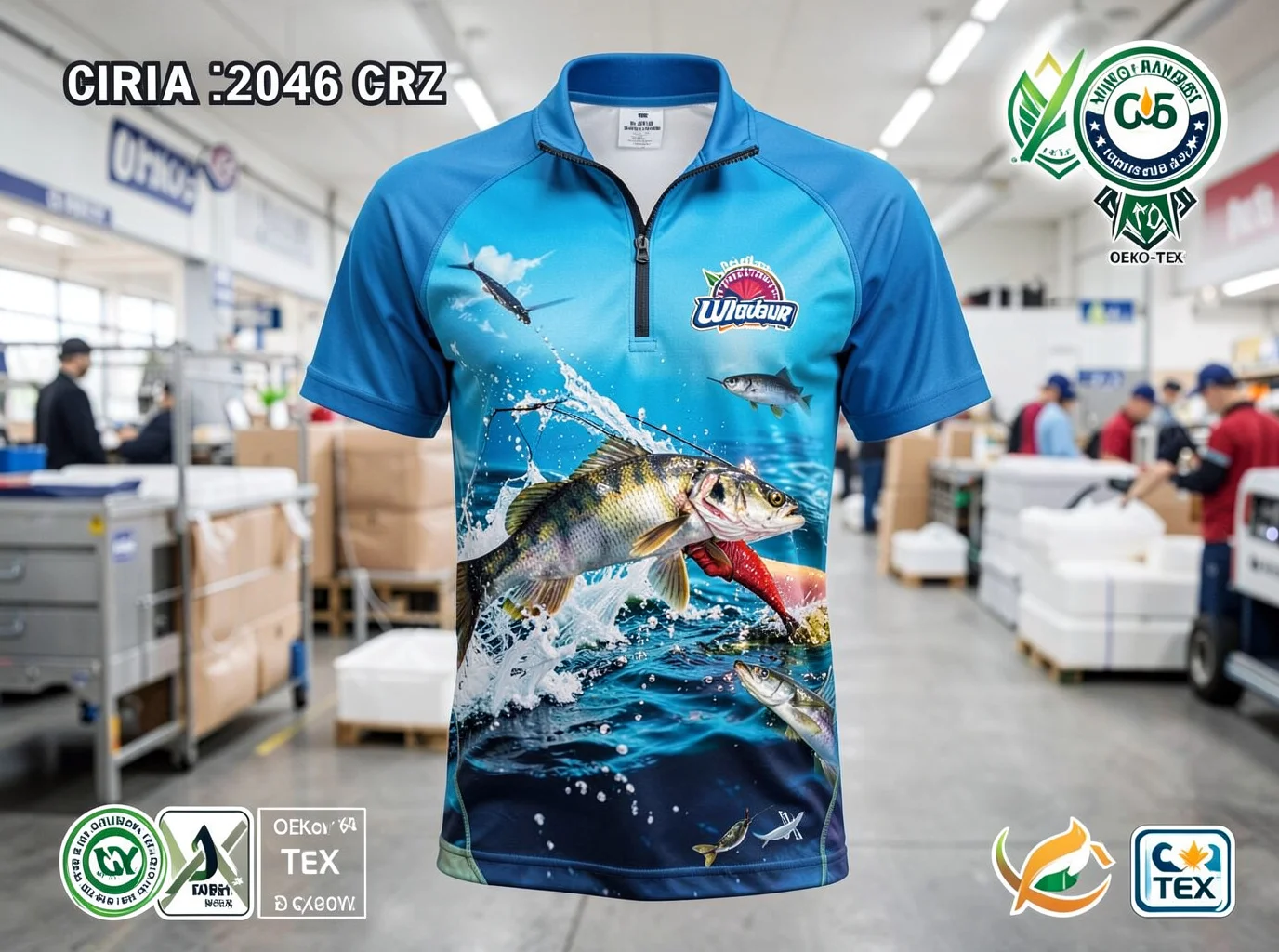
China's low prices on custom fishing shirts come from mature manufacturing clusters, vertical supply chains, and decades of scaled production experience. The real risk is skipping due diligence and partnering with the wrong fishing shirts factory.
Cheap doesn't have to mean risky, and expensive doesn't guarantee quality. Vet your fishing apparel manufacturer China supplier the same way you'd vet a business partner. Check certifications, request samples, and clarify MOQs and lead times upfront.
You're building a supply chain relationship that can scale with your brand. Before you send that deposit, ask the hard questions, request references, and start with a small trial order.