You approved the sample. The colors looked right, the fabric felt solid, and the stitching passed a quick once-over. Three months later, 2,000 fishing jerseys arrive at your warehouse — and half of them are unwearable.
The sublimation has faded in patches. The moisture-wicking performance is gone. The chest logos are sitting a full centimeter off-center.
Sound familiar? This nightmare plays out more often than most fishing apparel suppliers will ever admit. fishing apparel buyers who move from sampling to bulk production face this risk every time.
The gap between a clean bulk order and a budget-killing disaster almost always comes down to five specific, preventable mistakes. These mistakes happen early — before production even starts, often before you realize there's a problem.
What follows is a field-tested breakdown of where deals go wrong. You'll see exactly what causes these failures, and what you can do to stop them before they eat your budget and your timeline.
Mistake #1: Approving a Single Weak Sample and Treating It as a Bulk Green Light
Here's a hard truth most OEM fishing wear manufacturers won't tell you: one approved sample proves almost nothing about your bulk order.
A single sample gives you zero confidence in what 2,000 units will look like. That's true if the sample wasn't made on the actual production line, with the actual bulk fabric lot, at full production speed. Zero. And yet buyers approve weak samples every single day — then treat that approval as a bulk green light.
The consequences are predictable. And expensive.
What "Weak Sample Approval" Costs You
Your approved sample may come from a different fabric roll than bulk. That alone can produce shade variation of 1–2 grades on a standard gray scale — showing up as a visible "tone jump" between lots. Fabric GSM can drift ±10–20 g/m² too. So the jerseys your customers receive feel thinner or heavier than what you signed off on.
Skip the wash test? Bulk can show 3–8% shrinkage after a standard consumer wash cycle. That's enough to push a size M into S territory — and enough to trigger a wave of returns that eats your margin fast.
Measurement drift is just as brutal. Lock every Point of Measure against your final size spec, or bulk will deviate ±2–3 cm on chest, length, and waist. Across 1,000 units, a 2 cm chest deviation can make 30–40% of pieces feel like the wrong size — completely off.
The Fix: Build a Structured Approval Sequence
Stop treating sample approval as a single yes/no decision. Replace it with a numeric approval system :
Lock specs with real numbers — not "match sample." Define fabric GSM (e.g., 180 ± 5 g/m²), shrinkage max 3%, colorfastness minimum Grade 4–5, and every key measurement with tight tolerances (±0.5–1.0 cm).
Demand a PP (Pre-Production) sample made on the actual production line, with actual bulk materials. That's your one legitimate bulk reference. Nothing else qualifies.
Approve a full size-set (XS–XL) before cutting bulk fabric. Grading errors caught at this stage cost nothing. Caught at the warehouse? They can push 20–50% of total units into unsaleable fit-fail territory.
Run at least one wash test on the sample before sign-off. Shrinkage exceeds 3–4%? Color bleeds? It fails — no exceptions.
Keep a sealed golden sample at your office. Your supplier keeps signed copies on the line. Every inspection compares bulk to that reference, side by side.
One weak sample approved under time pressure is one of the most reliable paths to a fishing jersey bulk order disaster . The fix isn't complicated — it just means refusing to skip steps because the production timeline feels tight.
Mistake #2: Submitting Vague Tech Packs That Leave Performance Specs Open to Interpretation
Every factory will build what your tech pack tells them to build. The problem? Most tech packs are full of language that tells them almost nothing.
Words like "standard," "midweight," "moisture-wicking," "good stretch," and "as shown" are not specifications. They are open invitations for a factory to make its own decisions — and those decisions will not match what you had in mind.
This is how fishing apparel buyers lose control of their bulk order before the first piece is cut.
The Hidden Cost of Ambiguous Language
Vague performance specs leave gaps. Factories fill those gaps with whatever is most convenient, most available, or cheapest at the time.
Here's what that looks like in practice:
No tolerance defined on your chest measurement? The factory sets its own — ±1–1.5 cm on knits is the norm. Your garments pass their internal QC and still feel wrong to your customers.
Fabric listed as "poly jersey, moisture-wicking" with no further detail? The factory swaps in a similar fabric. You get the wrong GSM, the wrong stretch %, the wrong finish — and none of it is their fault on paper.
No measurement method or tolerance specified? A sizing deviation of 2–3 cm on key Points of Measure is normal. That's not a small error. Across a bulk fishing jersey order, it's a returns disaster waiting to happen.
Vague vs. Precise: What Your Specs Need to Say
The fix is not complicated. It's just more specific. Here's what that looks like:
Fabric spec for a performance fishing top:
- ❌ Vague: "Moisture-wicking poly spandex, midweight."
- ✅ Precise: "88% polyester / 12% spandex, circular knit interlock, 220 GSM , wicking finish, 4-way stretch, stretch ≥ 60% width / ≥ 40% length, colorfastness to washing grade 4–5 , pilling grade ≥ 4 , vendor code ABC-2210."
Neckline and rib performance:
- ❌ Vague: "Crew neckline with rib, standard stretch."
- ✅ Precise: "Crew neckline, finished width 7 in (size M), rib 1×1, 95% cotton / 5% elastane, 280 GSM , stretch ≥ 70% in width, recovery ≥ 90% after 30 seconds, tolerance ±¼ in on finished width."
Chest measurement:
- ❌ Vague: "Chest 52 cm."
- ✅ Precise: Base size M, measured 2.5 cm below armhole, garment laid flat , graded +2 cm per size up , tolerance ±1 cm (reject below 51 cm or above 53 cm).
That level of detail is not excessive. It's what separates a clean bulk production run from a custom fishing shirt production cost nightmare.
The 4-Part Spec Audit Your Tech Pack Needs
Before you submit your next tech pack to any OEM fishing wear manufacturer, run it through this quick audit:
Hunt down every subjective word. Search for standard, normal, approx, midweight, stretchy, breathable, high quality. Replace each one with a number, a test result, or a named standard. "Midweight" becomes 180–220 GSM . "High stretch" becomes ≥ 60% elongation .
Rebuild every fabric line using the 5-part format: fiber % (to 1% accuracy) → construction → GSM (±5 GSM) → finish → performance targets + vendor code. No vendor code means the factory can swap in a "similar" fabric without breaking any rules — and they will.
Give every Point of Measure a clear description, full size breakdown, grading rule, and numeric tolerance. Attach a one-page How-To-Measure guide with flat sketches. Measuring the chest at the armhole versus 2.5 cm below it can produce a 2–3 cm difference. That's enough to push garments outside acceptable range.
Connect every performance spec to your QC acceptance criteria. Colorfastness to washing must hit grade 4–5 . Pilling resistance must hold at grade ≥ 4 . Those numbers belong in the tech pack — not just in a verbal conversation with your supplier.
A vague tech pack is not just a communication problem. It's a fishing apparel quality control failure built into the process before production starts. The factory produces to what's written. Make sure what's written reflects what you need.
Mistake #3: Selecting Fabric and Trims Based on Appearance Alone, Without Performance Testing
Fabric that looks premium in a swatch can destroy your bulk order in a single wash cycle. This is one of the most expensive lessons in fishing apparel quality control — and it's 100% preventable.
Most buyers touch a sample, hold it up to the light, and move on. That's not fabric selection. That's guessing with money. Performance fishing wear lives in brutal conditions: salt water, sun exposure, repeated washing, aggressive movement. A fabric that looks right but hasn't been tested for shrinkage, stretch recovery, or colorfastness will fail your customers. And it will come back to you as returns.
Here's where the gaps show up — and what to do instead.
What "Looks Good" Actually Costs You
Here are real failure scenarios worth knowing:
A soft knit with no recovery testing → knees and elbows bag out after a few wears. Your customers don't contact the manufacturer. They contact you.
A deep-colored fishing jersey chosen for color richness → high crocking. After 10 rub strokes on a damp white cloth, the dye transfers onto skin and other fabric. That's a returns disaster after the first wash.
Decorative metal trims that skip corrosion testing → rusted hardware after repeated sweat and water exposure. On a custom fishing shirt, that's a one-star review and a lost repeat customer.
Lightweight fabric approved because it drapes well, with no check on GSM or seam performance → seam slippage under moderate stress , plus visible needle holes on stretch zones.
None of these failures are hidden. Every one of them shows up in testing. The buyers who avoided them ran the tests. The ones who didn't are still explaining it to their clients.
The Performance Data You Must Collect Before Approving Any Fabric
Stop relying on supplier descriptions. Pull the actual technical data sheet for every fabric candidate. At minimum, confirm:
Fiber composition (exact % — not "polyester blend")
GSM — light performance tops: 120–180 GSM; heavier fishing knits: 180–250 GSM. Record this on your spec sheet every time, no exceptions
Construction type — jersey, interlock, rib, stretch woven
Applied finishes — moisture-wicking, anti-pilling, water-repellent coating, UV treatment
That's the baseline. Now run your own tests.
Four Tests That Catch Failures Before Bulk Production
1. Wash & Shrinkage Test
Cut a 20×20 cm square of sample yardage. Record the exact dimensions. Wash and dry using realistic customer care conditions — 40°C wash, tumble dry low. Re-measure. Target: ≤3–5% shrinkage in both directions. Exceed that threshold? Adjust your pattern grading or reject the fabric. Catching this at the sample stage costs almost nothing. Catching it at the warehouse costs everything.
2. Stretch & Recovery Test
Mark a 4-inch section on your knit or rib fabric. Stretch it to 6 inches (50% elongation), hold for 5 seconds, release, and wait 30 seconds. Remeasure. Good recovery means the fabric returns to ≥95% of its original length. Still stretched beyond 4.2 inches? That fabric will bag out on your customers' elbows and knees after a few wears.
3. Crocking / Colorfastness Test
Dampen a white cotton cloth. Rub it across the fabric surface for 10 full strokes with steady pressure. Any dye transfer is a red flag — watch this closely on dark fishing jerseys placed against light panels. Run this same test on your trims: zipper tapes, elastic, labels. Colorfastness failures on trims stain the main fabric after washing. That's not a factory problem. That's your problem.
4. Seam Integrity Test
Sew at least 30–50 cm of straight seam on your actual production machine settings. Inspect for fraying, puckering, and needle holes on knit zones. Then pull the seam edges apart by hand. Easy slippage means the seams risk opening under real-use stress. Record the needle type, stitch length, and tension settings that perform best — those go straight into your production notes.
Build a Fabric Comparison Grid — Not a "Feel" Preference
Before approving any fabric for a fishing apparel bulk order, run every candidate through a structured comparison grid:
Criteria | Fabric A | Fabric B | Fabric C |
|---|---|---|---|
GSM | 210 | 185 | 220 |
Shrinkage % | 2.5% | 6.1% ❌ | 3.0% |
Stretch recovery | 97% | 94% | 96% |
Colorfastness | Grade 4–5 | Grade 3 ❌ | Grade 4–5 |
Seam performance | Pass | Pass | Pass |
Cost/meter | $X | $X | $X |
Score each fabric 1–5 across four areas: durability, maintenance, appearance consistency, and cost-effectiveness. Set a minimum composite score of 30/40 before approving. A fabric that can't hit that number on data doesn't belong in your order — no matter how good it looks on a hanger.
This isn't extra work. This is the work. Buyers who select fabric based on data scale with fewer losses. Buyers who go by appearance alone keep absorbing production problems they can't trace back to a cause.
Mistake #4: Skipping In-Line QC Checkpoints and Relying on Final Shipment Inspection Alone
Here's a number that should stop you cold: 100×.
That's how much more rework you face when a cutting defect gets caught at unit #1,000 instead of unit #10. Same defect. Same factory. Completely different outcome — because nobody checked during production.
This is the QC mistake that feels invisible until it isn't. Buyers approve the sample, hand off to the factory, then wait for the pre-shipment inspection report. Final inspection passes. Product ships. Somehow, thousands of fishing jerseys still land in the warehouse with misaligned chest logos, seams sewn at 7 SPI instead of 10, or size labels packed into the wrong cartons.
Final-only inspection never caught those problems. It was never built to.
Why Final Inspection Alone Is Broken by the Numbers
A standard AQL 2.5 pre-shipment inspection on a 10,000-piece fishing apparel bulk order checks 200 pieces — and can still accept up to 14 major defects. That means 90–99% of your lot never gets inspected.
No in-line QC means defective units stay in production. Those defects aren't isolated. They're systemic. A mis-aligned marker at cutting can affect 100% of panels cut from that layout — but final sampling sees a fraction of them.
The math is not on your side. Amazon FBA guidelines expect defect rates well under 1%. Final inspection alone, with no in-line process stabilization, makes that target close to impossible to hit with any regularity.
What In-Line QC Catches — At Each Stage
A structured IPQC (In-Process Quality Control) system doesn't replace final inspection. It makes final inspection reliable. Known defects get removed before they pile up.
Here's where checkpoints must exist in a fishing apparel bulk order:
Incoming fabric QC — Use the 4-Point System. Any fabric lot exceeding 40 penalty points per 100 yards gets quarantined before a single panel is cut.
Cutting QC — Inspect 3–5% of panels per lot for pattern alignment, cut dimensions, and notch placement. A mis-aligned marker caught here costs minutes. Caught at final? It costs a full re-cut.
Sewing QC — Check SPI (target: 10–12 stitches per inch ), seam integrity, and critical measurements at side seams and armholes, per bundle.
Finishing QC — Check pressing quality and run a full measurement check against spec. Cover every size and color in your defined sample.
Packing QC — Verify label accuracy, barcode scan readability, and carton assortment before sealing.
Skip any of these and you're not running quality control. You're running quality hope.
An In-Line Check Fails: The Four-Step Response
Every in-line failure needs an immediate response — not a note in a report. Here's the protocol:
Stop the operation. Production should not continue until you know the root cause.
Classify the defect — is it a machine setup issue or a systemic process failure?
Decide: rework the current batch or re-setup and restart. Document the decision with photos.
Re-inspect at the same checkpoint before resuming full production speed.
Miss this sequence and the problem surfaces at pre-shipment inspection instead. That means 100% re-sorting or re-sewing on the entire finished lot. It's a timeline disaster and a custom fishing shirt production cost hit, both at once.
The Shipment Release Standard You Should Enforce
Before any fishing clothing bulk order ships, your quality sign-off must confirm four things:
Zero open critical NCRs in the IPQC summary
All in-process and final NCRs are closed or risk-accepted on record
PSI disposition cross-checked against IPQC records — not treated as a standalone pass
Full chain-of-evidence sign-off : IQC + IPQC + PSI together, not PSI alone
A single final inspection number — pass or fail — tells you nothing about where in production quality broke down. Without DHU tracked by operation, you can't pinpoint the root cause. You can't fix what you can't see.
Build the checkpoints in. Track the numbers. Your sportswear bulk production timeline will hold — because you won't be absorbing rework disasters in the final week before shipment.
Mistake #5: Underestimating Factory Capacity, Production Timelines, and True Landed Cost
Buyers lose money on this one before the first stitch is sewn.
You've locked your specs. You've run your QC checkpoints. You've got a solid PP sample sitting on your desk. Then you place the bulk order — and the factory misses the delivery window by six weeks. Or the jerseys land with a true landed cost that's 30% above what you budgeted. Or both.
This mistake won't look like a mistake until it has already killed your launch window and your margin.
The Capacity Number You're Not Asking For
Most buyers ask a factory one question: Can you handle this order? The factory says yes. That's not capacity validation. That's a sales conversation.
What you need is line-level output data:
Rated units per hour × hours per shift (e.g., 1,200 units/hour × 8h = 9,600 units/shift)
Number of active lines and shifts (medium to large factories run 1–3 shifts)
Real cycle times observed on the line — not theoretical. A spec showing 20 seconds per operation may run at 23.5 seconds under real production conditions
Historical line utilization over the last 3–6 months — if average daily output runs at 78% of rated capacity, plan around that number. Not the rated figure
Your bottleneck operation — name the exact machine or process limiting throughput. Get its maximum output per day
One more metric worth knowing: OEE (Overall Equipment Effectiveness) . It tracks availability, performance, and quality together. That gives you the real usable capacity number — not the figure printed on a spec sheet.
Skip this data and you're scheduling a bulk fishing jersey order against a capacity estimate that has no connection to what the factory can deliver.
The Timeline Math Most Buyers Get Wrong
Here's how timelines fall apart: buyers plan to the factory's quoted lead time. They forget to add everything else.
For a standard international fishing apparel bulk order, the realistic door-to-door timeline breaks down like this:
Pre-production sample (PP sample): 2–4 weeks — made on the line with bulk materials
Mass production: 8–16 weeks depending on order volume and complexity
International ocean freight: 4–6+ weeks, depending on origin and destination port
Port congestion and customs buffer: add 5–10 days at minimum
Inland trucking and warehouse receiving: another 3–7 days
That's a realistic range of 14–22+ weeks from contract signing to product in your warehouse. Launching for a seasonal fishing window? You need to be talking to your OEM/ODM fishing wear manufacturer at least 3–6 months before peak season — not 3–6 weeks.
Add a 10–20% time buffer to every major segment — production, transit, and customs. That's standard industry practice. It's not padding. It's the difference between a smooth launch and an emergency air freight bill that eats your margin whole.
Your True Landed Cost Is Not Your FOB Price
This is where fishing apparel buyers get hit the hardest — and the most quietly.
Most buyers build their unit economics on: product cost + freight + import duties. That number looks clean. It's also incomplete.
Here's what the full landed cost formula includes:
Landed Cost = Product Cost + Shipping + Duties + Taxes + Port Fees + Terminal Handling + Customs Broker Fees + Insurance + Bank/FX Fees + Inland Trucking + Warehouse Receiving + Storage + Fulfillment
The line items most buyers miss:
Port and terminal handling charges: $50–$150 per container
Cargo insurance: 0.3–1.0% of cargo value
Warehouse receiving: $0.10–$0.50 per unit
Storage: $10–$20 per pallet/month
DTC fulfillment (pick/pack + shipping): often $4–$10 per parcel
Capital cost of inventory in transit: at a 10% annual cost of capital, every extra week of transit is money sitting idle
Miss even half of these line items and your real landed cost can jump 15–30% above your FOB-based budget estimate — enough to wipe out margin on an entire custom fishing shirt production run.
Build a fixed landed-cost template in a spreadsheet. Lock in fields for every cost bucket: SKU, PO number, Incoterms, freight, duties, fees, insurance, handling, and time-cost. Run it on every order. Then track estimated vs. actual landed cost after each shipment. Update your assumptions based on real variance.
Stress-testing a new performance fishing wear supplier? Run three scenarios before signing anything: +20% freight, +20% transit time, and a 3–5 point increase in duties or surcharges. Margin holds across all three? You have a solid unit economics model. It doesn't? You've caught a problem before it becomes a loss.
The five mistakes in this guide — weak sample approval, vague tech packs, appearance-only fabric selection, skipped in-line QC, and underestimated capacity and cost — are not random bad luck. They're predictable. Every one of them is avoidable with the right process in place before production starts.
The Complete Sampling-to-Bulk Procurement Checklist for Fishing Apparel Buyers
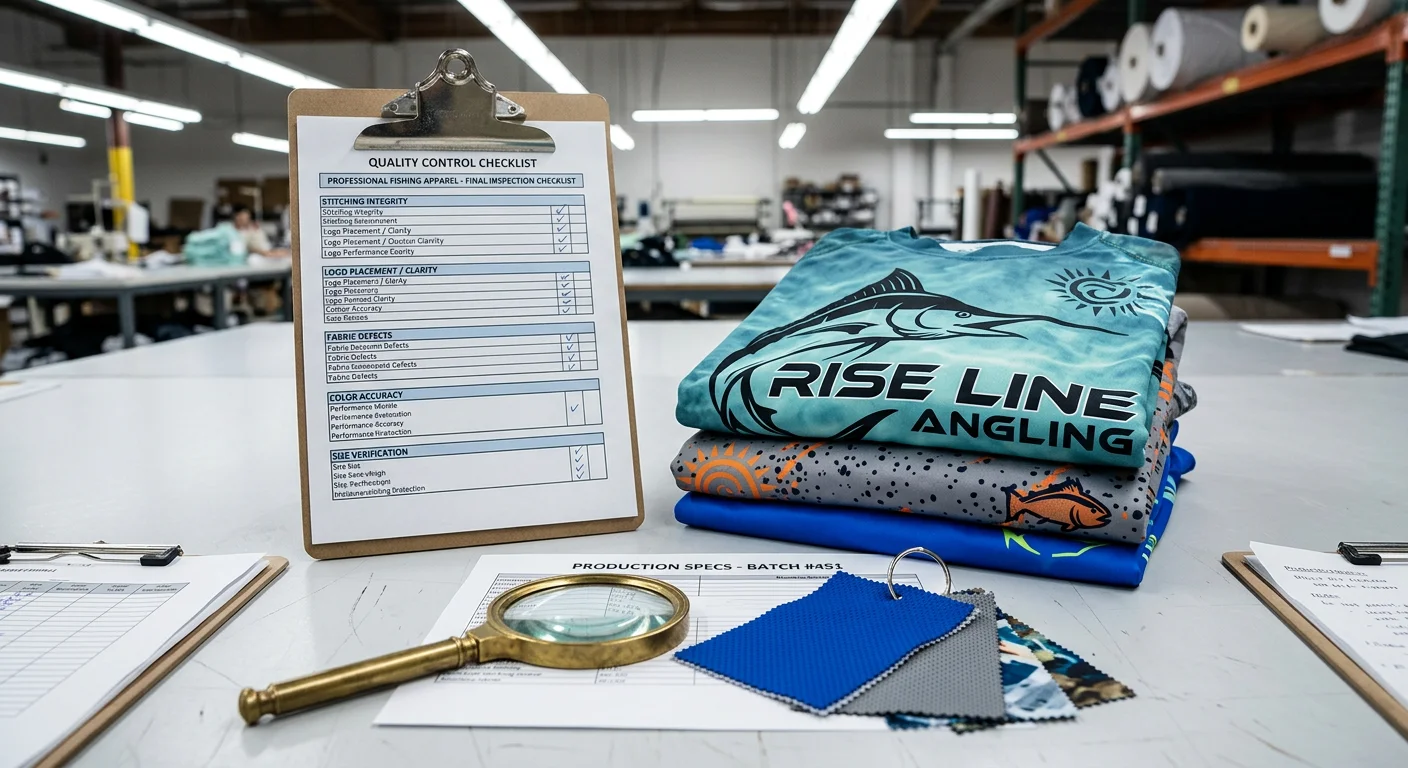
Every mistake in this guide has a paper trail. The buyers who avoid them aren't luckier — they're more systematic. Use this checklist before you sign off on any bulk release.
Pre-Production: Lock Everything Before Sampling Starts
Freeze your tech pack — fabric, GSM, trims, finishes, tolerances. No moving targets once sampling begins.
Set fishing-specific performance minimums in writing:
UPF rating: UPF 30–50+ , tested to AATCC 183
Sun shirts: 120–160 GSM | Hoodies: 180–230 GSM | Rain shell: 90–140 GSM
Waterproof minimum: 10,000 mm hydrostatic head. Breathability: 8,000–15,000 g/m²/24h
Knit stretch for casting mobility: ≥20–30% . Recovery ≥90% after 50 cycles
Critical POMs tolerance: ±0.5 cm on chest, body length, sleeve length
Require corrosion-resistant hardware (YKK or equivalent). All metal parts need a 48–72-hour salt-spray test on record.
Sample Approval: Four Stages, No Shortcuts
Don't treat sampling as a single event. Run all four stages:
Prototype — verify pocket placement, hood shape, basic fit
Fit/size set — full S–3XL run. Check casting mobility and sleeve coverage over rod grip
Pre-production sample — built with actual bulk fabric, trims, and your chosen decoration method (sublimation, silicone print, or embroidery)
Production sample — pulled from the bulk cut line, not the sample room
Check these points before any bulk authorization:
- ✅ Same fabric composition, GSM, and knit/weave structure as bulk
- ✅ Identical trims: zippers, snaps, cord locks, reflective tape
- ✅ Made by the production team — not the sample room alone
- ✅ Sealed and kept as the physical bulk QC reference
Performance Testing: Data Over Instinct
Get these results in writing before approving any fabric for your fishing apparel bulk order . Don't rely on a supplier's spec sheet. Ask for actual test reports:
Test | Target |
|---|---|
Shrinkage (knit tops) | ≤ 3–5% per direction |
Shrinkage (woven shells) | ≤ 2–3% per direction |
Pilling resistance | ≥ 15,000–20,000 Martindale rubs |
Color accuracy | Delta E ≤ 1.5 vs. Pantone standard |
Moisture dry time | Full drying within 30–60 min |
Odor control (if specified) | ≥ 99% bacterial reduction |
Seam strength (high-stress zones) | ≥ 120–150 N |
Also run UV exposure (20–40 hours minimum) and saltwater soak tests. These reflect real fishing conditions — not showroom conditions.
Trims, Labels, and Packaging: The Details That Sink Shipments
Zipper pull strength: ≥ 70–100 N . Snap fastener strength: ≥ 50–70 N
Hang tag pull resistance: tags must hold under 5–10 kg of force without detaching
Polybag sizing: oversize by ≤ 10–15% of the folded garment to stop shifting
Check that barcode, style code, size, and color print matches spec — do this before sealing a single carton
Final Go/No-Go: Do Not Release Bulk If Any of These Are Open
❌ Shoulder tightness or restricted casting motion
❌ GSM deviation outside tolerance, failed UPF or waterproof test
❌ Misaligned logos, peeling transfers, or blurred artwork
❌ Skipped stitches or seam slippage in stretch zones
❌ Trims or packaging that don't match the sealed sample
Scale-Up: Maintain the Same Standards, Not Looser Ones
Use AQL 2.5–4.0 across your bulk inspection. Pull 2–5 pieces per color per lot and re-test waterproof performance and UPF — not just at the sample stage. Your sealed reference sample stays the visual and functional standard at every incoming inspection.
MOQ reality check: Most performance fishing wear suppliers require 200–300 pcs per color/size at minimum. For new styles, a 100–500 piece trial batch per color run is a smart step before committing to full volume. It reduces risk and gives you real production data.
Plan for 3 sample rounds per style — initial, revised, and final approval. Build that into your sportswear bulk production timeline from day one. Your schedule stays on track. Revision cycles won't derail it.
Ready to move from sampling to bulk without the losses? The team at runfishapparel.com works with fishing apparel brands at every stage — from tech pack development and pre-production sampling to in-line QC and final shipment release. Your quality standards are non-negotiable to us. Get in touch here.
Conclusion
The gap between a perfect sample and a flawless bulk order isn't luck — it's process.
Every mistake covered in this guide has the same root cause: assumptions treated as agreements. Vague tech packs, skipped QC checkpoints, and underestimated timelines don't just delay shipments. They eat into your margins, damage your brand reputation, and break your customers' trust.
The buyers who win in fishing apparel bulk production aren't smarter. They're more systematic. They validate before they commit. They document before they approve. They inspect before they ship.
Now it's your turn.
Take the procurement checklist above and make it your standard for every order. Use it for your first run of custom fishing shirts . Use it when scaling an established line. No exceptions.
Want a manufacturing partner who already knows these standards? runfishapparel.com is where serious buyers start.
Don't let the next bulk order teach you lessons this guide already covered.