The wrong manufacturing partner doesn't just cut into your margins — it can stop your fishing apparel brand cold before it builds any momentum.
Fishing apparel factories in Vietnam and China versus nearshore options in Mexico or Central America — this choice runs much deeper than per-unit cost. Tariffs, lead times, quality oversight, MOQ thresholds, and IP exposure all shape your supply chain's true cost. They also affect how fast your brand can respond when the market shifts.
This guide breaks the offshore vs. nearshore fishing apparel manufacturing decision into a clear, step-by-step framework. You'll stop guessing and start building a sourcing strategy that fits exactly where your brand stands today.
Offshore vs Nearshore Fishing Apparel Manufacturing: Side-by-Side Comparison Table
Seven variables separate a profitable fishing apparel brand from one that bleeds cash on every shipment. The table below puts each critical dimension side by side — so you can see where each manufacturing path wins, loses, and surprises you.
Factor | Offshore (Asia: China, Vietnam, Bangladesh) | Nearshore (Mexico, Central America, Portugal/EU) | Best Fit |
|---|---|---|---|
FOB Unit Cost (180gsm UPF fishing shirt, 5,000+ pcs) | US$2.50–3.50/pc | US$3.50–4.50/pc (Mexico/CA); €4–6/pc (Portugal) | Cost-sensitive brands under $40 retail → offshore |
Total Landed Cost (5,000 cotton tees, US brand, China vs. Mexico) | ~US$5.60/pc (after tariffs, freight, insurance) | ~US$4.60/pc — 11.4% cheaper than China post-Section 301 | Mid-size US brands ($5M–$50M revenue) → nearshore wins |
Average Lead Time (PO to US warehouse) | ~14 weeks (98 days) | ~5 weeks (35 days); overland transit just 3–10 days | Fast-turn fishing lifestyle brands → nearshore |
In-Season Replenishment Window | 8–10 weeks minimum; mid-season pivots carry high cost | 3–5 weeks; weather-driven and fishing-season spikes are manageable | Brands selling into peak fishing seasons → nearshore |
Typical MOQ (per style/colorway) | 1,000–3,000+ pcs; some knit/performance lines require 5,000+ | 300–500 pcs (Mexico/CA); as low as 50–200 pcs (Portugal) for capsule testing | New brands, club jerseys, style validation → nearshore |
Defect Rate (first-order data, 2026 audits) | China: 2.4%; Vietnam: 2.7% | Mexico: 3.1%; Guatemala: 3.6%; Honduras: 4.0% — drops by batch 5 | Strict QC at scale → offshore slight edge; design-driven brands → nearshore closes gap fast |
Time Zone Alignment (US brand perspective) | 12–15 hour gap; live fabric reviews often happen at midnight | 0–3 hour gap; real-time sampling calls, fit reviews, and print approvals are practical | Brands updating UPF prints and patterns often → nearshore |
IP & Pattern Protection | Higher risk of design diffusion; cross-border enforcement is slow and expensive | USMCA/EU legal frameworks give stronger contract enforceability; direct-sale conflicts can be blocked by contract | Brands with proprietary cuts, sublimated patterns, or exclusive fishing team graphics → nearshore |
Factory Visit Feasibility (US buyer self-inspection) | Transpacific flight + visa + language barriers; third-party QC often required | Mexico/CA: 1–2 day roundtrip is realistic; builds direct QC checkpoints | Small teams needing hands-on UPF seam and stitching oversight → nearshore |
Tariff Exposure (US market) | Section 301 + potential additional duties add 10–18% to landed cost | USMCA/CAFTA-DR: 0–low tariff on cotton knitwear; 10–18% total landed cost advantage over China | High-volume US cotton fishing tees and UPF shirts → nearshore |
Freight Cost Stability | Ocean freight is volatile; port congestion and geopolitical events spike insurance surcharges | Overland-dominant; more predictable cost structure, lower markdown risk | Conservative financial models → nearshore |
Functional Fabric Access (UPF, DWR, quick-dry, anti-salt hardware) | Strong supply base: polyester microfiber, coated waterproofs, anti-corrosion zippers all sourced in-region | Getting better each year, but some advanced composite fabrics still need importing | Technical multi-piece performance kits → offshore; UPF print tees, shorts, hats → nearshore |
Ideal SKU Volume per Style | 10,000+ units/year per style (classic sun shirts, basic quick-dry tees) | 500–5,000 units; frequent colorway or graphic updates | Evergreen basics at retail chain scale → offshore; limited drops and community-driven styles → nearshore |
Capital Requirement & Cash Flow | 1,000 pcs × US$10 = US$10,000 upfront; heavy markdown risk if styles miss | 100–300 pcs × US$25 = US$2,500 to start ; validates styles before scaling | Bootstrapped or early-stage fishing apparel brands → nearshore to start |
What the Numbers Mean for Your Brand
Two data points from the table deserve a closer look before you move on.
First: the landed cost inversion. Asian factories look cheaper on paper at $2.50–3.50/pc FOB. Add Section 301 tariffs, ocean freight, port insurance, and US customs clearance, though — a China-routed 180gsm fishing tee lands at $5.60/pc. That same shirt from Mexico, at a higher FOB, clears US customs at $4.60/pc under USMCA. That's not a rounding error. At 5,000 units, you're looking at a $5,000 difference before you've sold a single shirt.
Second: the MOQ math for new brands. Offshore factories with 1,000–3,000 piece minimums push an early-stage brand to commit US$10,000+ to an unvalidated style. Nearshore partners that accept 100–300 pieces cut that entry cost to $2,500. The risk profile isn't just different — it's a completely different business model.
The right column in this table isn't offshore or nearshore. It's which tradeoffs your brand can afford to absorb right now.
True Cost Breakdown: Why Unit Price Is Not the Full Picture in Fishing Apparel Manufacturing
That $20 FOB quote from a Chinese fishing factory looks clean on a spreadsheet. It isn't.
By the time a fishing jacket clears US customs, crosses the dock, and arrives at your warehouse, that $20 unit has become $28.14. Here's where the money goes:
Ocean freight: +$2.00
US customs duties on synthetic fishing apparel (HS 6110/6201) at 18%: +$3.60
Port handling and brokerage: +$0.60
Marine insurance: +$0.14
Domestic trucking: +$0.60
AQL inspection rejects run at a 2.4–2.7% rate on first offshore orders. Rework and replacement add $0.40 to $1.80 per unit on top of that.
Freight and duty alone add 41% to your FOB price. That's not a footnote. That's your actual margin problem.
The nearshore math flips this. A comparable jacket sourced from Mexico starts at $24.00 FOB — 20% higher ex-factory. But the numbers shift fast:
USMCA cuts the duty to 3% — or zero for garments that fully qualify
Truck freight runs 4% of FOB instead of 10%
QC travel and inspection drop from 6% to 3% — a US buyer can do a roundtrip factory visit in a single day
Total add-ons: $3.36 per unit
True landed cost: $27.36 — or $26.64 at full USMCA qualification
The factory charging more per unit delivers a lower landed cost. That's not a paradox. It's supply chain math.
Across a 1,000-unit run, that gap puts $780 to $2,580 back in your pocket . And that's before markdowns on unsellable inventory. Sizing variance and spec drift on technical garments can push your true per-unit cost up another 5–11% once you write off stock that won't sell.
One data point worth building into your sourcing process: across 47 competitive apparel bids in 2024–2025, the second or third-cheapest FOB quote produced the lowest landed cost 60% of the time. Factories with higher quotes delivered better quality, shorter transit, and fewer chargebacks. That means lower real cost per garment shipped and sold.
Use this formula every time you evaluate a fishing apparel vendor:
LC_unit = FOB + Freight + Duty + Port/Broker + Insurance + QC + Domestic Trucking + (AQL failure costs ÷ total units)
Compare factories on that number. Not the quote.
Lead Times and Supply Chain Flexibility for Fishing Apparel Brands
Fishing apparel runs on seasons. Miss the window, and no amount of great product saves you.
That's the core problem with Asia offshore lead times. A sublimated long-sleeve fishing jersey — custom graphics, articulated panels, sponsor placement — takes 90 to 125 days from purchase order to US warehouse under normal conditions. Red Sea or Hormuz disruptions push that to 140+ days . Ocean freight alone adds 30 to 40 days on top of 45 to 60 days of bulk production.
Nearshore flips the calendar. The same jersey routed through Central America lands in 55 to 70 days by sea, or 40 to 60 days by air . Sampling drops from 15–25 days offshore to 7–15 days nearshore . That's not a small efficiency gain. It's the difference between capitalizing on a viral product moment and watching a competitor take it instead.
Where the Lead Time Gap Costs You Money
Tournament teams often confirm sponsor rosters just 4 to 8 weeks before an event . Asia offshore pipelines require designs locked 90 to 120 days out. Last-minute logo changes become impossible without emergency air freight. That eats your margin fast.
Fast replenishment is the other pressure point. A UPF sun hoodie sells out after a weather spike or social post. Your customers don't wait 100 days. Nearshore partners can repeat production within 30 to 45 days — so a sell-out becomes a reorder. With offshore timelines, it becomes a markdown problem next season.
DTC fishing apparel brands get a real advantage here. Nearshore MOQs of 50 to 150 pieces per colorway let you test a new style, read 2 to 4 weeks of real sales data, and replenish within the same fishing season. Offshore's 300 to 500-piece minimums force year-ahead commitment on styles the market hasn't proven yet.
The sourcing split that works in practice:
- Route high-volume staple styles — classic logo tees, basic quick-dry shirts — through Asia with 4 to 6 months of forward planning
- Reserve nearshore capacity for tournament jerseys, fast-moving replenishment SKUs, and styles tied to a hard event date
That hybrid structure keeps your cost base competitive. More importantly, it protects your brand from the one thing offshore can't fix: time.
Quality Control and Factory Capability for Performance Fishing Wear Production
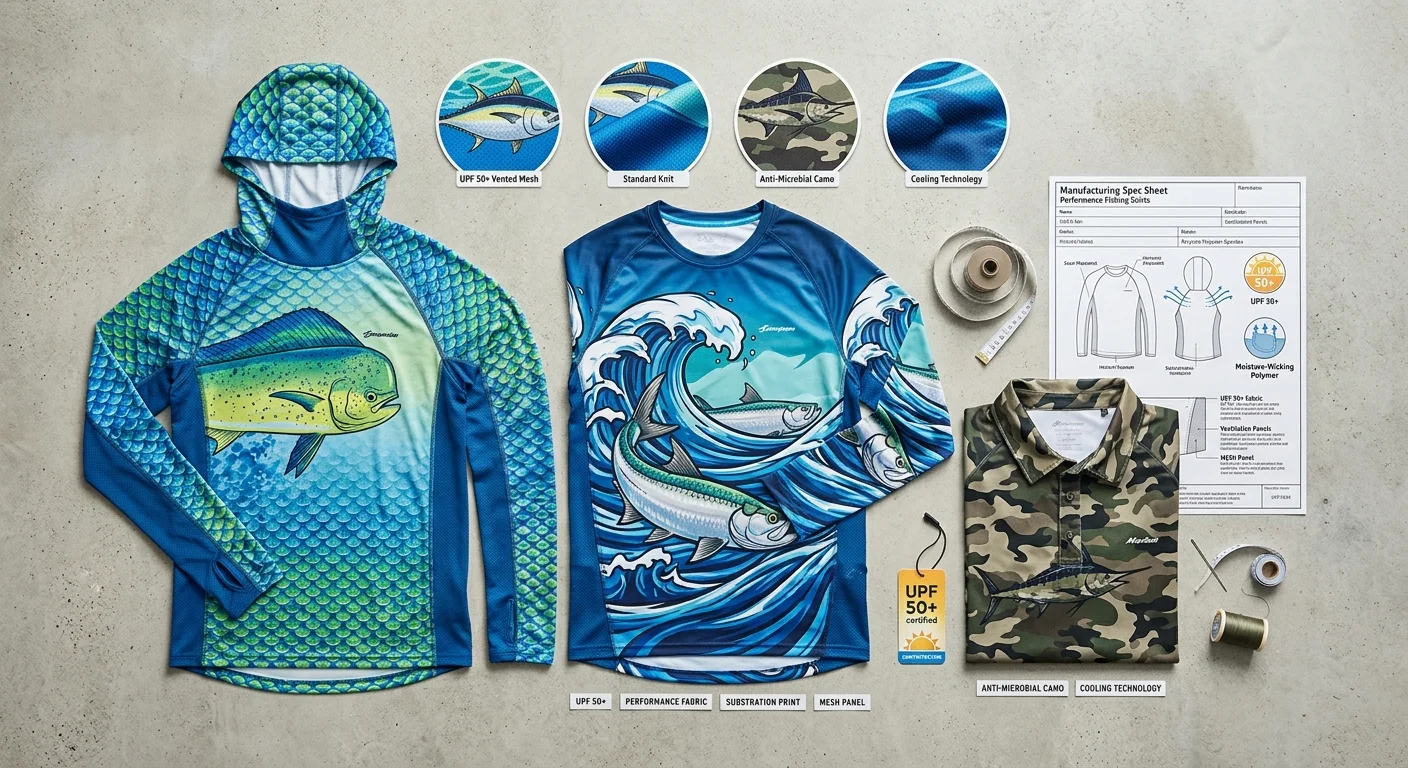
Performance fishing wear isn't regular apparel. A plain cotton tee delivers UPF 5–7 and blocks maybe 20% of UV radiation. A purpose-built UPF 50+ fishing shirt blocks 98% or more. That gap isn't marketing language — it's the difference between a product that protects your customer on the water and one that silently lets them down. That gap lives inside your factory's technical capability. Nothing else.
Here's where offshore and nearshore manufacturing split hard.
UPF and Functional Fabric: Where Asian Factories Lead
Large Asian performance fabric mills have built serious infrastructure around UPF verification. UV-Vis spectrophotometers, wash fastness testers, perspiration resistance equipment — these aren't optional add-ons. They're standard. For every new fabric run, expect a minimum of two rolls sampled at three test points each. Batch-to-batch UPF variance stays within ±5–10%.
Moisture management specs are just as demanding. High-performance fishing shirts target:
Wicking rate : ≥150–200 mm per 30 minutes
Evaporation rate : ≥0.5–0.8 g/h·dm²
Moisture vapor transmission : ≥5,000–10,000 g/m²/24h
Asian functional fabric factories hit these benchmarks as standard practice. They use cross-section polyester fibers and hydrophilic finishes, tested to AATCC 195 standards. Documented tolerances go into every spec sheet — not just verbal claims.
Most nearshore mills can't match this yet. The majority source finished performance fabrics from third-party fishing apparel suppliers and accept vendor-provided spec claims instead of running independent tests. Nearshore QC focuses on garment dimensions and stitching — not fabric function. For a fishing hoodie where UPF performance is the core promise, that's a real gap.
Sublimation Print Precision: The Numbers That Matter
Fishing jerseys live or die on sublimation quality. Tournament sponsors, custom graphics, and sponsor placement demand precision. Most buyers don't realize this until their first bad batch.
Industry-standard targets for performance fishing apparel sublimation:
Pattern placement tolerance : ≤3–5 mm
Color deviation : ΔE ≤2–3 against approved standard
Fabric distortion : <2–3% warp-to-weft differential
Specialized Asian sublimation factories hit these numbers with consistency. They run digital printers at 720–1,440 dpi resolution. Heat press conditions are controlled at 190–210°C for 30–45 seconds. Color accuracy gets measured with spectrophotometers. Pre-print fabric moisture content, pre-set weight, and shrinkage rates are logged per batch. The 4-point fabric inspection system catches substrate defects before a single print head fires.
Nearshore facilities without in-house sublimation lines outsource to local print shops. The result is predictable. Batch-to-batch color variance exceeds ΔE 3. Placement errors stretch to 5–10 mm — worst at sleeve-to-body seam junctions where continuous graphics must line up. QC comes down to a visual check and a handful of final-goods samples. No spectrophotometer. No statistical tracking.
Dimensional Control and Inline QC Structure
A complex performance fishing jacket can carry 15–25 points of measure (POM). Standard tolerance expectations:
Chest, waist, hem circumference : ±1.0–1.5 cm
Sleeve and body length : ±1.0 cm
Small details (cuffs, collar) : ±0.5 cm
Stitches per inch : 8–10 SPI for standard fishing shirts; 10–12 SPI for stretch performance tops, with reinforced double-stitching at shoulders, armholes, and side seams
Large offshore factories deploy three QC inspectors per production line — first piece, mid-run, and final check. Complex technical garments scale that up to 5–8 dedicated inspectors per line. Defect rates are tracked and managed against AQL 2.5–4.0 thresholds for major defects.
Mid-size nearshore factories run one to two end-line inspectors per line . At lower daily outputs — under 500 pieces per line — visual inspection coverage is solid. But systematic data collection, statistical defect tracking, and formal AQL sampling protocols are not in place at the same level.
Fixing Problems: The Cost Gap Nobody Talks About
Defect management costs land differently based on where your factory sits.
An offshore quality failure on 10,000 sublimated fishing shirts — print placement off by more than 10 mm, or UPF testing below 50 — carries a brutal cost structure:
Rework at origin : US$0.50–1.00/pc for simple fixes, plus 2–4 weeks of production delay
Functional failures (UPF, moisture management): often non-repairable — full remake required at original unit cost of US$7–10/pc
Return or destroy logistics : US$0.30–0.60/pc in freight and duty losses on a full container
Missed season : spring and summer fishing windows don't wait
Nearshore failures cost less to fix — in both time and money. A defect caught in production gets corrected same day . Tooling adjustments, pattern revisions, seam rework — these happen on-site. No three-to-seven-day email-and-third-party-inspection loop. Return freight runs US$0.05–0.10/pc overland versus US$0.30–0.60/pc transpacific.
Plus, nearshore's standard practice of 100–300 piece pilot runs before full production means structural defects don't reach batch scale in the first place. That alone changes the risk profile.
Third-Party Inspection vs. Direct Factory Access
Running offshore production means third-party QC agencies are a necessity. Firms operating in Asia charge US$280–350 per man-day — covering on-site inspection and formal report delivery within 24–48 hours. The standard workflow: submit your spec sheet, the agency samples 125–200 pieces from a 2,000-unit order at AQL 2.5, checks 100% of critical POM points, runs fast tests for seam strength and wash fastness, and delivers a pass/fail recommendation.
It works. But it adds cost, lead time, and one more layer of distance between your brand and your product.
Nearshore changes the math. A US-based brand within 200–500 km of a Mexican or Central American factory can visit once or twice a month — fly in, walk the line, confirm first pieces, and be back in the office that evening. Something needs fixing? The correction happens that afternoon. Not next week.
For fishing apparel brands that update UPF graphics on a tight schedule, run tournament-driven production cycles, or are still dialing in their technical specs — that direct access is worth more than any inspection report.
MOQ Requirements and What They Mean for Your Fishing Apparel Brand Stage
Minimum order quantities don't just set a production floor. They determine whether your fishing apparel brand launches with breathing room — or burns through its cash reserve before a single customer sees the product.
Here's the mechanic that matters: MOQ is calculated per style, per colorway — not as a total order. Launch 4 styles in 3 colors each and you're managing 12 separate MOQ commitments at the same time.
The Numbers Behind Each Manufacturing Path
Offshore Asian factories (China, Vietnam) require 800–2,000 pieces per style per color for functional performance fishing apparel. That threshold exists for a real reason. Fabric mills sell by the roll — 70–120 meters minimum. Factories need that volume to cover line changeovers, custom hardware, and material procurement. Drop below 500 pieces and most large export factories either refuse the order or add a US$500–1,000 small-order surcharge per run.
The price ladder reinforces this pressure:
≥2,000 pcs/colorway : ~US$4.00–4.50 FOB (standard UPF quick-dry fishing tee)
1,000–1,999 pcs : unit price climbs 8–15%
500–999 pcs : unit price jumps another 15–30% — or the factory declines outright
Nearshore factories in Mexico and Central America run on a different model. A mid-size Mexican cut-and-sew operation accepts 100–300 pieces per style per color . Some specialized micro-units go as low as 50 pieces per colorway . They pool fabric orders across multiple brands to hit mill minimums on their end. Unit prices run 20–40% higher than large Asian factories — but your total capital commitment drops by a large margin.
What This Math Looks Like for a Real Brand Launch
Run the numbers on a four-style, three-color debut line:
Offshore (Asia) | Nearshore (Mexico) | |
|---|---|---|
MOQ per SKU | 800 pcs | 150 pcs |
Total units produced | 9,600 pcs | 1,800 pcs |
Average unit cost | US$5.00 | US$6.00 |
Total capital required | US$48,000 | US$10,800 |
Budget consumed (of US$30K) | 160% — exceeds budget | 36% — leaves US$19,200 free |
That free capital isn't a bonus. It's your marketing budget, your reorder reserve, and your safety net against styles that don't move.
First-year brands miss demand forecasts by ±50–100% per SKU more often than not. At offshore MOQs, two underperforming colorways means thousands of units in dead inventory. At nearshore MOQs, the same miss means a few hundred pieces — a write-down, not a cash crisis.
Matching MOQ Strategy to Your Brand Stage
Early-stage brands (0–12 months): Keep production at 80–200 pieces per colorway . The goal isn't margin optimization — it's style validation. A 60–70% sell-through rate on a 150-piece run confirms the pattern before you scale it. Test 10–15 new graphics per season at nearshore quantities. That's a real product development engine, not a guessing game.
Growth-stage brands (US$1–5M annual revenue): Your proven bestsellers can now absorb offshore MOQs of 500–1,000 pieces per colorway . The scale justifies the unit cost savings. Push experimental styles and seasonal graphics through nearshore at low quantities. This dual-track approach keeps your cost base competitive without betting the season on unvalidated designs.
Established brands (US$5M+): Core volume styles scale to 2,000–5,000 pieces per colorway offshore. You capture the full price ladder advantage at that level. Set aside 10–20% of seasonal capacity for nearshore quick-turn production. That gives you fast iteration on new designs, rapid response to tournament-driven demand spikes, and capsule drops that don't need year-ahead forecasting.
One Tactic That Cuts Offshore MOQ Risk Without Switching Factories
Your offshore unit economics make sense for your volume — but the per-colorway MOQ is still blocking you. Fabric consolidation is the most direct solution here.
Group multiple styles around a shared base fabric — UPF 50+ coated knit for sun shirts, lightweight waterproof for rain layers, quick-dry stretch for fishing pants. A fabric mill's roll minimum of 800 meters translates to around 800–1,000 finished garments. Spread that volume across four styles at 200 pieces each. You've met the mill's requirement while keeping your commitment per style manageable.
The negotiation shifts from "can you accept 200 pieces per style?" to "here's 900 total pieces sharing the same fabric." Large Asian factories respond to the second framing. The first one gets rejected.
Limit your core fabric library to 2–3 materials across your entire line . Differentiate through cut, graphic, and end-use positioning — not fabric switching. That constraint makes offshore MOQs workable at earlier brand stages than most founders expect.
IP Protection and Design Confidentiality Risks in Fishing Apparel Manufacturing
Design theft in fishing apparel manufacturing doesn't announce itself. By the time you spot a competing product using your sublimation pattern or your proprietary UPF pocket structure, the damage is done.
Offshore manufacturing makes this risk worse. Most brand founders never see it coming.
How Designs Leak
The most common source isn't factory staff walking out with your files. It's undisclosed subcontracting .
Large export factories in Vietnam and China send overflow production to secondary facilities without telling you. These are facilities you never audited, never signed an NDA with, and never knew existed. Those subcontractors get your complete tech packs — pattern blocks, sublimation files, fabric specs, functional coating ratios. They have no contractual obligation to you. Sourcing auditors in Vietnam flag undisclosed subcontracting as the single most frequent IP exposure point across the region.
The second leak path is tech pack ownership . Your contract needs to state clearly that all pattern files, spec sheets, grading data, and development samples belong to you. Without that language, the factory can — and often will — claim shared rights after the relationship ends. That custom UPF quick-dry fishing hoodie construction you built together? Under vague contract language, the factory may treat it as part of their "accumulated process knowledge."
Functional fabric formulas carry a third risk. Anti-salt treatments, hydrophilic fiber blend ratios, DWR coating specifications — contract law can protect these as trade secrets. But your agreement has to define them as such, in clear terms. Without that language, a fabric mill can take your formula straight to the next buyer.
Why Enforcement Fails Offshore — And What Works
Signing an NDA with a Chinese or Vietnamese factory feels like protection. It rarely is.
Standard English-language NDAs with phrases like "shall not disclose or use confidential information" carry almost no enforcement weight in local courts. The real problem isn't the agreement itself — it's proving actual damages under a foreign legal standard. That takes expensive local counsel, translation, travel, and years of patience most brands can't afford.
Two mechanisms that do work:
Liquidated damages clauses — preset penalty amounts written into the contract, denominated in a recoverable currency, structured to avoid the "prove your actual loss" burden that kills most offshore IP claims.
Specific enumeration of protected assets — skip general NDA language. List what's covered: all vector and raster pattern files, graded spec sheets, fabric test reports, sample garments, production templates, and cloud backups. Courts and arbitration panels respond to specificity. Vague language gets dismissed.
Nearshore's Structural Advantage
USMCA and EU legal frameworks do more than reduce tariffs. They give fishing apparel brands enforceable contract rights in jurisdictions where injunctions get issued and damages get paid.
A US-based brand manufacturing in Mexico can file for injunctive relief in a court system with established precedent, familiar procedures, and no transpacific logistics overhead. That access changes your negotiating position with every factory you approach. They know enforcement is realistic, and that matters.
Nearshore manufacturing also cuts IP exposure through proximity. Monthly factory visits let you confirm production lines aren't running duplicate samples, no undisclosed subcontractors are in the chain, and your pattern files aren't sitting on a shared server. With offshore production, that same visibility costs three days of travel and $2,000 in flights. Nearshore, it's a roundtrip.
What's Worth Protecting — and How
Not everything in your fishing apparel line qualifies for IP protection. Basic garment silhouettes, standard colorways, and common structural elements are unprotectable in most jurisdictions — no matter how distinctive they feel to your team.
What holds up:
2D surface graphics — distinctive fish species camo, nautical chart prints, and original illustrated patterns qualify for design registration and, in some jurisdictions, copyright protection as separable artistic works
3D structural innovations — a multi-compartment tackle chest configuration or a proprietary vented brim geometry can be registered as an industrial design (up to 15-year term in Canada; Community Design in the EU covers unregistered works for 3 years from first disclosure)
Functional fabric formulas — document these as trade secrets in your contracts, with clear language covering fiber blend ratios, coating concentrations, and performance test data
The Segmented Development Model
For brands manufacturing offshore with proprietary designs, the most practical risk-reduction approach is segmented production disclosure . Split your full design into three separate modules:
Fabric system : share performance specs and base colorways with the fabric mill only — no patterns, no final garment templates
Pattern and construction : share graded spec sheets and structural files with the cut-and-sew factory — no sublimation artwork
Print and graphics : share complete artwork files with your dedicated print supplier of fishing apparel only — no access to final pattern blocks
No single factory holds the complete picture. Recreating your full product means coordinating across three separate suppliers. That's a practical barrier that stops most opportunistic copying.
Before You Sign Anything
Run these checks on every factory before sharing a single tech pack:
Does the factory run its own consumer brand in outdoor or performance apparel? That's the highest-risk profile — your design goes straight into a competing product line
Does the factory have a documented subcontracting policy? Require written disclosure of all downstream partners and cross-NDAs with each one
Is there any prior history of IP litigation with foreign brands? Ask straight out. Search PACER, EU court databases, and local trade press
Inside your contracts, require that all design assets — digital files, physical samples, production templates, and any backups — are either returned or certified-destroyed at termination. "Certified-destroyed" means a signed attestation covering cloud storage, not just physical samples.
Your fishing apparel patterns and performance specs are product assets. Give them the same contractual rigor you'd apply to a patent license — because in practice, that's what they are.
Which Manufacturing Model Fits Your Fishing Apparel Brand Stage?
Your brand stage is the variable that makes every other comparison in this guide click into place.
The offshore vs. nearshore decision isn't a fixed answer. It shifts as your revenue grows, your SKU count expands, and your cash position changes. Here's how to match the model to where you stand right now.
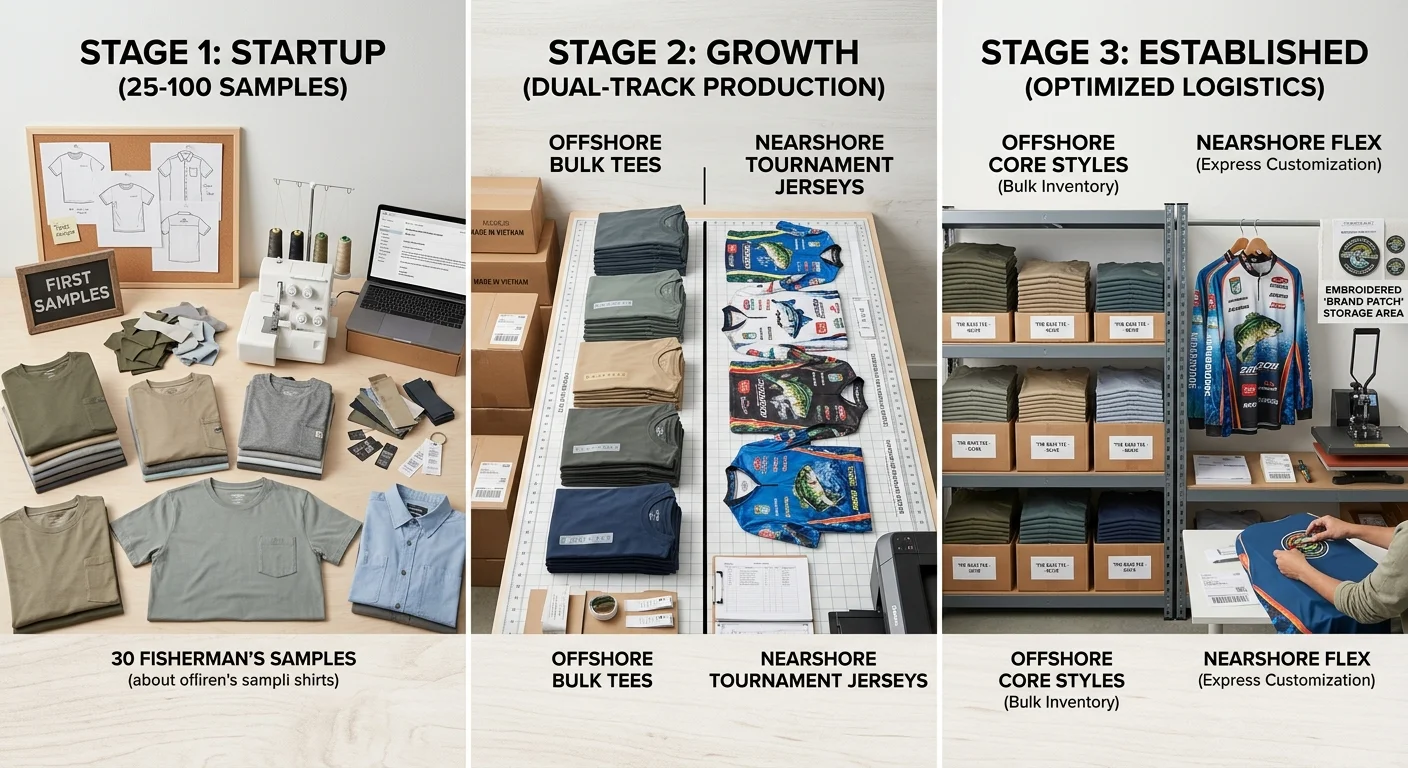
Starting Out: Low MOQ + Nearshore First
At launch, protecting capital beats cutting unit costs. Every time.
Keep your first production run between 25–100 pieces per style . That's enough to validate fit, fabric performance, and market response. You won't lock up cash in untested inventory. Start with one core style and one upgrade variation. Test your UPF fabric, your quick-dry performance, and your pocket layout at small scale. Lock those details down before committing to anything bigger.
Keep your initial SKU range tight: one size range, one colorway per style . Spreading too wide on your first order is how brands end up with dead stock in three colors nobody wanted.
Nearshore gives you the fast feedback loop this stage needs. Low MOQs, short lead times, and realistic factory visits let you iterate in real time. You're not waiting on a 14-week ocean freight cycle to find out what's wrong.
Growing: Run Both Tracks in Parallel
Your bestsellers are proven. Now the most effective structure is dual-track sourcing .
Route your high-volume core styles — basic UPF sun shirts, logo quick-dry tees — through offshore factories at 500+ pieces per colorway . The unit cost savings at that scale are real. Run your fast-turn capacity nearshore at 100–250 pieces per style for seasonal drops, tournament jerseys, and any style that hasn't earned a full offshore commit yet.
Classify every SKU before production: Track A for volume, Track B for speed. Technical fishing apparel with complex functional construction — articulated panels, vented structures, multi-layer UPF systems — should prototype nearshore first. Scale offshore once the spec is locked. That sequence cuts rework costs by a measurable margin.
Established Brand: Offshore Lead, Nearshore Flex
At scale, the question isn't cost per unit. It's sell-through rate, stockout cost, and premium line performance .
Your offshore factories carry the annual volume — core styles, long-run contracts, the SKUs that move on a reliable schedule. Your nearshore capacity handles regional replenishment, event-driven drops, and the high-margin limited lines that don't fit a 120-day offshore pipeline.
Keep 10–20% of your seasonal capacity nearshore. That reserve protects you against trending styles, tournament schedule changes, and fast-moving retail moments that offshore can't catch in time.
The quick-select framework:
- Brand just launching → nearshore or hybrid, 25–100 pcs/style
- Brand scaling → dual-track, volume offshore / fast-turn nearshore
- Brand established → offshore primary, nearshore regional flex
How RunFishApparel.com Supports Your Fishing Apparel Manufacturing Decision
runfishapparel.com was built for the decision you're working through right now.
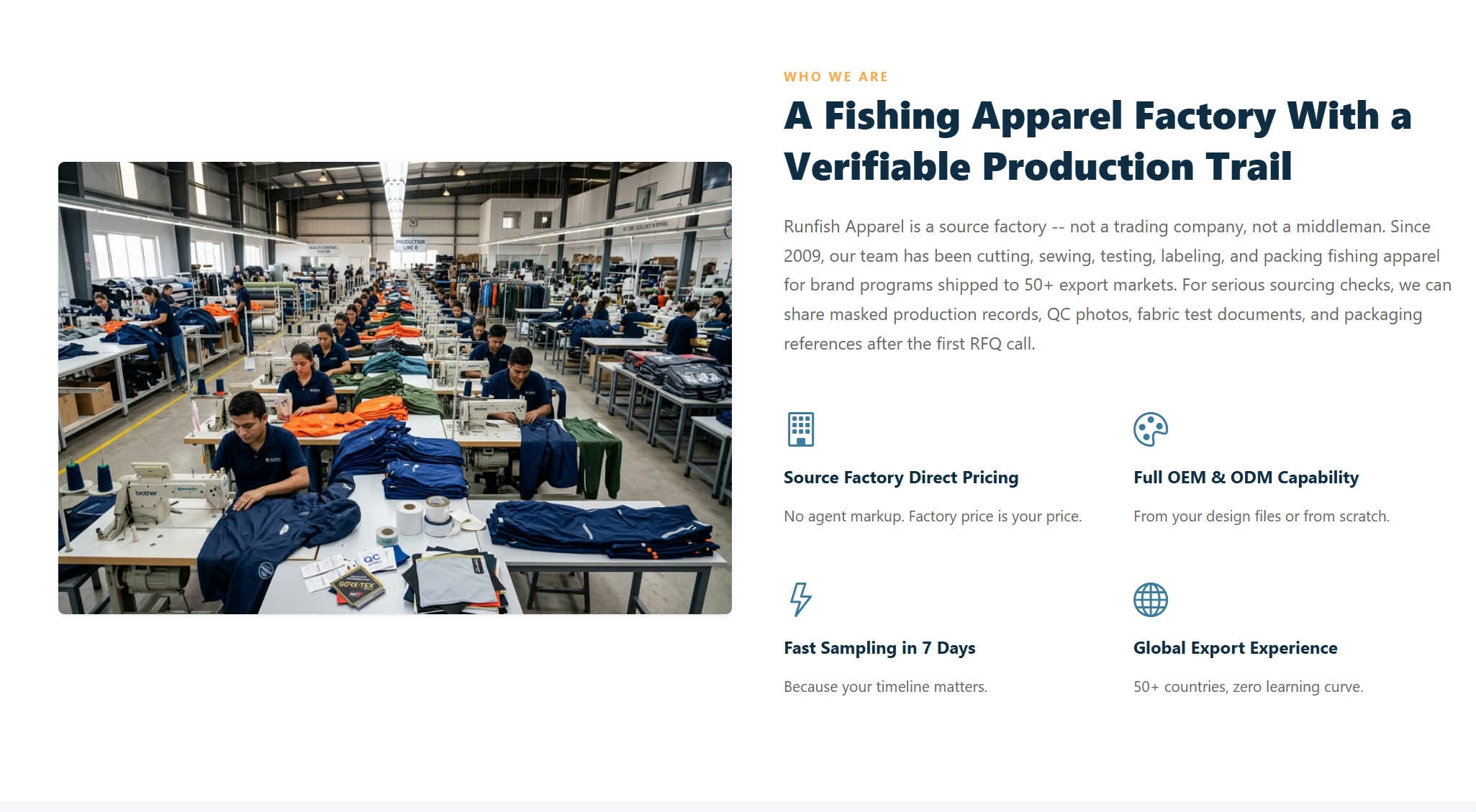
We've been in operation since 2009. Our facility covers 18,000 sqm and runs 12 production lines. We carry OEM/ODM programs across saltwater, freshwater, fly fishing, and ice fishing categories. That range is useful when you're sourcing a mixed seasonal assortment from one supplier.
Here's what matters for early-stage brands: 50 pieces per style per color MOQ . That's the entry point. Not 500. Not 1,000. Fifty.
You also get:
- Fast sampling turnaround
- Full design support before bulk production
- A workflow built to validate your spec — pattern, fabric, fit, durability, QC — before you spend capital at scale
Our product range covers UPF 50+ sun shirts, waterproof jackets with ultrasonic seam sealing, and tournament uniforms built for UV, odor, corrosion, and spray exposure. We ship to 50+ export markets.
Ready to find a production path that fits your brand stage? Share your target fishing category, expected volume, and launch timeline. Our team will match a manufacturing recommendation to your program.
Conclusion
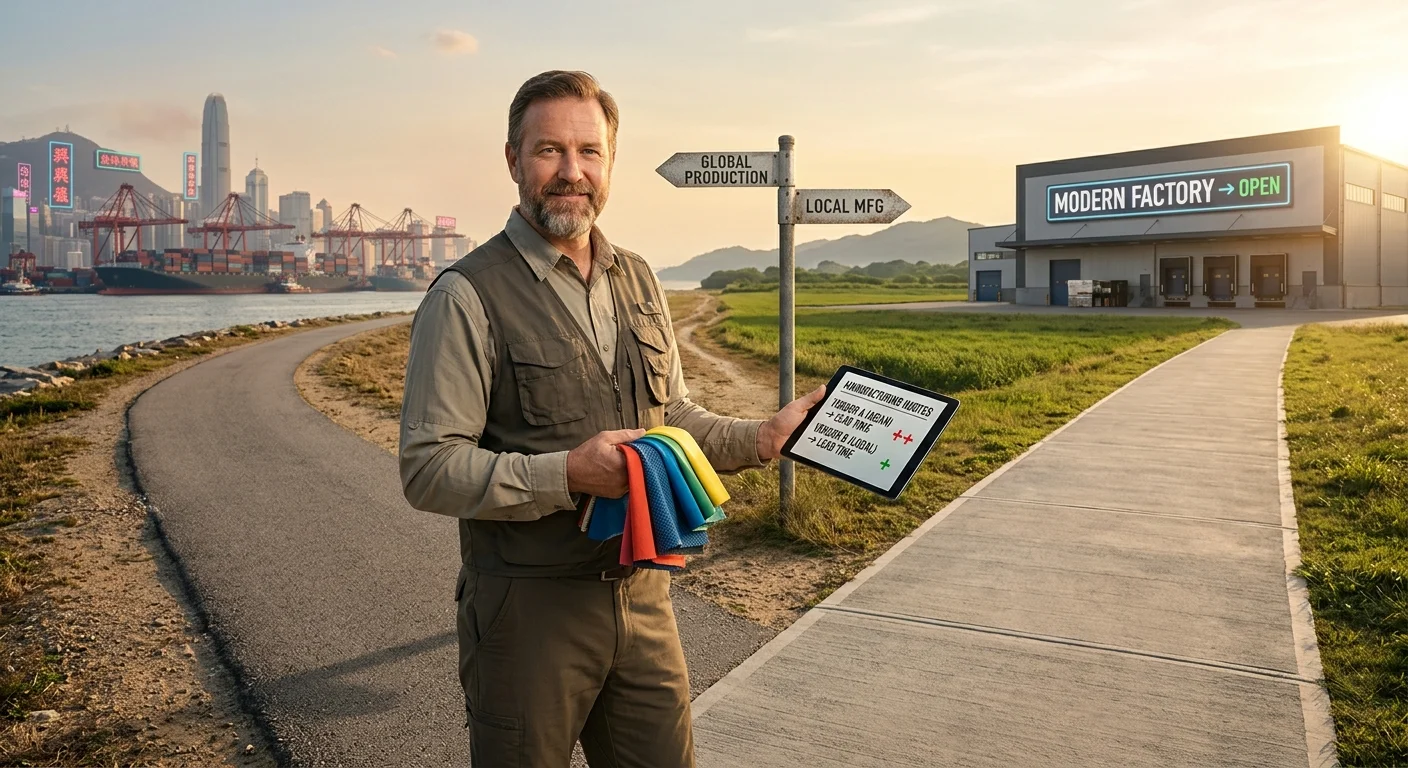
The offshore vs nearshore decision has no single "right" answer. It's about finding the right answer for your brand, right now .
Starting your first private label fishing apparel line? Offshore manufacturing in Asia gives you a cost structure built for early-stage growth. Scaling fast with freight delays and tariff costs eating into your margins? Nearshore production stops being an option and starts being a need.
Either way, unit price was never the full story.
The brands that win in performance fishing wear aren't the ones who chased the lowest FOB cost. They're the ones who built a supply chain that could keep up with demand.
Ready to stop guessing and start building? RunFishApparel.com works with fishing apparel brands at every stage — from first samples to full-scale production runs. Reach out and let's map out your manufacturing strategy together.