Starting a fishing apparel brand sounds exciting—until you hunt for a Private Label Fishing Apparel manufacturer who actually delivers on low MOQs, UPF-rated fabrics, and turnaround times that won't leave your launch date hanging in limbo. Most private label directories throw generic factory lists at you with zero context on which ones are actually built for fishing gear. We spent weeks vetting production capabilities, sampling processes, and fabric tech across the industry to find six manufacturers worth your time in 2026—from performance-driven specialists to budget-friendly testing partners with 20-piece minimums. Whether you're bootstrapping a startup or scaling an established fishing gear brand, you'll walk away knowing exactly which private label sportswear manufacturer fits your production stage, budget, and quality bar.
Runfish Apparel (Performance Fabric Private-Label Fishing Apparel Expert)
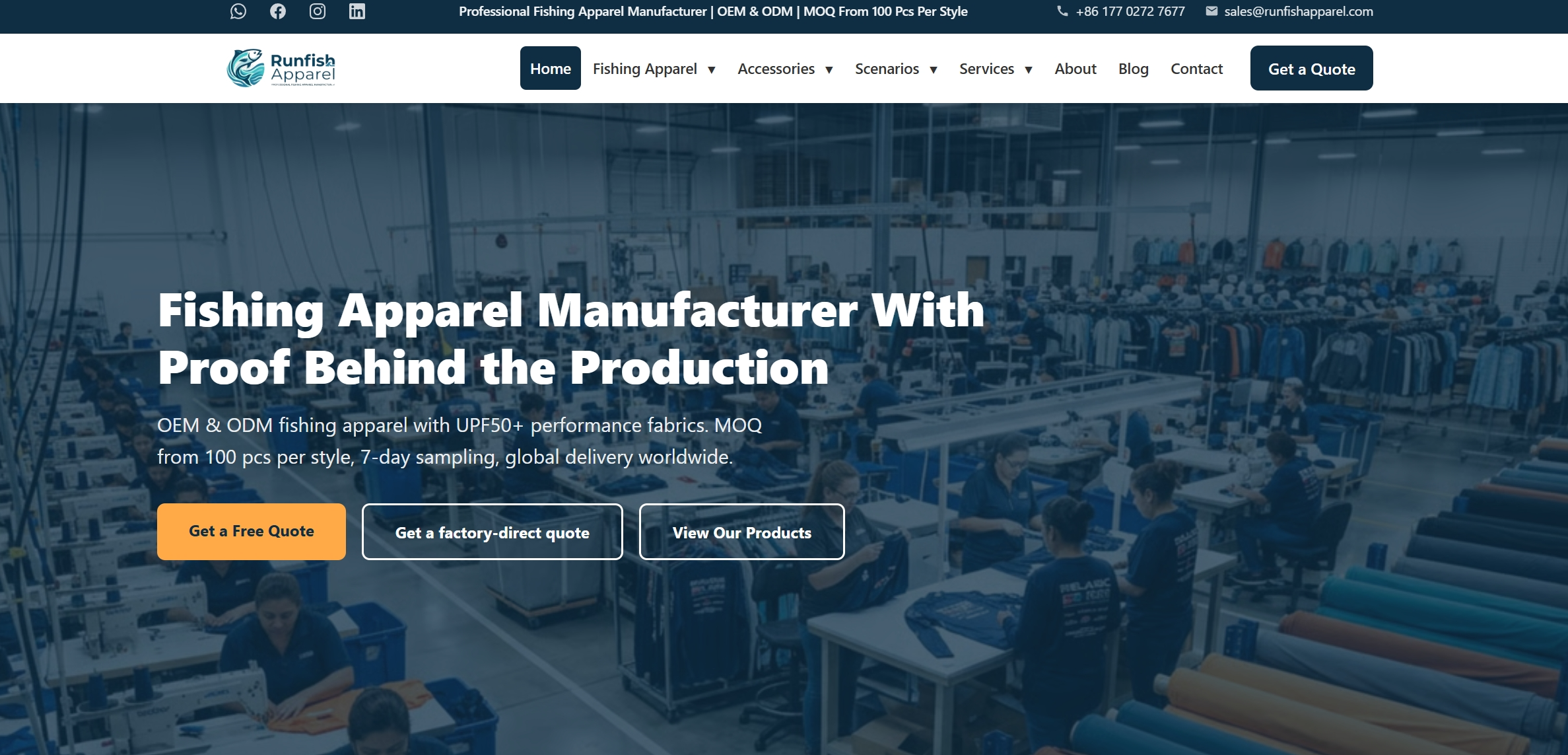
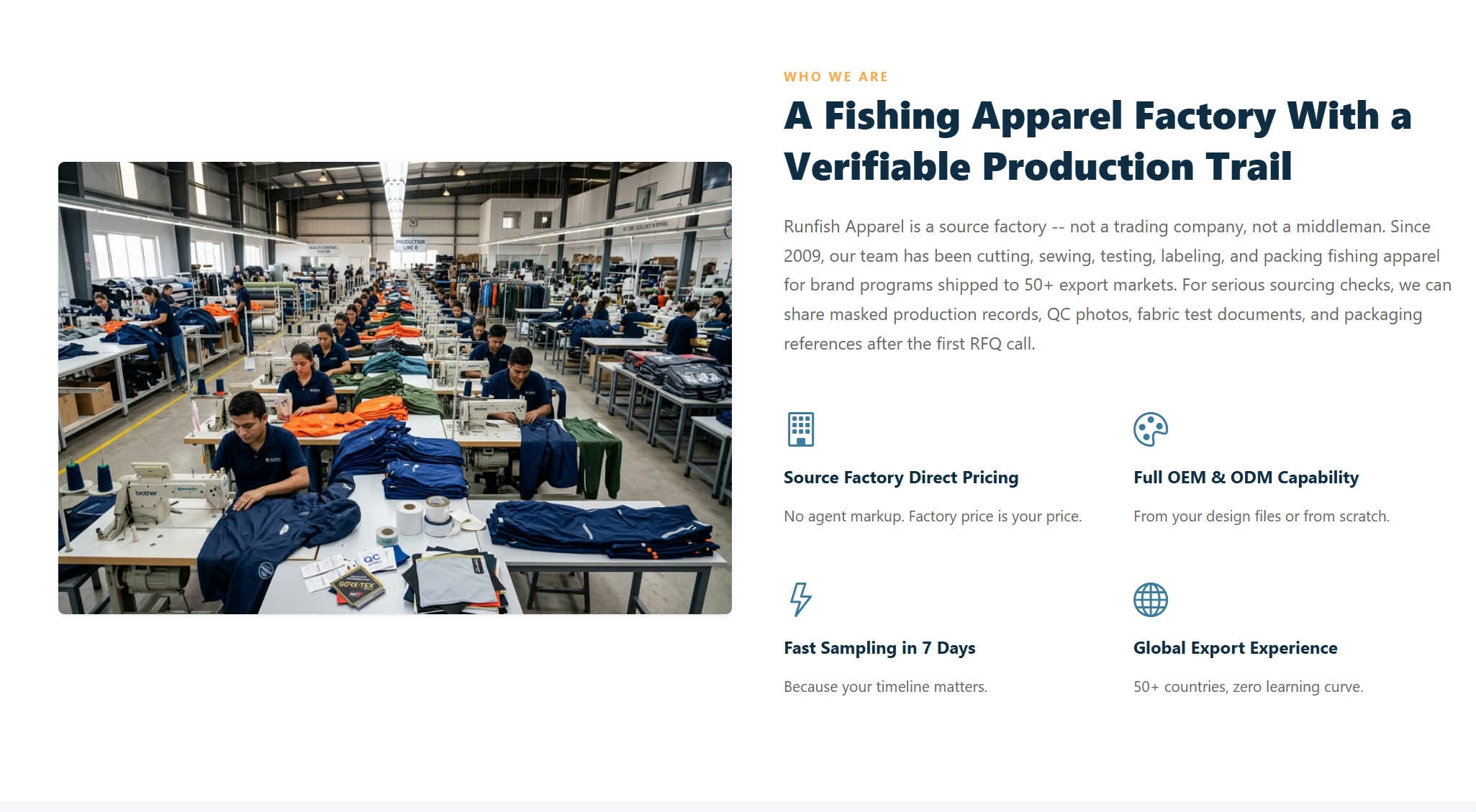
Seventeen years in the game changes how a factory operates. Runfish Apparel has been running as a dedicated fishing apparel manufacturer and OEM factory since 2009. That longevity shows in how tightly they've dialed in performance fabric technology. This is a UPF fishing apparel supplier for brands that need moisture-wicking, quick-dry, anti-odor, and water-resistant fabrics tested to actual standards, not marketing claims.
Why It Tops Our List for Startups
The MOQ is the headline: 100 pieces per style, whether you're doing a full custom build or adding a logo to stock garments. Compare that to the industry-typical 300-500 piece minimum, and you're looking at a fraction of the upfront inventory risk. Samples start at 1 piece, ready in 7-10 business days, so you can test designs before committing capital. Bulk orders ship in 25-35 days after sample approval, and their team responds to inquiries within 24 hours.
Fabric Tech That Holds Up to Scrutiny
Runfish tests UV protection using AATCC 183 and AS/NZS 4399 standards, hitting UPF 52-58. That blocks 98%+ of UV rays. They'll hand over SGS, Bureau Veritas, and SDL Atlas test reports before you place an order, plus OEKO-TEX certification and ISO 9001 quality control. With products exported to 50+ countries, this isn't a factory that guesses.
Product Range and Customization
Custom fishing shirts, polos, saltwater and freshwater apparel
Fly fishing apparel with tech-pack-to-bulk development
Custom logos, colorways, pocket layouts, packaging
Reach them at [email protected] or +86 177 0272 7677, Monday–Friday, 9 AM–6 PM (GMT+8).
Rajco USA (New York-Based Low-MOQ Custom Fishing Apparel Manufacturer)
Brooklyn doesn't get talked about much in the fishing apparel world, but Rajco USA Inc. has been running a factory there since 1935 under the Rajco Industries name. Their pitch is bold: "MOQ: Any Quantity." No middlemen, no offshore lead times, no minimum-order gatekeeping for new customers—just a direct custom fishing apparel factory relationship with free samples included.
What "No MOQ" Means in Practice
That homepage headline sounds too good to be true, and the fine print backs it up only partially. Their custom soccer jersey program, for reference, runs a 25-unit standard MOQ with wholesale tiers starting at 100 units. So "Any Quantity" works better as a signal of flexibility than as a universal guarantee across every fishing product line. Treat it as a strong sign they'll work with you, not a hard promise on every SKU.
Fabric and Product Specs
Men's Fishing Shirt: 92% polyester/8% elastane, 140 GSM—lightweight and stretchy
Custom Sublimated Fishing Jersey: full sublimation printing, moisture-wicking, unlimited customization
Hooded Fishing Jackets: 240gsm pique interlock with mesh vent sleeves
Fishing Long Coat: 210T popline, 100% coated polyester
Customization Capabilities
Rajco covers embroidery, screen printing, and sublimation, with custom colors, sizes, and private label branding available. Pricing isn't published, so expect project-based quotes.
Best Fit: micro DTC brands, fishing clubs, and tournament organizers needing fast, low-commitment test orders. Contact via [email protected] or WhatsApp +1 929 729 4003.
Pamoo Industries (20-piece MOQ trial-oriented factory)
Twenty pieces. That's the number that separates Pamoo Industries from most fishing gear brand manufacturers still using the old 100-500 piece minimum. This custom fishing clothing manufacturer publishes 20 pieces per style per color as its standard threshold, and unlike the vague "flexible MOQ" marketing you see elsewhere, this number shows up consistently across their catalog—cut and sew clothing, private label basics, sublimation printing, hunting apparel, and custom fishing shirts all repeat the same floor.
Where the 20-Piece MOQ Actually Applies
The threshold isn't limited to one basic tee style. It covers custom sublimation printing and private label fishing clothing, lacrosse shirts, camo baseball jerseys, basketball warm-up suits, and hunting apparel and fishing shirts.
That contrasts with the 100-500 piece minimum Pamoo itself calls out as the "typical manufacturer" benchmark elsewhere on its site.
Who This Actually Serves
Pamoo targets startups, school teams, youth programs, and notably small charter operations looking to test fishing shirts before committing to bulk. One third-party comparison also lists 15-25 day production lead time at this MOQ tier, though that figure comes from an outside source, not Pamoo's own page.
Operational Footprint
The company runs offices in both Pakistan and the USA, with manufacturing tied to Sialkot. Public pages mention factory-direct pricing and free design support, though itemized label or packaging surcharges aren't listed anywhere visible.
Best Fit: founders testing one design in one colorway before scaling into full production runs.
Fishing Apparel Factory (Retail-Ready Private Label All-in-One Factory)
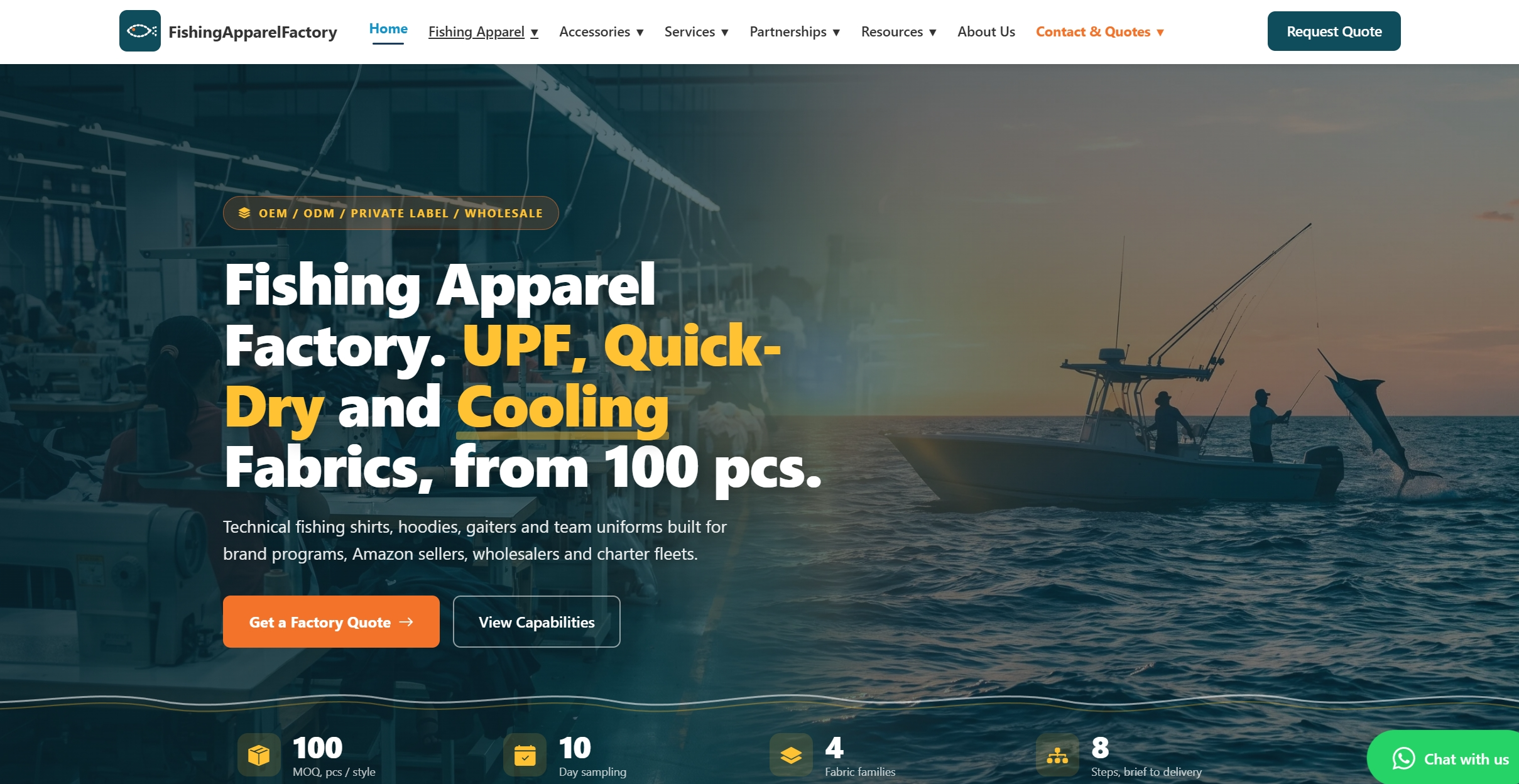
Getting product made is only half the battle. The other half is showing up to a warehouse dock, a retail partner, or an Amazon FBA queue with something that clears inspection. Fishing Apparel Factory built its entire model around that second half, positioning itself as a fishing-only OEM/ODM shop that ships retail-ready, not just factory-finished.
What "Retail-Ready" Includes
Their private label package bundles four things most manufacturers quote as add-ons: woven labels, hangtags, poly-bagging, and retail-ready master cartons. You send over your logo, label art, and destination—DTC, retail shelf, or marketplace—and they handle the rest, including barcode systems and care-label compliance.
Channel-Specific Fulfillment
DTC brands: fast single-SKU launches for content-driven test drops
Retail accounts: shelf-ready packaging synced to seasonal calendars
Marketplace sellers: FBA-ready cartons built to spec for Amazon inbound
MOQ, Timeline, and Pricing
MOQ starts at 100 pieces per style, which is consistent with other low-barrier private label sportswear manufacturers. No fixed lead time is published, but their sample-approval-first workflow suggests 5-8 weeks for first orders, 3-4 weeks for reorders, in line with industry norms at this MOQ tier. Pricing isn't listed publicly; expect $10-18 per piece for standard builds, climbing to $14-19 with performance fabric or full retail packaging.
Product Range: beyond apparel, they cover headwear, gaiters, flags, and bags—useful if you're building out a full brand ecosystem, not just a shirt line.
Best Fit: brands needing packaging and compliance handled in-house, especially FBA sellers and retail-bound startups.
CustomFishingWear (Fishing Apparel Specialty Factory / 100-Piece MOQ)
Fishing gear brand manufacturers rarely narrow their focus this tightly. CustomFishingWear does exactly that—it makes only fishing apparel, not general athletic wear or team uniforms. The catalog reads like a tackle box: UPF shirts, fly fishing apparel, saltwater gear, fishing hoodies, jerseys, jackets, vests, and bibs & waders for anyone wading into deeper water.
MOQ Positioning: The Middle Ground
The published MOQ sits at 100 pieces per style or colorway—roughly five times Pamoo's 20-piece floor, but well under the 300–500 piece minimums common at broader-scope factories. This is a custom fishing jersey manufacturer built for brands past the pure testing phase but not yet ready for 500+ unit commitments.
Production Timeline
-Sample development: 7–10 days
-Small-batch runs: 15–20 days
-Bulk orders (500+): 20–30 days
Risk Controls
Their workflow runs Tech Pack Intake through Fit Sample, Sales Sample, and Pre-Production Sample before bulk—each stage catches fit or fabric issues before they multiply across a full run. QC inspection happens at multiple checkpoints, and NDAs are standard for brands protecting new patterns or prints.
Best Fit: fishing-vertical DTC startups, tournament merch programs, and seasonal drops needing mixed sizing with logo, hang tags, and branded packaging already dialed in.
LeelineWear (Premium Private Label Precision Finishing Supplier)
Zipper pulls tell you everything about a brand's ambition. LeelineWear built its entire private label pitch around that idea. Branding is the hardware, the tags, the trims nobody notices until they're missing. This outdoor apparel private label factory runs 12 production lines in China, housing cut-and-sew, printing, embroidery, and packaging under one roof. Garments leave the factory floor with zero trace of LeelineWear branding—only yours.
Details
Woven neck labels: precision-dyed to match your exact logo colors
Waterproof hang tags: built for salt-air and humidity without fading or tearing
Heat-transfer care labels: scratch-free, rated to survive 50+ wash cycles
Silicone logo patches, metal plates, branded O-rings: premium hardware for swimwear and outdoor gear
AQL 2.5 inspection standards applied to every trim and packaging element on the line
Tooling Investment Math
Custom zipper pulls and branded hardware require 500+ unit orders to unlock tooling. A simple metal mold runs $80-300; complex engraved shapes climb to $300-1,000+, plus a $30-150 prototype fee. At 500 pieces, a $300 mold adds $0.60 per unit. At 1,000 pieces, that drops to $0.30. If branded hardware justifies even a $2 retail price bump, the tooling pays for itself fast, especially on higher-ASP categories like fishing apparel and swimwear.
This factory fits established brands with tech packs and reorder cycles, or funded startups with a clear design brief. Entry starts at 100 units per style, but this isn't the factory for founders needing rock-bottom MOQ with zero tooling budget.
Core Comparison Table: 6 Key Dimensions Across Manufacturers
Numbers tell the real story here. Side by side, the gap between a “flexible MOQ” claim and an actual production floor becomes obvious fast. So does the difference between a factory that tests UPF ratings against AATCC standards and one that just prints “UV protection” on a hangtag.
Manufacturer | MOQ | Customization Depth | Lead Time | Fabric Tech / Certification | Price Range |
|---|---|---|---|---|---|
Runfish Apparel | 100 pcs/style | Full OEM/ODM: fabric, fit, print, embroidery, packaging | Sample: 7-10 days; Bulk: 25-35 days | UPF52-58 (AATCC 183, AS/NZS 4399), OEKO-TEX, ISO 9001 | ~$8-15/pc (industry benchmark) |
Rajco USA | “Any Quantity” (~25 units for jerseys) | Sublimation, embroidery, screen print | Not disclosed | 92% polyester/8% elastane, 140-240gsm | Project-based quote |
Pamoo Industries | 20 pcs/style/color | Sublimation, private label basics | 15-25 days | Basic performance blends | Low-tier, budget-friendly |
Fishing Apparel Factory | 100 pcs/style | Retail-ready packaging, hangtags, barcoding | 5-8 weeks first order; 3-4 weeks reorder | Standard performance fabrics | $10-18/pc; $14-19 performance |
CustomFishingWear | 100 pcs/style | UPF-rated fishing-specific catalog | Sample: 7-10 days; Small batch: 15-20; Bulk: 20-30 | UV-protective, moisture-wicking | Mid-range, undisclosed |
LeelineWear | 100 pcs entry; 500+ for tooling | Premium hardware, custom trims | Not disclosed | AQL 2.5 inspected trims | Higher due to tooling costs |
How to Choose the Right Private Label Fishing Apparel Manufacturer for You
Pick the manufacturer that fits your growth stage. Startups testing designs need 100 pieces per style/color, mixed-size flexibility, and 1-piece samples that turn around in 7-10 days. That is the low-barrier range for fishing gear brand manufacturers. Mid-size buyers reordering seasonally want stable 100-300 piece runs, fast reorder cycles, factory-direct pricing, and 25-45 day bulk timelines. Premium brands skip volume math. They look for full OEM+ODM development with custom patterns, 3D mockups, and branded hardware.
MOQ Math You Need to Verify
Ask exactly how MOQ gets calculated per style, per color, per print, per size run. Most factories quote 100 pieces per style per color, and colors don't stack together to hit that number. Confirm sample MOQ and bulk MOQ separately (usually 1 sample, 100 for bulk), and get it in writing whether dyeing, printing, zippers, or custom packaging push the minimum higher.
Brand Depth Checklist
Woven labels, size tags, wash-care labels
Hangtags with QR codes, barcodes, brand story space
OPP bags, color boxes, FBA-ready cartons
Custom zipper pulls, D-rings, reflective trim
Pattern variants: loose sun-protection cut, compression quick-dry, saltwater-durable builds
Fabric Priority by Use Case
UPF50+ for sun protection (top options reach UPF100+), moisture-wicking polyester blends for quick-dry needs, and corrosion-resistant hardware plus colorfastness testing for saltwater durability.
Questions to Ask Every Factory
-"Is MOQ calculated by style, color, or fabric? Can I mix sizes?"
-"What UPF, quick-dry, or saltwater test data do you have on file?"
-"What's your sample turnaround versus bulk lead time?"
Practical Sourcing Checklist: Samples, Certifications, and Production Fit
Paper promises don't survive a production floor. Numbers do. Before you wire a deposit, run every quote through three filters: sample terms, certification proof, and channel fit. Skip any of these, and you're gambling with inventory money.
Sample Process: What "Normal" Looks Like
Physical samples typically take 7-15 days. Complex builds, revisions, and fabric confirmation can stretch that window. Most factories send a 3D render or virtual sample first, then confirm with a physical piece. Expect 1-3 revision rounds as standard, with each round adding 5-7 days for pattern, fabric, logo, or trim fixes. Sample fees are usually deductible from your bulk order, a common OEM/ODM term worth confirming in writing. For reference, third-party UPF testing through ARPANSA runs AUD 180 per sample (1-10 units), or AUD 156 at higher volume. Hats and multi-piece garments run AUD 193/168. No factory should start bulk production without your written sample approval first.
Verifying UPF, Quick-Dry, and Saltwater Claims
"UPF 50+" without a standard number is marketing, not proof. Demand the actual figure plus the testing standard: AATCC 183, AS/NZS 4399, or EN 13758. Certification through labs like Hohenstein takes 10 business days. Fabric swatch requirements start at 50cm x 50cm per color/material (UV STANDARD 801 wants 1m² minimum). Quick-dry claims should reference AATCC TM199, TM200, or TM201, with thresholds like ≤90 minutes drying time or ≥10ml/h absorption. Saltwater durability is tested through chlorinated saline immersion (EN 13138-1 5.7.2). Samples stay submerged for 12 hours, then get checked for discoloration, coating separation, or corrosion.
Matching Production Channel to MOQ
-DTC brands: 100 pieces/style, fast reorder cycles
-Retail accounts: 300-1,000 pieces/style, stable QC systems
-Fishing clubs: 100-300 pieces/style, multi-size embroidery capacity
-Tournament teams: prioritize ISO 9001 factories with formal sample sign-off
Four questions seal the deal: MOQ terms, deductible sample fees, standard-numbered test reports, and confirmed production timelines after sample approval.
2026 Private Label Fishing Apparel Industry Trends
The numbers show where this market is heading. UPF-rated apparel is projected to hit $8 billion by 2025 at roughly 7% CAGR—one report pushes further, pegging the global UPF clothing market at $1.7 billion in 2025 climbing to $3.34 billion by 2034. Moisture-wicking fabric tracks the same trajectory: $3.74 billion in 2024, rising to $3.91 billion in 2025 and $5.02 billion by 2034. Performance fabric, not print design, is now where the real competition sits for any performance fishing apparel factory. That's where the margin is shifting.
Testing Orders Before Betting the Warehouse
Low MOQ now functions as risk management, not a courtesy. Factories openly market "test before you scale" language, offering 50-piece light customization or 100-piece full builds with mixed sizing allowed. Brands use these small runs to check fit, fabric hand, and price tolerance before committing to bulk.
Retail-Ready Packaging Becomes the Default, Not the Upsell
Woven labels, hangtags, poly bags, barcodes, and FBA-compliant cartons used to cost extra. Now they're baked into standard quotes—because retail buyers and Amazon warehouses won't accept anything less.
Frequently Asked Questions (FAQ)
Numbers answer most objections here, so let's skip the fluff.
What's a "normal" MOQ if I'm not using one of the six factories above?
Many broader private label sportswear manufacturers still default to 480 pieces per style/color for full custom fishing apparel builds, though stock customization (adding your logo to existing quick-dry tees) can drop to 10 pieces.
How many logo application methods should a factory offer?
Look for at least seven: embroidery, screen print, heat transfer, rubber print, fluorescent print, foil stamping, and laser reflective.
What's realistic production time at higher volumes?
Standard 500-1,000 piece runs with basic washing take 45-60 working days. Complex patterns or 1,000+ orders push that to 50-65 days.
What happens if defects show up?
Report with photos within 3 business days. You'll get free reproduction or a partial refund, plus a 3-month warranty on stitching and hardware.
Sea or air freight?
Sea runs 30-40 days and gets cheaper for 500+ piece orders. Air covers 3-6 days for urgent restocks.
Conclusion
Finding the right partner for your growth stage matters most when launching a fishing apparel brand in 2026. Whether you're testing the waters with Pamoo's 20-piece minimums or scaling with Rajco USA's East Coast agility, the six fishing apparel manufacturers covered here each solve a different part of the supply chain puzzle.
If UPF-rated performance fabric, sub-30-day turnarounds, and low-MOQ flexibility are your priorities, Runfish Apparel is the best choice among private label sportswear manufacturers built specifically for fishing brands.
Pull three manufacturers from this list, request fabric swatches and sample pricing, and compare their actual turnaround against your launch timeline.