You got a quote from your fishing apparel manufacturer . The price per unit looked solid. Then the invoices started rolling in—sample fees, tooling charges, a "small batch surcharge" nobody mentioned during negotiations, and suddenly your margins took a hit you didn't see coming.
Sound familiar? You're not alone. Most brands searching for a fishing wear private label manufacturer focus on the unit price and miss the line items that quietly eat into their budget.
A real apparel production cost breakdown goes way beyond fabric and labor. I'll walk you through seven hidden costs—from MOQ markups to tariff surprises—that catch even experienced buyers off guard. Know these before you sign, and you'll negotiate smarter, budget tighter, and avoid the price disputes that derail partnerships.
Sampling and Development Costs: Tech Packs, Pattern Making, and Fit Sample Fees
Most buyers don't see this coming: developing a single custom fishing jersey style can cost $800–$2,000 before you ever see a production unit. That's the apparel sampling cost most quotes conveniently leave out.
Break it into three line items, and you'll see where the money goes.
Tech packs run $50–$800+ per style, depending on complexity. A basic tee tech pack costs $50–$200. A technical outerwear piece—think waterproof fishing jackets—climbs to $400–$800+. Some studios bill hourly at $125/hour with a 2-hour minimum, so even a "simple" request can hit $250 fast.
Pattern making adds another $75–$1,000 per style. U.S. sample factories typically charge $75–$200 for basic patterns. Structured pieces with linings or panels—common in performance fishing wear—push that to $400–$600. Some fishing wear private label manufacturer partners bundle pattern work into a broader "development fee" of $150–$500 per style instead of billing separately. Always ask which model you're getting.
Fit samples are where costs stack fastest. A first prototype runs $200–$1,000. Fit samples in final fabric add $150–$800. Pre-production samples tack on another $100–$1,000. Many factories also charge 2×–5× the bulk unit price for a single sample—if your production unit is $10, expect $20–$50 per sample.
Maker's Row published a real-world breakdown for one style: $850 for three sample rounds, $550 for patternmaking, $725 for grading, $300 for the tech pack. Total: $2,425 —excluding fabric.
What to negotiate:
- Ask if sample fees credit toward your first bulk order
- Cap revision rounds—$100–$500 per extra round adds up
- Confirm payment terms upfront; some factories require 100% payment before pattern work starts
Skip this conversation, and a five-style collection's sampling phase alone could cost $2,000–$7,500 before you've locked a single fabric sourcing cost.
runfishapparel.com
Not every custom fishing jersey manufacturer publishes their cost structure upfront. Runfish Apparel does, and that transparency is why brands sourcing UPF sun-protection and cooling fishing gear should put this Guangzhou-based OEM/ODM fishing apparel factory on their shortlist.
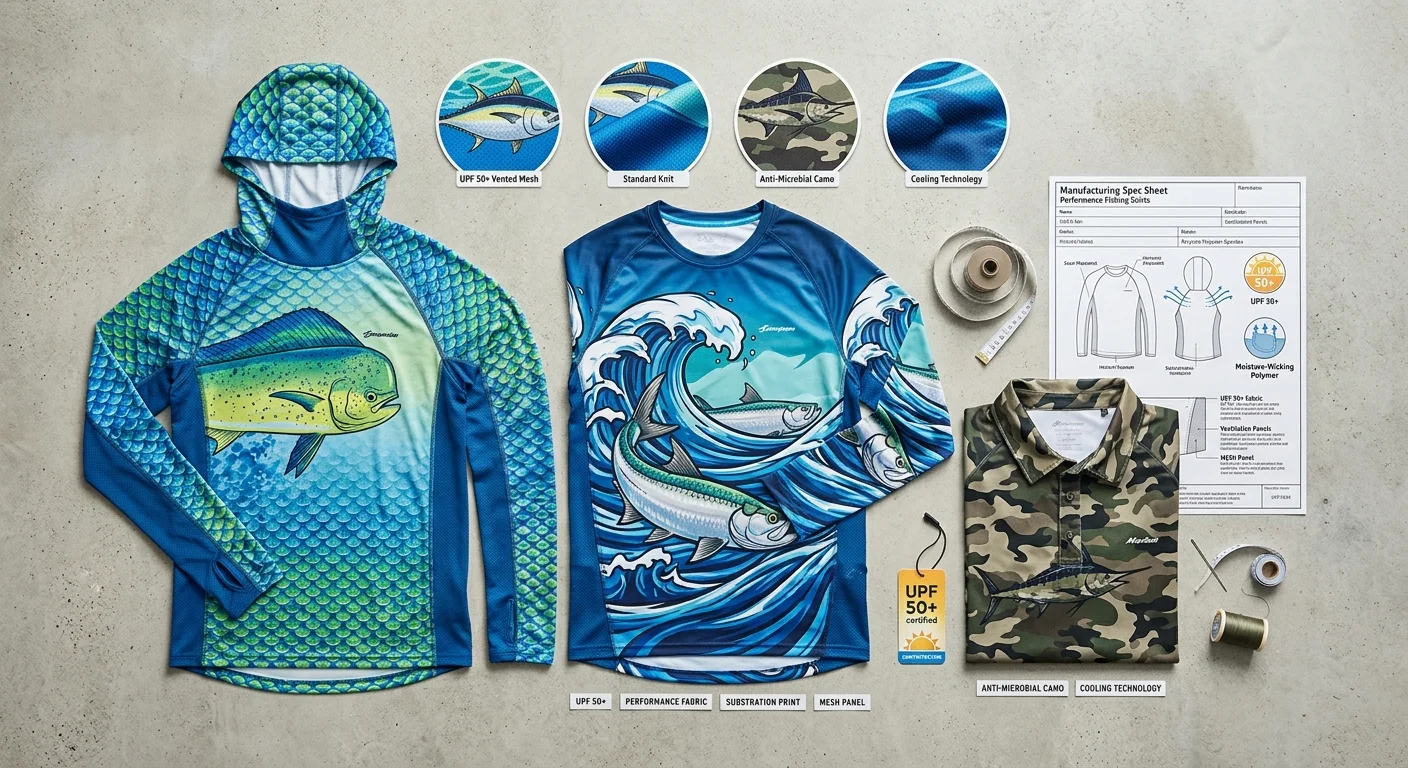
Runfish specializes in UPF 52–58 performance shirts, including long-sleeve, short-sleeve, sun-hoodies, and quick-dry gear engineered for fishing conditions. That UPF range blocks roughly 98%+ of UV radiation.
Minimum order quantities run 50–300 pieces per design, with sublimation jerseys often landing at 50–100 pieces. That helps when you're calculating minimum order quantity surcharges against your budget. Sampling takes 7–15 days after specs are confirmed; bulk production runs 25–45 days post-deposit. Wash-test records, cooling performance data, and swatch catalogs are available on request, so you don't have to guess about fabric sourcing cost for fishing gear.
They also retain project data and transaction records for a minimum of 5 years under Chinese commercial law. For brands planning repeat orders, that means specs, tech packs, and logo files stay on file. No resubmitting documentation every season.
Reach their sales team at sales@ runfishapparel.com or WhatsApp +86 177 0272 7677. They state a 24-hour response window, which matters when you're comparing quotes across multiple fishing wear private label manufacturer options on a deadline.
MOQ Markups and Small-Batch Surcharges in Custom Fishing Apparel Orders
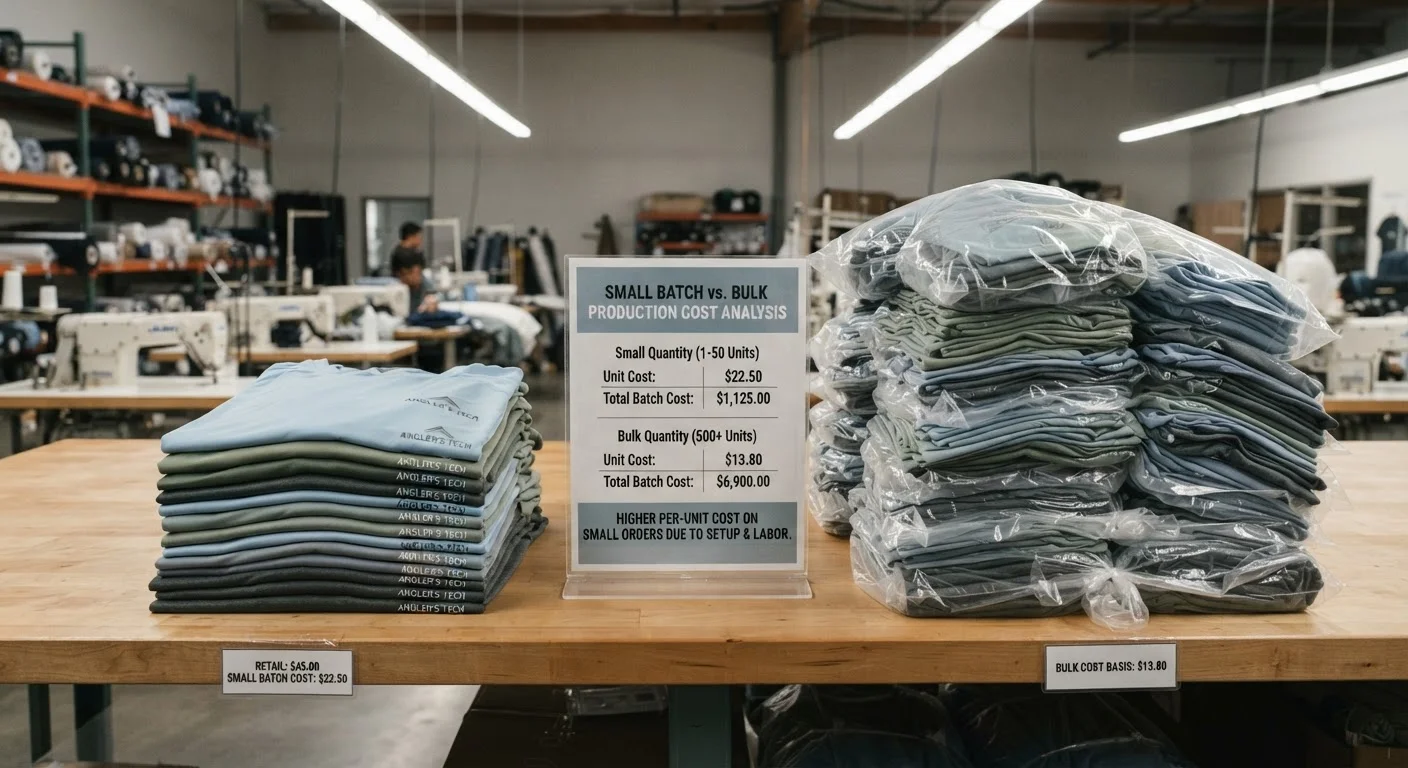
Ordering 24–50 pieces instead of 100–300 pieces can cost you 20–80% more per unit. That catches most first-time buyers off guard. It's the MOQ penalty, and every brand that starts small before scaling up runs into it.
Here's what real production paths cost for the same fishing jersey:
POD/on-demand (1 pc): $28–45 per shirt
Stock fabric + custom print (30–50 pcs): $14–19 per shirt
Custom sublimation printing fishing apparel ODM (50–100 pcs): $11–15 per shirt
Domestic small-batch OEM (200–300 pcs): $10–18 per shirt
Do the math. A single POD unit costs 90–150% more than a 50-piece sublimation run. Go from 200–300 pieces down to 30–50 pieces, and you're still paying 20–40% more for identical specs.
Bangladesh custom fishing apparel suppliers show the same pattern. Brandex Sourcing prices basic performance tees at $2.00–2.50 FOB at 1,000+ pieces. Push to 4,000–5,000+ pieces for campaign polyester tees, and price drops to $1.25. Order just 100–400 pieces, and you're told it "costs more" — typically 25–60% higher per unit.
MOQ tiers vary by manufacturer. Domy Beach requires 50 pieces for logo-only work, jumping to 200–300 pieces for full ODM with new materials. RunFish Apparel sets MOQ at 50 pieces per style per color. Rise Sportswear goes as low as 10 pieces per design. On Alibaba, one supplier prices MOQ 2 at $6.90–14.90, while MOQ 100 drops to $7.96–12.90.
Where the hidden surcharge bites:
Sample fees ($90–230) only credit toward bulk orders once you hit 300–500 pieces overseas or 25–100 pieces domestically. Order below that, and the fee spreads thin — a $150 sample on 50 pieces adds $3 per unit.
Design and setup fees ($50–150) get waived above 100 units at most factories. Stay under 100, and you're absorbing $0.50–3.00 extra per piece.
Certified UPF or eco-fabrics push finished-goods minimums to 150–250 pieces, versus 100 for standard materials. Insist on smaller runs, and factories bill you for unused fabric.
Negotiate smarter, not smaller:
Request tiered pricing at 100/200/500 pieces so you can model the exact markup at each level. Ask if your MOQ can flex 30–60% lower by simplifying colorways or print complexity. Confirm whether sample fees credit at your actual order volume — not the factory's preferred threshold.
Quality Control, Lab Testing, and Rework Costs
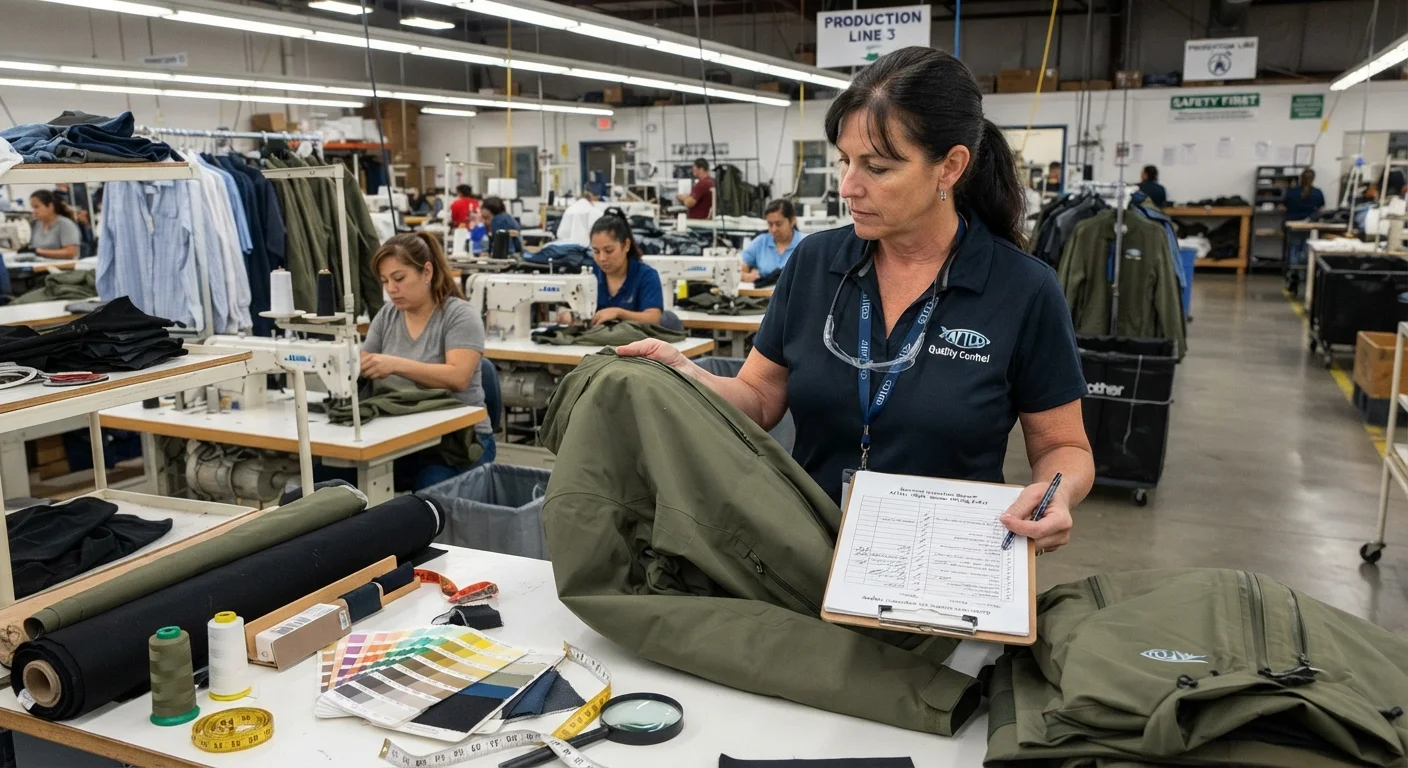
Here's a number that stops most brand owners cold: 56% of companies with consistent QA/QC processes keep rework under 5% of their budget. Only 37% of companies without standards hit that mark. That gap is exactly where your fishing apparel manufacturer quote either holds up or falls apart.
Quality costs break into four buckets. Most quotes only show you one. Prevention costs cover quality planning and training. Appraisal costs are your quality control inspection fee: third-party inspectors, AQL sampling, lab testing for UPF ratings and colorfastness. Internal failure costs hit when garments fail inspection: rework, repairs, scrap. External failure costs show up later as warranty claims and returns once customers find the defects your factory missed.
The rework rate benchmark matters more than people realize. Development programs across manufacturing industries typically run 10-25% rework effort . Best-in-class operations hit 5-10% . Cross into hardware or technical goods, and performance fishing wear with taped seams and UPF coatings falls here, and rework climbs to 15-30% due to physical prototyping and compliance retesting.
Calculate your real rework cost per batch:
Extra direct labor time × labor rate
Additional material for replaced panels or trims
Re-inspection and re-testing fees
Overhead allocated to the rework cycle
Where lab testing costs sneak in:
UPF certification retesting after fabric changes
Wash-fastness and colorfastness re-runs
Third-party inspection fees per shipment, not per style
Skip the appraisal spending, and internal failure costs, the rework and scrap line, become the largest share of your total Cost of Poor Quality. Ask any custom fishing jersey manufacturer for their historical rework rate by SKU. If they can't produce that number, you're the one absorbing the risk.
Tariffs, Freight, and Landed Cost Surprises
Your FOB price from a fishing wear private label manufacturer tells you almost nothing about what you'll actually pay. Tariffs and freight surcharges can swing your real unit cost by 30–70%, and most brands don't discover this until the customs bill arrives.
China-origin apparel stacks duties fast. MFN customs duty runs 5–8%, Section 301 tariffs add 25%, and proposed Section 122 surcharges tack on another 10–15%. On a $10 FOB shirt the total effective rate is 40%—that's $4.00 in duties alone. Sell that shirt at $25 with a planned 60% margin, and tariffs just erased 16 percentage points of it.
Freight isn't safer ground. Major carriers rolled out Peak Season Surcharges in 2026—$1,000 per 20' container, $2,000 per 40'—stacked on top of base rates. Brands that budgeted $5,000 all-in per 40' container in Q1 2026 are now paying $7,500–$8,500. On a 10,000-unit container, that's a jump from $0.50 to $0.80 per unit in freight alone.
Don't forget the government fees hiding in every entry:
Merchandise Processing Fee: 0.3464% of value, $31.67–$614.35 per entry
Harbor Maintenance Fee: 0.125% of cargo value (ocean only)
Customs broker fees: $150–$400 per entry
Drayage: $300–$800 per container
Brands that don't track these components lose 8–15% of gross margin to unrecovered costs. Audit your last three customs entries before you sign your next PO.
Compliance Documentation, Color Matching, and Lab Dip Costs
A single wrong shade of blue on your fishing hoodie can trigger a chain of fees you never budgeted for. Compliance testing and color approval are buried in most quotes, but they often determine whether you get a smooth production run or a costly reprint.
RSL and chemical compliance testing hits your budget per color, per material. A full chemical panel covering azo dyes, formaldehyde, and heavy metals runs $120–$250 per test. A limited panel drops to $60–$120. Multiply that across a five-color, three-fabric collection, and you're looking at $1,800–$3,750 before a single unit ships.
Lab dip approval adds another layer. Basic lab dips cost $5–$15 internally, but factories typically bill $15–$30 per color per fabric. New colors on new fabric usually need 2 to 4 submission rounds. For a style with 4 colors averaging 2 dips each, that's 8 lab dips and roughly $80 per style. Scale to 50 styles × 4 colors, and internal costs hit $4,000 per season; billed externally, that jumps to $8,000.
Color tolerance matters too. Standard apparel accepts ΔE ≤1.0–1.5. Tighten that tolerance for brand-consistent sun-protection gear, and expect 1 to 2 extra dip rounds—a 30–70% cost increase.
What to lock into your PO:
Who pays for RSL testing (you or the manufacturer)
Maximum lab dip rounds included in the base price
Whether compliance costs are itemized or rolled into fabric pricing
Skip these clauses, and every re-dip becomes a negotiation.
Financial and Project Management Overhead: FX Fees, Communication Costs, and Inventory Holding
Nobody puts this on the invoice. It's the silent 10–20% that erodes your margin between the FOB quote and the money that actually leaves your bank account — and most fishing apparel brands never see it coming until year-end reconciliation.
FX fees bleed the most. Pay your custom fishing jersey manufacturer through a standard bank wire, and you'll eat 2–5% per transaction in currency conversion spread. Switch to a specialist FX provider or multi-currency account, and that drops to about 0.5% — a 75–90% reduction. Run the math on a $5M annual spend with a fishing wear private label manufacturer: bank FX costs you $150,000 a year. A specialist provider costs $25,000. That's $125,000 back in your pocket from changing how you pay invoices.
Project management overhead adds another layer. Coordinating sampling, QC, and shipping across time zones runs 7–11% of total project cost , climbing to 9–15% once you factor in scheduling and risk controls. Smaller orders (under $10k in PM effort) still eat 1–4 labor-weeks of your team's time chasing status updates.
Communication costs sneak in too. Telecom, collaboration platforms, and video calls with your factory run 1–3% of labor cost . Add travel for factory visits or quality audits, and that climbs to 3–10% .
Inventory holding is the sleeper cost. Carrying unsold stock runs 20–30% of inventory value annually — capital cost alone (8–15%), plus storage (3–8%), insurance/tax (1–5%), and obsolescence (2–10%). A $2M inventory position costs $500,000 a year just sitting on shelves.
Cut it down: consolidate FX through multi-currency accounts, negotiate fixed PM fee tiers upfront, and shift to vendor-managed inventory wherever your fabric sourcing cost allows it.
Conclusion
The quote you get isn’t the price you’ll pay. Sampling fees of custom fishing apparel, MOQ markups, lab testing, tariffs, FX fluctuations—they stack up fast, and most brands don’t see them coming until the invoice lands.
That’s why a real apparel production cost breakdown matters more than a flashy per-unit price. The brands winning in 2026 aren’t chasing the cheapest quote. They ask the right questions upfront and partner with a fishing wear private label manufacturer transparent about every line item, from tooling fees to landed costs.
Before you sign that next PO, pull this checklist back out. Ask your supplier to break down costs by category, not just total price. Better yet, talk to a manufacturer who’s already solved these problems for brands like yours.
Ready to build a budget that holds up? Let’s map out your true costs together—no surprises, no hidden fees.