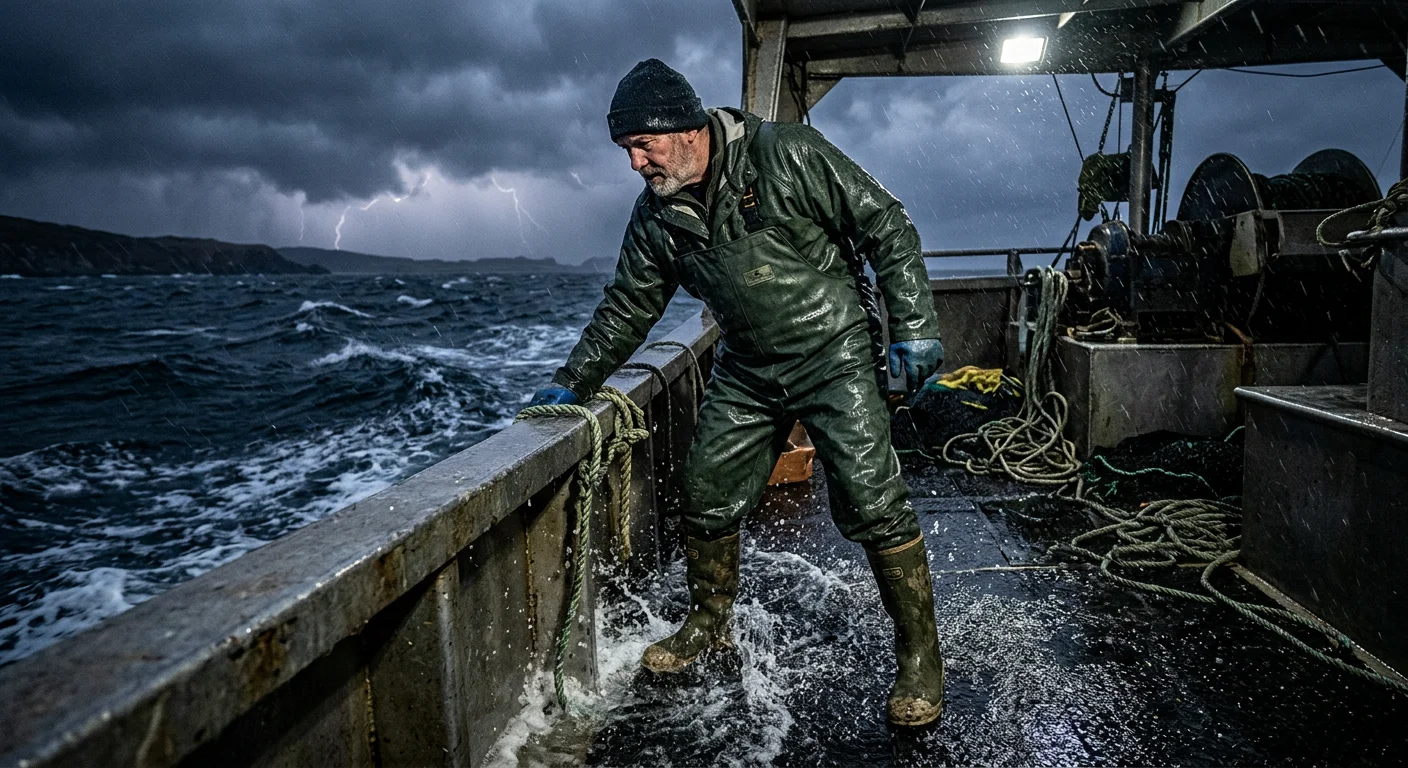
A rogue wave crashes across the bow. Cold spray hits you broadside. Your gear either works or it doesn't — you find out right then.
That's the moment rain pants fail most offshore anglers. The waist seal buckles under a hard soaking. The waistband slides down every time you lean into a fighting fish. That bone-chilling gap between your jacket hem and your pants opens up — and 55-degree seawater pours straight through.
This isn't a comfort problem. It's a gear failure at the worst possible moment.Offshore anglers sourcing gear from trusted fishing aapparel suppliers understand how critical sealed protection becomes in heavy spray conditions.
This guide breaks down waterproof fishing bibs vs pants by looking at six specific ways rain pants fall apart under heavy offshore spray . Then, point by point, it shows how the structural design of chest-high bibs stops each failure before it costs you a fish, a dry layer, or your focus.
6 Real-World Rain Pants Failures in Offshore Heavy Spray
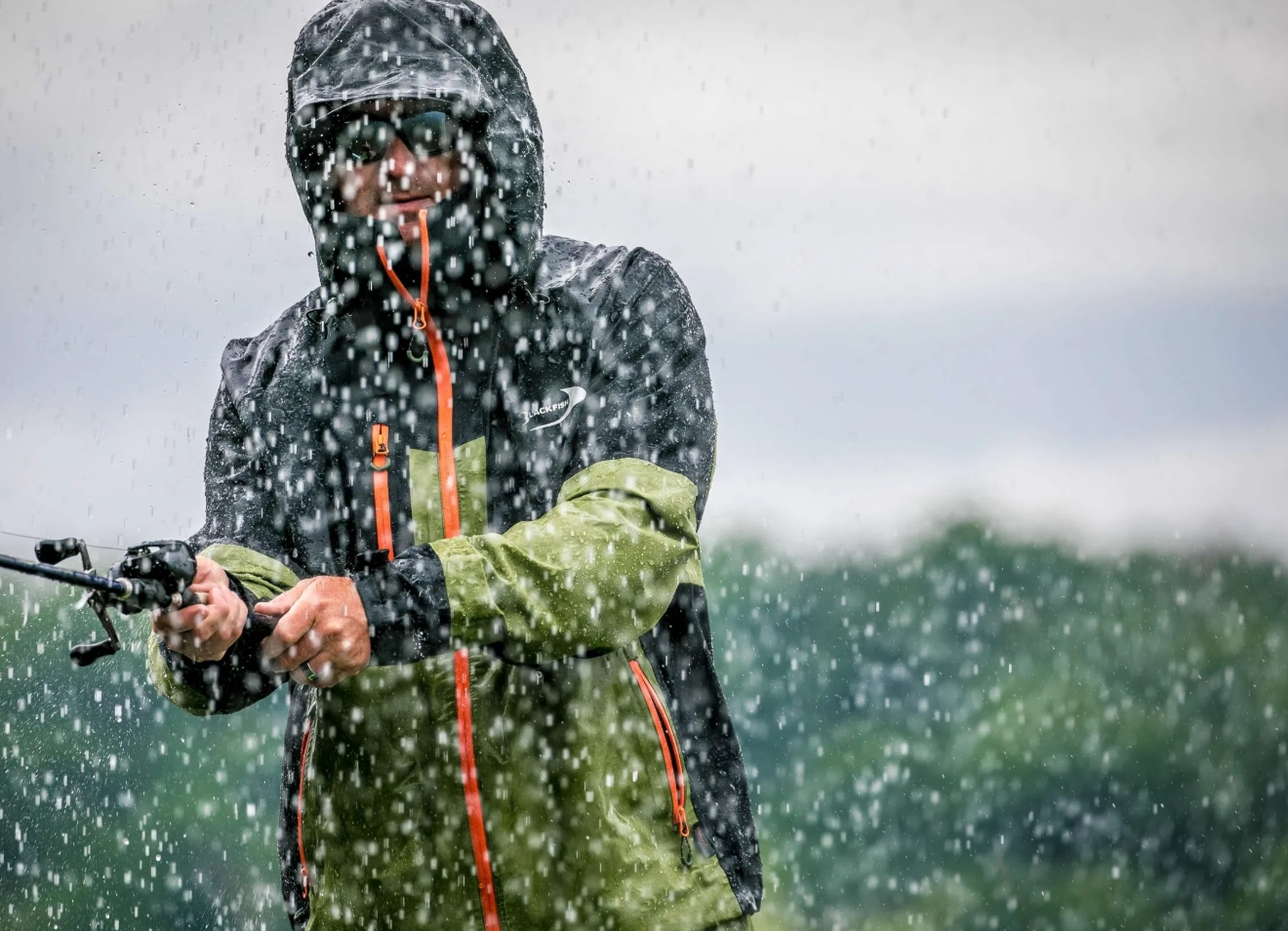
Most rain pants pass every test you run on them at home. Hold them under a showerhead — water beads right off. Seams look solid. DWR coating feels fresh. Take them 30 miles offshore into a 4-foot chop with spray breaking across the bow, and the whole picture changes fast.
Here are the six specific ways rain pants break down out there — not in theory, but in the exact conditions offshore anglers face every trip.
Failure #1: DWR Wet-Out Within 60–90 Minutes of Continuous Spray
This is the one that surprises people most. Your pants aren't defective. The DWR is just done.
Under light rain or occasional splash, that fishing apparel factory DWR coating works as advertised — water beads up and rolls off the outer fabric. Continuous offshore spray is a different animal. The face fabric gets hammered from multiple angles, without pause. The DWR gets overwhelmed. The outer nylon or polyester starts absorbing water instead of shedding it.
Once that happens, the membrane underneath is fighting physics alone. A saturated outer layer builds hydrostatic pressure. That pressure pushes water toward every weak point — thighs, knees, seat. Motorcycle touring tests on comparable membrane-plus-DWR systems showed pants soaked through in about 60 minutes of heavy continuous water exposure. Offshore spray works the same way. The thighs and knees fail first. Fabric compression against the body speeds that up.
The benchmark most anglers don't know: offshore guides reject anything under ~15,000–20,000 mm hydrostatic head for pants used in heavy spray. Most consumer rain pants sit well below that threshold.
Failure #2: Salt + Flex Cracking at the Crotch and Seat
This failure doesn't show up on day one. It shows up on trip eight or twelve — after kneeling on nonskid, sitting on wet coolers, and bending hard into every hookup.
Here's the mechanism. Salt crystals embed in the coating during each trip. Every time you flex — squatting to grab tackle, leaning over the gunwale — those crystals cut against the PU or PVC coating like micro-knives. Over time, hairline cracks form along the crease lines at the crotch and seat.
Here's the deceptive part: those pants still pass a hose test hanging on a rack. Sit on a wet cooler for 45 minutes, though, and cold water seeps straight through those invisible cracks into your base layer. Anglers blame the seams. It's almost never the seams.
The fix most people skip: rinse salt off after every trip. Salt residue left on coated fabrics between sessions is the main driver of this type of cracking.
Failure #3: Seam Tape Peeling at Inner Thighs and Ankle Cuffs
Rain pants' seam tape is built for the gym or the trailhead — not for repeated abrasion against a nonskid fiberglass deck.
Inner thigh seams take the worst of it. Walk forward on a pitching boat, and those seams drag and flex against a rough deck surface. The tape adhesive fatigues. After a handful of heavy-spray trips, the tape starts peeling from the inside. You can't see it from the outside. But water starts wicking through stitched holes that are no longer sealed.
Ankle cuffs fail in a different way. Salt water gets into the thread at the cuff hem. Over a season, that salt breaks down the thread. You start getting slow wicking up from the boot line — subtle enough that your socks are wet by noon and you can't place why. No obvious puncture. No visible damage. Just compromised stitching doing what compromised stitching does.
Failure #4: Boot Interface Leaks Disguised as Fabric Failure
This is the most misdiagnosed failure in offshore boat spray waterproof clothing . It costs people money on gear they don't need to replace.
The scenario: spray hits your leg, runs down the outside of the pants, reaches the top of your rubber boot. The ankle cuff isn't gasketed or snugged tight. Water pools right at that gap and funnels straight in. Your socks are soaked from the ankle down within an hour. Your first conclusion is that the pants leaked.
In reality, the fabric panels can be completely intact. The problem is geometry. Wide, non-adjustable cuffs on consumer rain pants weren't built for the boot-over-pant or pant-over-boot setup on a wet offshore deck. The fix isn't new pants. You need adjustable gasketed ankle closures that create a real seal around your boot shaft.
Failure #5: Condensation Mistaken for Spray Penetration
Heavy-duty PVC rain pants — the kind with enough waterproof rating to handle serious offshore conditions — have a breathability rating of near zero. That's fine standing in cold spray. It becomes a real problem the moment you start fighting fish hard.
Your body heat spikes. Sweat has nowhere to go. The inside of the pants turns into a humid chamber. Moisture builds up against your base layer — at the thighs and seat, the same spots where spray penetration would show up.
Most anglers call it leakage. It isn't. It's breathable fishing foul weather gear doing the opposite of breathing. The fix is different too: better base layer management and scheduled venting, not a warranty claim or a new pair of pants.
Failure #6: Tight Fit Creating Premature Delamination at Knees and Seat
This failure is preventable — and common.
Rain pants sized for a slim fit look clean on land. On a working offshore deck, "slim fit" means constant tension across the knees every time you squat to unhook a fish, and across the seat every time you brace against a wave. That stress concentrates at the zones where the membrane bonds to the outer fabric.
The result: delamination shows up at the front of the knees and under the seat — often within a single offshore season — well before the outer fabric shows any visible wear. The pants look fine on the outside. Inside, they're failing in patches.
Offshore gear guides recommend relaxed fit with articulated knees for this reason. It's not a style preference. It's a structural requirement. Gear that flexes thousands of times across a multi-day run needs room to move — or it destroys itself from the inside out.
The thread connecting all six failures is straightforward. Rain pants are built for weather. Offshore heavy spray is more demanding than weather. It's sustained, directional, salt-laden water pressure on gear designed for parking lots and hiking trails. One hard trip exposes every shortcut in construction, fit, and maintenance.
Structural Solutions: How Bibs Seal the Heavy Spray Zone
Chest-high bibs don't just cover more body. They fix the weak points that rain pants were never built to handle.
Every failure — the waist leaks, the sliding waistband, the ankle funneling, the cold gap between jacket and pants — has the same root cause: rain pants treat the torso as someone else's problem . Bibs don't. They cover the full system from chest to ankle. That one design choice changes how water gets managed under heavy offshore spray.
Here's how each structural element ties back to the failures that cost anglers fish, dry layers, and focus.
The Chest Panel: Closing the Gap That Ends Trips Early
The gap between your jacket hem and your rain pants waistband is the most dangerous spot on an offshore deck. One hard wave, one aggressive lean over the gunwale — and 55-degree water pours straight through. Bibs close that gap for good.
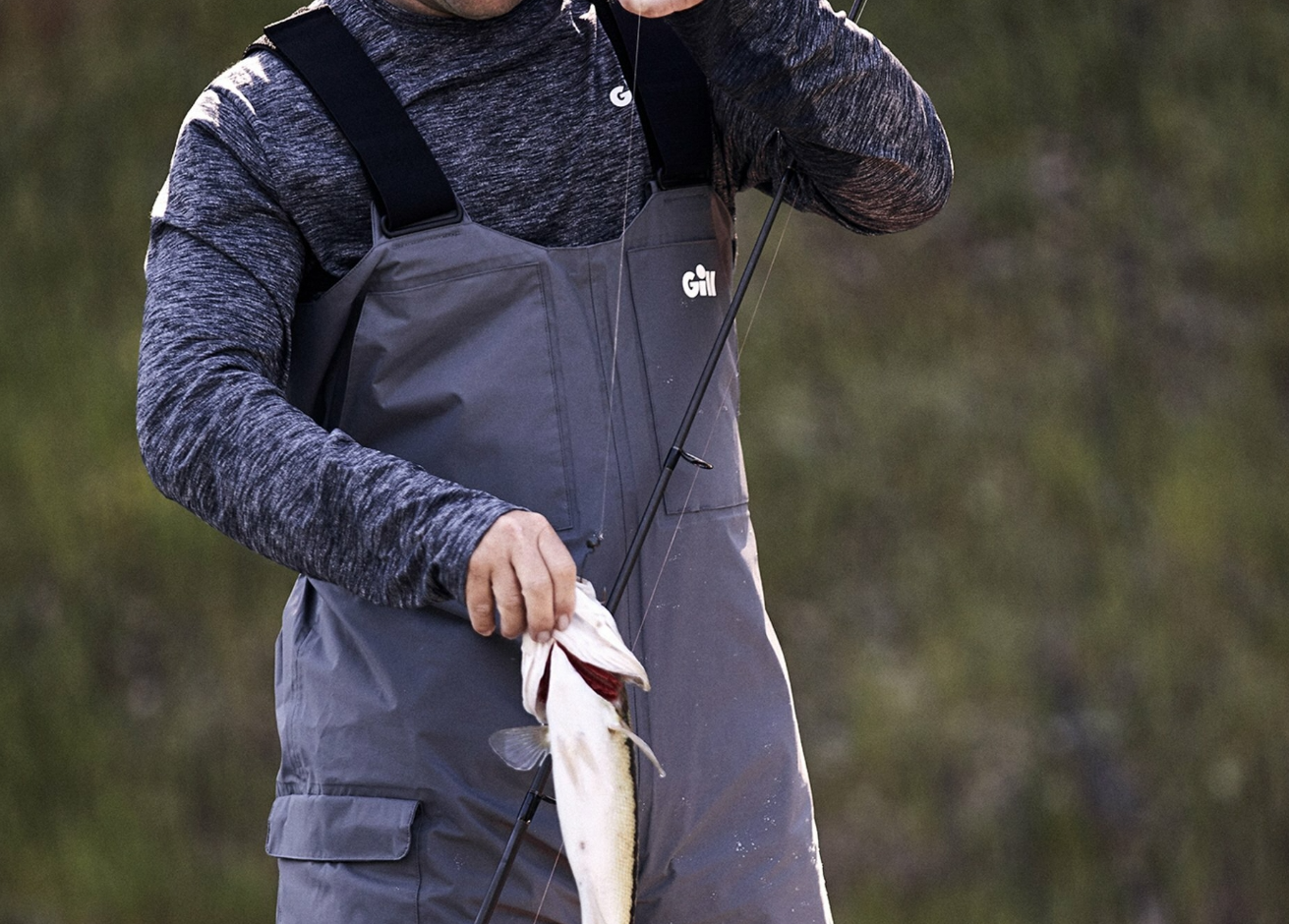
A chest-high waterproof bib overall extends the waterproof zone from mid-chest down. You get 8 to 12 extra inches of sealed coverage above where rain pants stop. Pair them with a quality foul weather jacket, and that junction goes from your most exposed point to your most protected one. The two garments overlap — they don't just barely meet. No gap. No cold water running straight to your base layer.Some offshore crews prefer custom fishing bibs designed for specific weather and deck conditions.
The Suspender System: Staying Put Under Load
The fishing bib suspender system solves the waistband slide problem with basic physics. Suspenders put the load on your shoulders — not your hips. Lean hard into a fighting fish, drop to your knees to unhook a mahi, or brace sideways against a rolling sea — the bib stays put. No readjusting. No exposed skin. No attention pulled from the rod.
High-quality offshore bibs use wide, padded suspenders with quick-adjust buckles built for extended wear — not the thin elastic loops on consumer bib overalls. Leading fishing bibs and rain pants manufacturers reinforce these stress zones to improve long-term offshore durability.Some designs add a secondary sternum clip that keeps the straps from spreading under a heavy jacket. Over a 12-hour offshore run, that stability difference adds up fast.
Sealed Seam Architecture: Built for Sustained Hydrostatic Pressure
Sealed seam fishing bibs handle seam construction differently from trail rain pants. Consumer pants often rely on single or double stitching with a taped overlay. That holds up in light rain. It fails under continuous directional spray.
Offshore-grade bibs use welded or heat-taped seams at every high-stress point: inner thighs, seat, bib panel junction, and ankle cuffs. The seam tape bonds through heat welding — not adhesive alone. That matters because salt exposure and repeated flexing crack standard coated seams by trip eight or twelve.
The face fabric spec matters too. The standard offshore guides rely on for spray protection fishing apparel is 20,000 mm hydrostatic head or higher — about double what most consumer rain pants offer. That rating is not just a number on a tag. It's the line between staying dry in a sustained broadside spray and starting to soak through at the 90-minute mark.
Ankle-to-Boot Gasketing: Sealing the Funnel
Offshore-specific bibs include adjustable, gasketed ankle closures — not wide, loose cuffs. A neoprene or laminated gasket cinches tight around the boot shaft. It cuts off the pooling path that sends spray-runoff straight into your footwear.
Most quality offshore bibs give you two wear options:
- Boot-over-bib for shallow deck work
- Bib-over-boot with cinched gasket for heavy spray conditions
Conditions shift mid-trip offshore — that flexibility is not optional.
Breathability Layer: Dealing With Heat Build-Up
This is where nylon vs Gore-Tex fishing bibs becomes a real choice — not a marketing debate.
PVC or heavy nylon bibs deliver raw waterproof performance. But they trap body heat like a sauna suit during active fishing. Breathable fishing foul weather gear — bibs built on laminated membranes like Gore-Tex or comparable 3-layer constructions — adds a moisture vapor layer. Sweat vents out. Spray stays blocked.
The spec to look for: breathability ratings of 10,000 g/m²/24hr or higher for active offshore use. Drop below that, and condensation inside the bib feels the same as spray soaking through. Same wet base layer. Wrong diagnosis. Wrong fix.
Feature | Consumer Rain Pants | Offshore Fishing Bibs |
|---|---|---|
Hydrostatic Head | 5,000–10,000 mm | 15,000–20,000+ mm |
Seam Construction | Taped (adhesive) | Welded / heat-taped |
Coverage Zone | Hip to ankle | Mid-chest to ankle |
Waist Stability | Elastic/drawcord | Shoulder-load suspender system |
Ankle Closure | Wide unstructured cuff | Gasketed, adjustable |
Breathability | 0–3,000 g/m²/24hr (PVC) | 10,000–20,000 g/m²/24hr |
Spray Gap Exposure | High (jacket-pant gap) | Eliminated |
The structural logic of offshore rain suit fishing bibs is not complicated — but every detail is intentional. Each design element exists because someone got wet in a specific spot, and an engineer traced it back to a specific gap in the garment. Rain pants were not built with offshore heavy spray in mind. Bibs were. That difference shows up on your first trip out — and it builds on every trip after that.
Anatomy of a Bib vs. Pant Failure: Cross-Section Mapping
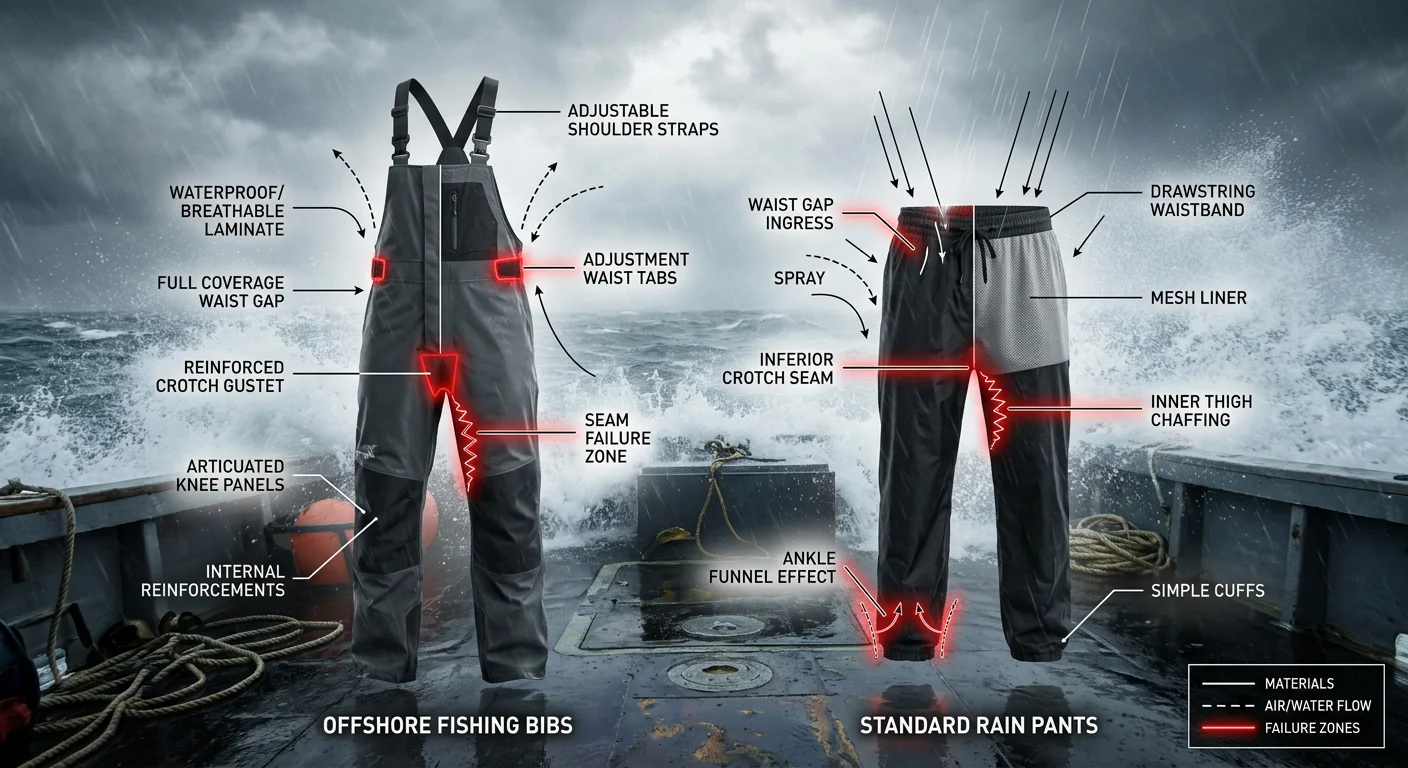
Gear failure on the water isn't random. It has a geography.
Every leak, every cold patch, every soaked base layer traces back to a specific structural zone — a seam junction, a panel boundary, a transition point where one material hands off load to another. You can pinpoint where rain pants fail versus where bibs hold. That's not abstract gear theory. It's a practical map you can read before you buy and check on your first heavy-spray run.
Picture this: draw a vertical line down the front of both garments — bib and pant side by side. Pull apart every layer at five critical zones. The structural differences between them show you right where the water gets in.
Here's that map.
Zone 1: The Torso Transition Line (Mid-Chest to Hip)
On a rain pant, this zone doesn't exist — because the garment doesn't reach it.
The pant's structural coverage ends at the waistband, close to your hip line. Everything above that relies on your jacket making a perfect handoff. In heavy offshore spray, that handoff fails. Water hits your jacket, runs toward the hem, and finds the gap. Once it's past that point, there's nothing waterproof between it and your base layer.
A chest-high bib extends the sealed zone upward by 8 to 12 inches. The bib panel — a reinforced shell with the same membrane stack as the main body — carries coverage from mid-chest down. Your jacket overlaps that panel. The junction becomes a double-sealed zone, not a single point of failure.
The cross-section difference: one garment has a structural boundary at the hip that water can breach. The other has a continuous sealed zone with no exposed transfer point.
Zone 2: The Waistband — Load Path and Seal Integrity
This is the clearest structural difference between the two garments. It also drives more real-world failures than any other single point.
A rain pant waistband does two jobs: it holds the garment up and creates the upper waterproof seal. The problem is those two jobs fight each other under load.
Lean hard into a fighting fish. The waistband drops. The seal breaks. The gap between your jacket hem and the pant top opens. At that exact moment — body flexed, jacket riding up, pants sliding down — you're most exposed. It's the worst possible time for the seal to fail. And it does, every time. The load path runs through your hip bones instead of your shoulders. That's the root cause.
Bibs shift that load path to your shoulders. The suspender system transfers garment weight to the shoulder girdle. The bib panel doesn't slide because it's anchored from above, not held in place by friction at the waist.
Practical result: under maximum body load — the position you're in when a fish is running — a bib holds its seal. A rain pant loses it.
Zone 3: The Inner Thigh and Seat — Compression and Flex
Look at a cross-section through the inner thigh of both garments during active use. You'll find the highest concentration of stress in either design: fabric compression against the body, repeated flex cycles, seam intersections, and constant salt exposure.
Rain pants stack all of that stress at sealed seam junctions with no pressure relief built in. The adhesive-taped seams that pass a showerhead test develop micro-gaps under real-world flex. Squatting and bending pushes water through those gaps faster than water pressure alone would.
Offshore bibs fix this through two structural changes:
- Welded seam construction at the inner thigh and seat — heat-fused bonds replace adhesive tape and hold up under sustained flex
- Articulated patterning with extra panel width through the seat and thigh — this reduces compression load on the seam lines
Less compression. Stronger seams. The two fixes work together.
Zone 4: The Ankle-to-Boot Interface — The Funnel Problem
Look at the cross-section at the ankle, and rain pants show a basic geometry flaw. A wide, ungasketed cuff creates an open channel. Spray runoff flows straight into it.
Water hits your leg, follows gravity, reaches the cuff, and pools at the boot collar. A loose cuff has no way to stop that path. The spray doesn't need to breach the fabric. It just needs to find the gap, and physics does the rest.
Offshore bib ankle closures change the geometry. A neoprene or laminated gasket cinches tight around the boot shaft. An open funnel becomes a sealed collar. The water path hits the gasket and stops. No pooling point. No channel. No funnel effect.
It's a small structural feature. But it makes a big difference in how dry your feet stay after six hours in the spray.
Reading the Full Map
Zone by zone, the structural logic becomes clear. Rain pants fail at predictable spots — the torso gap, the sliding waist seal, the compressed inner thigh seams, the ankle funnel. Their design doesn't account for the directional, sustained, salt-laden water pressure of offshore heavy spray.
Bibs don't just add coverage. They shift the load paths, seal the transition zones, and close the geometry gaps that rain pants leave open by design.
The cross-section doesn't lie. Every wet spot on your base layer has a structural address.
Material & Spec Comparison: Offshore Heavy Spray Readiness
Numbers separate gear that holds from gear that folds.
The structural design differences covered earlier — the chest panel, the suspender load path, the gasketed ankle — don't work alone. The materials behind them decide everything. A welded seam in substandard fabric still fails. A gasketed cuff on a 5,000 mm hydrostatic-rated shell still soaks through by noon. So before you spend money on bibs or rain pants marketed as "offshore ready," know which specs matter under sustained heavy spray — and what the numbers mean on the water.
Hydrostatic Head: The Threshold That Counts
Most consumer rain pants are rated between 5,000 and 10,000 mm hydrostatic head . That range handles commuting in the rain. It does not handle a 4-foot chop breaking across your bow every 90 seconds for six hours straight.
Offshore guides use a simple cutoff: 15,000 mm minimum for pants, 20,000 mm or higher for bibs . That gap isn't marketing. One membrane fights sustained directional pressure. The other is already losing by hour two.
Quality sealed seam fishing bibs built for heavy offshore spray spec out at 20,000–30,000 mm — some go higher. At that rating, the fabric shell stops being the weak point. The seams and closures carry the load instead.
Breathability: The Spec That Prevents Misdiagnosis
Spec | Consumer Rain Pants | Offshore Fishing Bibs |
|---|---|---|
Hydrostatic Head | 5,000–10,000 mm | 20,000–30,000+ mm |
Breathability | 0–3,000 g/m²/24hr | 10,000–20,000 g/m²/24hr |
Seam Construction | Adhesive-taped | Heat-welded |
Face Fabric | Single-layer nylon/PVC | 2.5L or 3L laminate |
Outer DWR | High-durability C6/C8 treatment |
Breathable fishing foul weather gear rated below 10,000 g/m²/24hr creates a real problem. Moisture buildup inside the garment feels the same as spray coming through. Same wet base layer. Wrong diagnosis. The fix for condensation is ventilation and base layer management — not a warranty return. The fix for spray penetration is higher hydrostatic head. Mixing up the two costs you money.
Comparing nylon vs Gore-Tex fishing bibs comes down to this one point. Heavy nylon shells with PVC backing give you raw waterproof numbers but near-zero breathability. Three-layer laminate constructions — Gore-Tex, eVent, or comparable membranes bonded to inner and outer fabric — give you both. You're fighting fish hard in cold spray. That active breathability rating isn't a luxury. It keeps your insulation layer dry instead of soaked from the inside out.
Face Fabric: Where DWR Durability Divides the Field
Spray protection fishing apparel rises or falls on how long the outer DWR treatment holds up under salt exposure and UV. Standard fishing rain gear factory DWR on consumer rain pants starts wetting out after repeated salt-spray sessions. High-durability DWR treatments — C6-based formulations on offshore-grade bibs — hold bead-off performance far longer under the same salt exposure.
Here's a practical test: after five offshore trips, lay the garment flat and hit it with a hose. Consumer rain pants start absorbing water across the face fabric. Quality offshore bibs bead it off clean. A saturated outer layer doesn't mean the membrane has failed — but it stacks extra hydrostatic load onto a membrane not built to carry that weight alone.
The short version: check your spec sheet on your boat spray waterproof clothing . No hydrostatic head above 15,000 mm? No seam-welding confirmation? No breathability rating above 10,000 g/m²/24hr? That gear wasn't built for offshore heavy spray. It was built for the parking lot.
Real-World Decision Matrix: Upgrade to Bibs
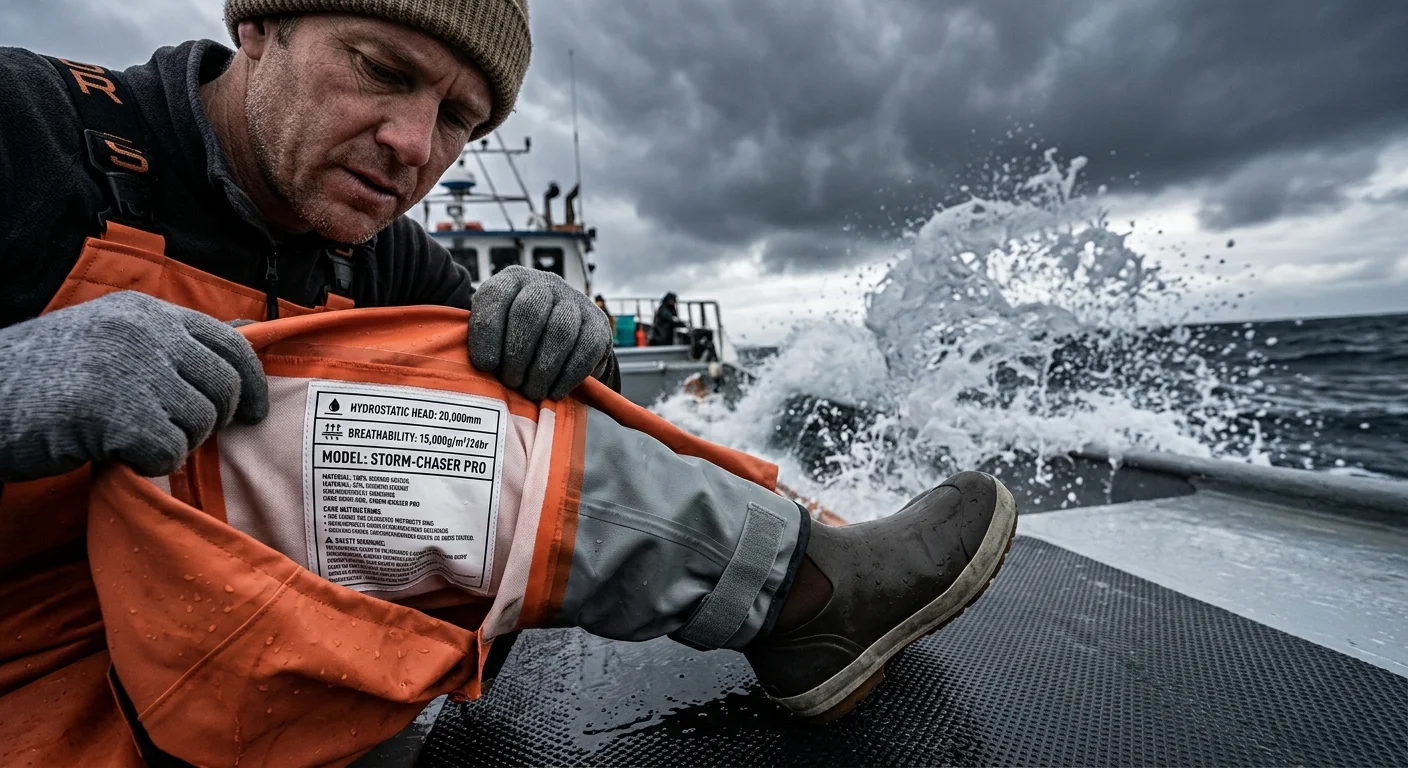
Three questions tell you whether bibs are the right call. How often are you offshore? How rough do conditions get? How much does a soaked base layer cost you in focus and fish?
Use this matrix. Score yourself. The answer will be clear.
The 3-Tier Upgrade Framework
Tier 1 — Occasional Inshore (1–4 trips/year, protected water, light spray)
Rain pants hold up here. You're not running 30 miles offshore into a 4-foot chop. Spray hits you in short bursts — not for hours straight. DWR wet-out, seam fatigue, and waist seal failure don't repeat often enough to stack up. A quality pair of consumer rain pants rated at 10,000 mm hydrostatic head gets the job done. Bibs are a want, not a need.
Tier 2 — Regular Near-Shore (6–15 trips/year, moderate chop, occasional heavy spray)
This is where rain pants start losing the argument. Six to fifteen trips means salt cycles through your seam tape every season. The crotch and seat flex against nonskid on a working deck. Waist seal failures stop being rare — they become predictable. Fish this tier from October through March in cold water, and the upgrade to sealed seam fishing bibs pays for itself in dry insulation layers alone.
Tier 3 — Dedicated Offshore (15+ trips/year, open water, sustained heavy spray)
No debate here. Rain pants aren't a budget option at this level — they're a liability. Broadside spray hits you for hours. Multi-hour fights drain your focus. Cold deck work grinds you down. Every failure mode from the earlier tiers stacks up across your season. Breathable fishing foul weather gear with 20,000+ mm hydrostatic head and welded seams is the baseline, not an upgrade.
Quick-Score Checklist
Score three or more of these, and bibs are the right move:
You fish offshore 6+ times per year in open water
You work in 3-foot chop or heavier on a regular basis
Water temperature drops below 60°F during your season
You've already had waist seal leakage or slide during a fight
Your trips run longer than 6 hours on the water
You layer fleece or insulation underneath your rain gear
Score 5–6: Stop shopping rain pants. Get bibs rated for offshore rain suit fishing conditions.
Score 3–4: Bibs are a smart investment this season — especially in cold water.
Score 1–2: Get more out of what you have. Refresh your DWR, check your seam tape, and reassess next season.
The math is simple. A ruined insulation layer. A lost fish at the gunwale because you were adjusting your waistband. A trip cut short because you're soaked through by noon. None of that is hypothetical. Chest-high waterproof bib overalls cost more than rain pants — not because they're a luxury product, but because they solve problems rain pants were never built to handle.
Conclusion
Spend enough hours getting hammered by offshore spray and the truth becomes clear. Rain pants don't fail because you picked the wrong brand. They fail because a waist seal was never built to handle a full day of heavy water from every angle.
That's the core problem waterproof fishing bibs fix — at the design level, not the patch-and-hope level.
Fishing nearshore a few times a year? Rain pants might still do the job. But running offshore in serious conditions is different. You're bent over the gunnel. Spray hits chest-high. Cold water finds every gap. At that point, the question isn't whether bibs are worth it. It's how many soaked layers it takes before you already know the answer.
The next step is straightforward:
Check your sea state and how often you fish offshore
Run it against the decision matrix above
Buy once. Fish dry.
Many commercial crews now work with OEM/ODM rain pants and fishing bibs programs for more reliable offshore gear systems.Out there at 30 miles offshore, comfort isn't a luxury. It's concentration.