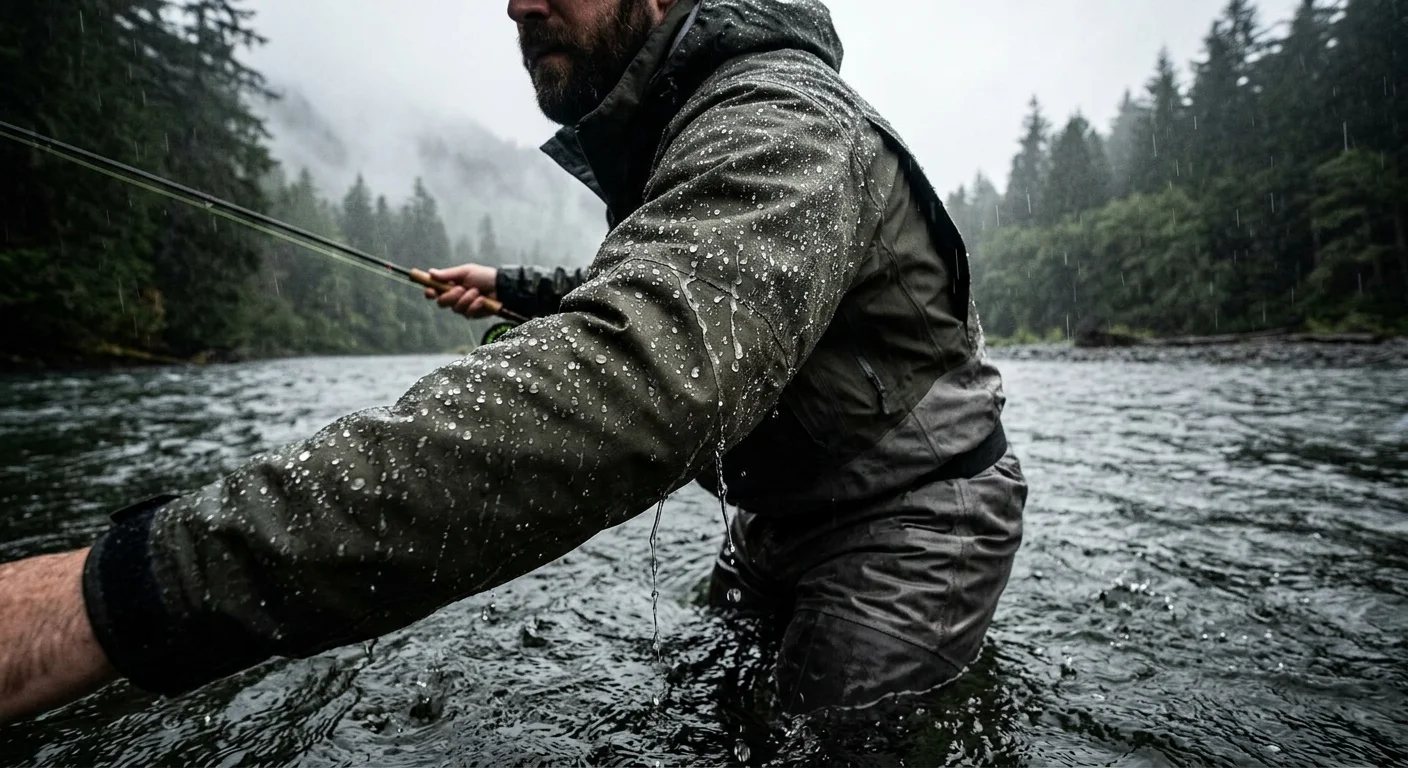
You've stood in the rain long enough to know that "waterproof" on a hang tag means almost nothing. The jacket that kept you dry on a weekend hike will betray you three hours into a river wade. You're crouching into the current, casting arm cycling overhead, and cold water finds every weak seam. It always does.
A fishing jacket isn't outerwear with a rod loop stitched on. For brands developing custom fishing jackets, understanding these technical details is often what separates a high-performance product from a generic outdoor shell.It's a precision instrument. The gap between a good one and a great one lives in details most anglers never stop to examine — until they're already soaked.
This is a ground-up breakdown of materials, construction methods, and functional design principles. These are the factors that separate a capable fishing jacket from an expensive letdown. So the next time you're standing in a shop or scrolling a product page, you'll know what to look for — and what to walk away from.
Decoding Waterproof Ratings: Hydrostatic Head Metrics & Scenario Performance
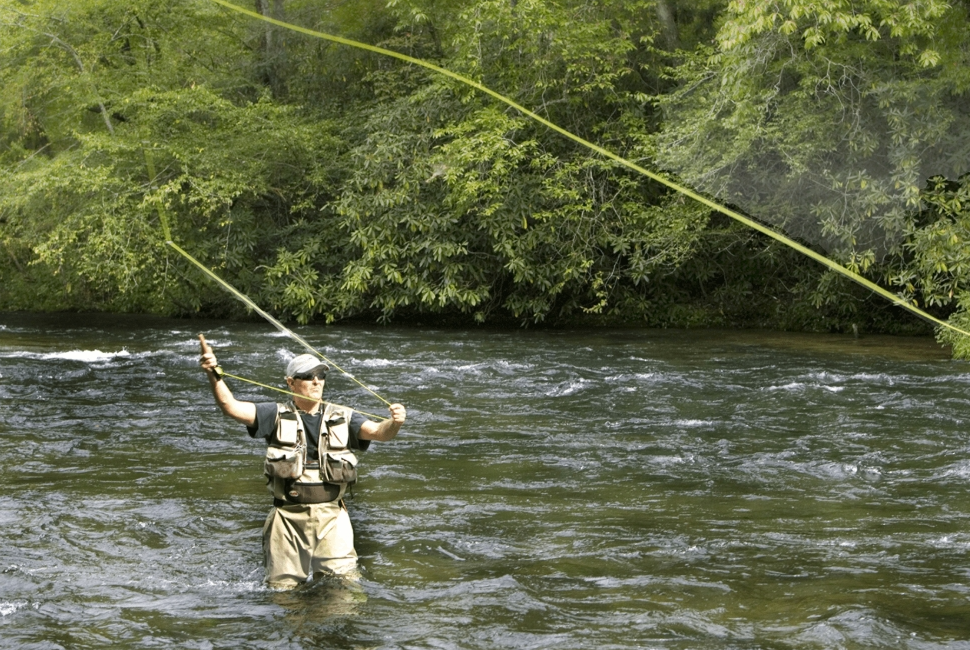
The number printed on a spec sheet — 10,000 mm , 20,000 mm — is not marketing poetry. It's a precise engineering measurement. Once you understand it, you'll shop smarter every time.
That number is called hydrostatic head (HH) . The test is simple: a column of water presses against a fabric swatch until water passes through. The height of that column, measured in millimeters, becomes the rating. Many OEM/ODM fishing apparel projects use hydrostatic head benchmarks as a core specification when developing jackets for different fishing environments and weather conditions.A jacket rated 20,000 mm HH can hold back a 20-meter column of water before leaking. Not a metaphor. A pressure test.
Here's why it matters on the water:
HH Rating | Practical Condition | Fishing Scenario |
|---|---|---|
3,000–5,000 mm | Light rain, brief exposure | Dock fishing, short walks between holes |
5,000–10,000 mm | Sustained moderate-to-heavy rain | Full-day lake sessions, light wading |
10,000–20,000 mm | Heavy rain, high-pressure contact | Creek wading, kneeling on wet banks |
20,000 mm+ | Premium protection, extended exposure | Offshore, expedition-level conditions |
Look at that last column. Kneeling and sitting aren't passive activities. They push your body weight into the fabric. That creates focused pressure in one spot. A lower-rated material hits its limit fast. A jacket rated at 5,000 mm might hold up in a downpour — then fail the second you kneel to net a fish.
DWR Is Not Waterproofing — Know the Difference
This is where fishing jacket manufacturers blur the line, and where anglers get burned.
DWR (durable water repellent) is a surface treatment. It makes water bead up and roll off the outer fabric. It looks impressive. It's useful. But it's not what keeps water out under pressure. The waterproof membrane beneath the fabric does that job.
DWR breaks down over time — abrasion and repeated washing wear it out. Once it goes, water stops beading and soaks into the outer fabric instead. The jacket feels wet and heavy. Most anglers think the jacket has failed. Most of the time, the membrane is still fine. You need reproofing spray, not a new jacket.
Reproofing restores surface beading. It does not change your HH rating. These are two separate systems. Mixing them up is a costly mistake.
The Spec Pair That Decides Performance
A high HH rating means nothing if the seams leak. Stitch holes are the weak point in any waterproof jacket — water finds them regardless of how good the fabric is. The fix is seam sealing : either taped seams (waterproof tape bonded over every stitch line) or targeted sealing on the zones that take the most exposure.
The buying rule is straightforward: check the HH number and the seam treatment together. A jacket listed as "waterproof fabric" with no mention of seam construction is an incomplete answer. For serious fishing — anything past a light drizzle — you want at least 10,000 mm HH with sealed seams. For wading, kneeling, or offshore conditions, 20,000 mm is the number worth paying for.
No both numbers on the product page? Assume it can't deliver.
Membrane Technology Breakdown: Breathability, Durability & Cost Trade-offs
Every waterproof jacket carries a built-in conflict. The same barrier that blocks rain also traps sweat inside. Fishing apparel manufacturers call this the breathability trade-off. Grasping this concept is the most useful thing you can do before spending serious money on fishing apparel materials.
Two numbers define this trade-off. The first is hydrostatic head (HH) — already covered. The second is MVTR (moisture vapor transmission rate) , measured in grams of vapor per square meter per 24 hours. A jacket rated at MVTR > 10,000 g/m²/24 h gives you real breathability for active fishing. Drop below that threshold, and you're wearing a warm, wet bag after 90 minutes of hard wading.
ePTFE Membranes (Gore-Tex and Similar): Maximum Armor, Real Cost
The benchmark technology is expanded polytetrafluoroethylene — ePTFE. The membrane contains up to 9 billion micropores per square centimeter . Each pore runs 0.1–0.5 microns wide. That's too small for a liquid water droplet to push through, but large enough for a vapor molecule to pass.
A quality 3-layer ePTFE shell delivers:
Hydrostatic head : 20,000–30,000 mm on premium marine and wading versions
MVTR : 15,000–25,000 g/m²/24 h in real-world conditions
RET (breathability resistance) : 5–8, with RET < 6 rated as extremely breathable
The 3-layer laminate bonds the face fabric to the membrane, then bonds the membrane to a tricot backer. This makes it the most durable build available. It shrugs off salt spray, holds up in sub-zero temperatures without going rigid, and works well with 70–200D ripstop nylon fishing jacket face fabrics that add solid abrasion resistance.
The price for this performance is clear: US$300–800 for serious wading jackets and Gore-Tex fishing gear . That's not a luxury charge. That's what it costs to engineer durable, consistent protection for cold rivers and offshore chop.
eVent: The Breathability Specialist
eVent uses an ePTFE membrane too, but takes a different design path. Gore-Tex-type builds seal the pores with a thin, continuous PU layer to block contamination. eVent keeps those pores open and uses an oleophobic treatment instead. The result is direct vapor venting — moisture exits before it condenses against your skin.
You can feel the difference in the field. During hard effort — aggressive wading, scrambling rocky banks, fighting a strong current — eVent shells feel drier against the skin than comparable Gore-Tex builds, even with similar lab MVTR numbers. The system reacts faster because it doesn't wait for humidity to spike before vapor starts moving.
Performance benchmarks:
HH : 20,000–30,000 mm, on par with ePTFE
MVTR : 20,000–30,000+ g/m²/24 h in good conditions
RET : 3–6, sitting firmly in the "extremely breathable" band
The trade-off is maintenance. Open pores that vent well also clog faster. Body oils, insect repellent, and sunscreen are the main threats. A neglected eVent shell loses its performance edge faster than a well-maintained Gore-Tex equivalent. Wash your gear on a regular schedule, and eVent earns its price. Skip gear care, and the investment fades fast.
PU Membranes: The Honest Budget Option
Polyurethane coatings cover most of the US$80–200 fishing jacket market. They work. The key is knowing where they work — and where they fall short. Most gear reviews skip that part.
A solid PU coating lays a continuous film over the face fabric. It holds 5,000–10,000 mm HH , which handles light to moderate rain and casual boat fishing fine. The breathability picture is harder to sell:
MVTR : below 8,000 g/m²/24 h for most options, with better hydrophilic PU membranes reaching 10,000–15,000 g/m²/24 h in good conditions
RET : often 6–13, ranging from "moderately breathable" into "barely breathable" territory
The reason comes down to how PU works. Hydrophilic PU doesn't vent vapor through open pores. It uses molecular diffusion — and that process only kicks in once internal humidity is already high. In plain terms: you'll feel clammy before the jacket starts working. For a low-effort session on a cool boat deck, that's a fair trade-off. For a three-hour wade in warm weather, that clamminess becomes the main problem of the day.
PU also wears down faster in saltwater and humid storage. Hydrolysis — the breakdown of the polymer by moisture — leads to delamination and flaking. This can happen within two to three seasons of hard use.
The Comparison You Need
Membrane Type | HH Rating | MVTR (g/m²/24h) | RET | Durability | Price Range |
|---|---|---|---|---|---|
3-layer ePTFE (Gore-Tex type) | 20,000–30,000 mm | 15,000–25,000 | 5–8 | Highest | $300–800 |
eVent (open-pore ePTFE) | 20,000–30,000 mm | 20,000–30,000+ | 3–6 | High (maintenance-sensitive) | Mid–high |
PU membrane / coating | 5,000–10,000 mm | < 8,000–15,000 | 6–13 | Lowest long-term | $80–200 |
The 30-Second Decision Framework
Cut through the fishing jacket marketing and two questions point you to the right choice.
How active is your fishing? Sessions with constant casting, wading current, or hiking to remote water need a microporous membrane — ePTFE or eVent — with RET < 6 and MVTR > 15,000 g/m²/24 h . Anything lower, and breathable fishing outerwear becomes a promise that breaks down under real effort.
What are the conditions? For serious, extended exposure — offshore chop, cold river wading, multi-day trips — set your minimum at 20,000 mm HH with 3-layer ePTFE construction. For calm bank sessions or the occasional boat day in mild weather, a quality PU shell at 10,000 mm is a smart, honest pick — not a compromise.
The membrane inside a jacket isn't a marketing feature. It's an engineering choice with real performance limits. Know the numbers, match them to your water, and the jacket you buy will perform when the weather turns bad — which, if you fish enough, it always does.
Base Fabric Architecture: Ripstop Nylon, Polyester & Denier Durability
The membrane inside your jacket handles water pressure. The base fabric handles everything else — the barnacled hull you brush against, the gunwale edge that catches your sleeve, the rocky bank you crawl over to land a fish. Most anglers never think about it until something tears.An experienced technical fishing apparel factory pays close attention to denier selection, weave structure, and abrasion resistance long before the garment reaches the water.
Denier is the starting point. It measures yarn thickness: grams per 9,000 meters of fiber. Higher denier means heavier, thicker yarn — and a tougher outer shell. Here's a simple breakdown:
Denier Range | Fabric Weight (est.) | Field Reality |
|---|---|---|
20–30D | ~43–65 g/m² | Ultralight, but a sharp rock contact can puncture it |
40–50D | ~87–110 g/m² | Balanced — packable and abrasion-resistant |
70D+ | ~150 g/m²+ | Guide-grade toughness; less packable |
40D is the practical floor for any jacket that touches rocks, dock hardware, or boat rails. Below that, you're gambling.
Ripstop Architecture: Why the Grid Matters
Ripstop fabric weaves thicker reinforcement yarns through a finer base at regular intervals — a 3–8 mm grid pattern. Those grid lines act as physical barriers. A snag starts a tear. The reinforcement stops it from spreading across the panel. A 40D ripstop nylon fabric stops tears far better than a plain-weave fabric at the same denier.
Nylon vs. Polyester: The Real Trade-off
These two fabrics are not interchangeable. Each one solves a different problem.
Nylon wins on toughness. At the same denier, nylon is stronger than polyester in both tear strength and abrasion resistance. The gap is real — 420D nylon can outperform 600D polyester on a rocky bank. For offshore fishing, reef edges, and repeated hull contact, nylon is the right call.
Polyester wins on environmental stability. It absorbs less water, dries faster, and holds its shape when wet. It also resists UV breakdown far better than nylon. For high-sun freshwater wading — all-day lake fishing, exposed stream banks — polyester's UV durability adds years to your jacket's life.
The abrasion trade-off is real. In sustained rough contact, polyester at equal denier fuzzes and pills faster. That's not a problem if your water doesn't demand it. It becomes a big problem if it does.
Matching Fabric to Water
Rock, reef, offshore, dock hardware : ≥40D ripstop nylon outer shell. Full stop.
Stream wading, light freshwater, packable travel use : 30D polyester ripstop works well here — lighter, faster-drying, UV-stable — but you do give up some abrasion protection.
One last point worth knowing: denier is just one variable. A 20D polyester plain weave loses to a 30D polyester ripstop. That 30D ripstop loses to a 40D nylon ripstop — even though each step just means "thicker" fabric. Material, denier, and weave structure all stack on top of each other. Bond a premium membrane to a weak face fabric and it still fails the moment the outer layer tears through. The shell underneath is only as strong as what protects it from the outside.
Weatherproofing Construction: Seam Sealing, Storm Flaps & Corrosion Hardware
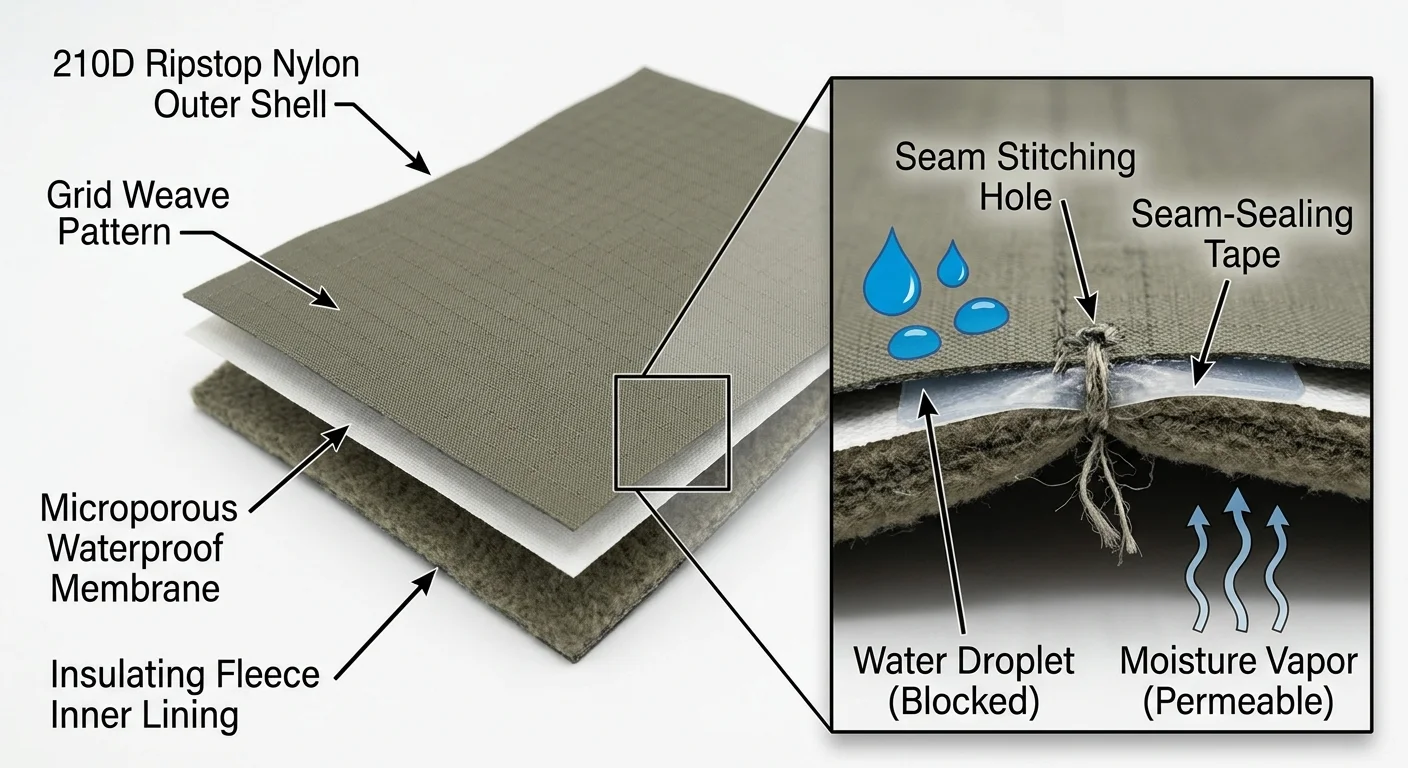
The fabric doesn't fail first. The seams do.
Every stitch hole is a perforation. A needle punches through your waterproof membrane hundreds of times along every seam line — shoulder, sleeve, hood attachment, pocket join. The fabric on either side of that seam might hold 20,000 mm of hydrostatic pressure without issue. The needle holes hold almost nothing. Without seam sealing, you're wearing a colander.
Fully Taped vs. Critically Taped: A Distinction Worth Understanding
Two seam-sealing standards exist in the industry. Most fishing jacket manufacturers count on buyers not knowing the difference.
Fully taped means what it says. Every stitched seam on the jacket — shoulders, back panel, side seams, sleeve seams, hood panels, pocket joins — gets covered with heat-applied waterproof tape on the inside. Tape width runs 13–22 mm across most panels. It widens to 25–30 mm at high-pressure zones like the shoulder yoke and hood attachment points. The result is a continuous sealed shell. Rain can push all day and find no way through.
Critically taped means the "important" zones get sealed — shoulders, upper back, and collar area. Side seams, underarm panels, and most pocket bags stay unsealed. The stitching is exposed. Under sitting pressure, kneeling contact, or sustained wind-driven rain, those unprotected seams pull water straight through.
Marketing language won't always flag this distinction. A jacket described as "waterproof construction" or "taped seams" might be critically taped — not fully taped. For serious fishing — wading, offshore, anything past a light drizzle — critically taped falls short. Turn the jacket inside out before you buy. Fully taped seams show continuous shiny tape on every seam line. No gaps. No exposed stitching. Critically taped construction leaves large stretches of raw thread in plain sight.
One more thing to inspect: T-junctions and curved seams around the armhole and hood are the hardest sections to tape well. Check those corners. A small un-taped gap at a junction leaks under the same pressure as a wide-open seam.
Storm Flaps: Width, Coverage & Water Management
The front zipper is a structural gap running the full length of your chest. The storm flap is the one thing standing between that gap and horizontal rain at 20 mph.
A functional storm flap needs at least 10–15 mm of overlap beyond the outermost zipper teeth along its full length. Close the zipper, pull the flap flat, then look from the side. Coil teeth peeking out at any point means wind-driven rain finds that gap in the first serious squall.
For offshore or coastal fishing, the best wading jackets and marine-grade fishing outerwear use a dual system: a wide external flap with snap or magnet closure, plus an internal gutter flap behind the zipper that channels water downward. The external flap handles direct rain. The internal gutter handles water that slips past under pressure.
Closure hardware on the flap matters more than most anglers expect:
Magnets : Fast with gloves, hold well under partial misalignment, don't clog with ice the way hook-and-loop does
Stainless steel or coated brass snaps : Slower than magnets but rock-solid in cold and salt
Hook-and-loop (Velcro) : Collects sand, weed, and ice; loses grip fast; wears down face fabric over time — common on budget rain shells, not suited for demanding marine conditions
Two small details separate well-built flaps from poor ones: a laminated chin guard at the top of the zipper shields the slider from direct rain. A drain notch or channel at the flap's lower edge lets pooled water flow out rather than get pushed through the zipper each time you bend at the waist.
Corrosion Hardware: The Slow Failure Nobody Warns You About
Salt destroys hardware on a timeline that outlasts your warranty. A zipper that glides in the shop will seize after two seasons of saltwater spray if the slider isn't built for it.
YKK AquaGuard zippers are the industry benchmark for water-resistant outerwear. PU-coated tape with reverse-coil or VISLON construction shields the teeth behind a smooth film. They offer strong weather resistance, though not full submersion waterproofing. For offshore and sea fishing, VISLON (plastic-toothed) zippers with corrosion-resistant sliders outlast standard metal-tooth construction in long-term salt exposure.
Slider material is the key thing to check. Look for:
Nickel-free, anti-corrosion coated sliders or full acetal/high-grade resin sliders — these resist pitting in saltwater
AISI 316 marine-grade stainless steel for exposed D-rings, carabiner loops, and any load-bearing attachment points
Acetal (POM) buckles for adjusters — solid cold-weather toughness and good resistance to salt
Avoid plain steel components, thin chrome-look plating, and any snap or D-ring with no material spec listed. Marine-grade hardware gets tested to 240–500 hours of neutral salt spray (ASTM B117) without red rust. Premium fishing jacket hardware targets over 1,000 hours on critical components. A product page with no salt-spray ratings and no clear "marine grade" callout on zippers and snaps? Assume it isn't.
The tell is right there on the display floor. Check the zipper pulls and snap faces on a jacket that's been hanging in a coastal shop. Micro-rust on a product that's never been fished tells you everything you need to know.
The Construction Check That Takes 90 Seconds
Before any fishing jacket earns serious consideration, run this sequence:
Turn it inside out. Examine every seam. Continuous tape with no breaks or lifting edges means fully sealed. Exposed stitching on side seams means critically taped — you'll know exactly where that line is the first time rain turns sideways.
Close the zipper, pull the storm flap flat, look from the side. Visible teeth mean inadequate coverage.
Tug the flap sideways and down. Movement that exposes zipper coil means wind-driven rain will do the same.
Check every metal component — slider, snaps, D-rings. Bare steel, thin plating, no material callout: walk away.
A seam-sealed jacket with a well-built storm flap and marine-grade hardware costs more to make. That cost shows up in the price. It also shows up — without fail — in the field, the day the weather turns and everything you're wearing gets tested at once.
Ergonomics & Accessibility: Hood Engineering, Articulated Sleeves & Pocket Systems
Casting a rod is a full-body movement. The shoulder rotates, the elbow drives forward, the wrist snaps through. Repeat that motion a hundred times in a jacket with flat-cut sleeves and a hood that folds over your eyes at the first gust. The jacket stops protecting you. It starts working against you.
Articulated Sleeves: Engineering for the Cast
The difference between articulated sleeves and standard-cut sleeves isn't visible on a hanger. You feel it the moment you reach overhead. Articulated construction adds shaped panels at the shoulder and elbow. These panels follow the arm's natural range instead of pulling against it. Good fishing jackets build this shaping into the sleeve pattern itself. The fabric moves with you rather than binding at the shoulder seam mid-cast.
The test is simple: put the jacket on and simulate a full overhead cast. Watch for three things:
- The back hem rides up
- The shoulder seam shifts toward your neck
- The sleeve pulls tight across the bicep
Any one of those signs means the pattern isn't built for active fishing.
Hood Engineering: Structure Over Softness
A collapsible hood is useless on the water. You need a structured hood with enough shape to stay open and stay in position. It should fit over a cap or a beanie without dumping rain onto your face every time you look downstream. A wire-brimmed or stiffened peak holds its shape under wind. Helmet-compatible sizing is worth having for offshore use.
Pocket Systems: Accessibility Under Pressure
Pockets on a fishing jacket aren't just storage — they're an operational system. The core rule is simple: the right item must be reachable with one hand, in the rain, while holding a rod.
Chest placement beats hip placement for active wading. High chest pockets sit clear of a wading belt or PFD. Waterproof zippers with garage pulls keep the entry sealed without snagging fly line. Internal trap-door geometry — an S-bend entry channel — keeps items from sliding out as you lean into a cast or crouch to net a fish.
Run the inversion test before trusting any pocket. Load it up, flip the jacket upside down, shake it hard. Anything falls out — the pocket failed.
Ventilation & Moisture Management: Pit Zips, RET Values & Packable Dynamics
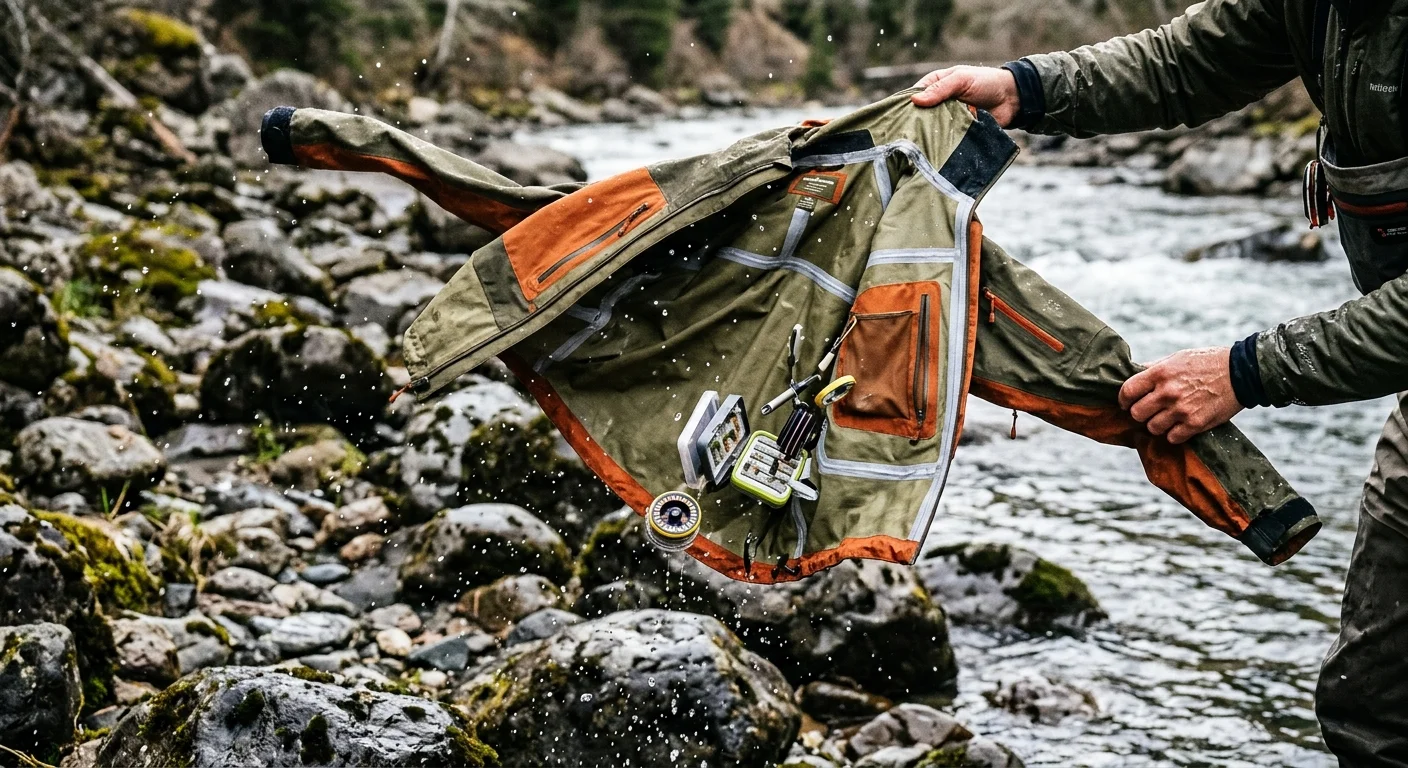
Here's what membrane marketing won't tell you: even a 30,000 g/m²/24 h MVTR rating turns into a sweat bag the moment your heart rate climbs. Fabric breathability has a ceiling. Physical ventilation does not.
Pit zips exist for exactly this reason. Their presence or absence on a breathable fishing outerwear shell tells you more about real-world performance than any lab number on the hang tag.
Why Membrane Numbers Aren't Enough
RET measures resistance to evaporative heat transfer. Lower is better. The comfort bands break down like this:
RET Range | Breathability Level | Best Fit |
|---|---|---|
< 6 | Very breathable | Hard wading, active lure casting |
6–13 | Moderate | Boat fishing, walking between spots |
> 13 | Low | Static use only — vents become mandatory |
Here's the catch: RET < 6 fabric still behaves like a plastic bag during intense effort. That's without mechanical ventilation. Field testing confirms it — no fabric breathes as well as a protected vent.
Pit Zips: Design Specs That Matter
A 5 cm pit zip is useless. Functional pit zips on a fishing jacket run 25–35 cm per side . That creates 75–140 cm² of open vent area . The difference? One trims humidity slightly. The other dumps heat fast.
Top designs — like Outdoor Research's hem-to-pit side zippers — build a full chimney effect. Cool air enters at the open cuffs and front zip. Warm air exits through the underarms. Add a mesh-backed back yoke vent under a storm flap, and you get genuine cross-flow ventilation. That external flap is non-negotiable. Skip it, and cold wind hits your spine on a moving boat.
For summer lake fishing in still air:
- Open the pits wide
- Loosen the cuffs
- Treat your membrane as backup
For cold-weather boat sessions, crack the pits halfway. That purges short moisture spikes without letting cold drafts flood your core.
2.5L vs. 3L: The Packability Trade-off
Packable rain jackets for fishing use 2.5-layer construction. The inner scrim gets replaced with a dotted protective coating. That cuts 15–25% in weight . The jacket compresses to a fist-sized bundle in a boat bag. That's a real advantage.
The cost shows up over time. That dotted inner coating wears down faster at friction points — shoulder seams under a pack strap, lower back against a seat. Delamination follows.
A 3-layer ripstop nylon fishing jacket runs heavier. But it spreads abrasion across a full inner fabric. It survives repeated casting motion and pack contact far longer.
One more thing: 2.5L often feels clammy once you start sweating. Micro-condensation forms and sits against your skin. A 3L inner fabric buffers that moisture. It still builds up, but you won't feel it pressing against you on every slow wade.
The minimum spec for a versatile fishing shell : MVTR ≥ 15,000 g/m²/24 h, RET ≤ 10, plus pit zips of at least 25 cm with a back yoke vent. A jacket advertising "highly breathable" with just a membrane number and no mention of vents? It's telling you half the story — and leaving out the half that matters most on a hard day on the water.
Scenario-Based Priority Matrix: Must-Have vs. Optional Features by Angling Discipline
Every fishing discipline puts different demands on your jacket. The features that keep a fly angler dry in a Montana creek are dead weight on a summer lake boat. Buying by spec sheet alone — without matching those specs to real fishing conditions — is how you end up with a $400 jacket that fails the first time it matters.
Below is a straight breakdown of four core fishing scenarios. Each one covers: the conditions that define it, the features you can't fish without, and the ones that sound good in a catalog but don't hold up in the field.
Fly Fishing & Wade Fishing
The wading angler deals with three physical realities at once: water coming up from below, weather coming down from above, and constant shoulder and elbow movement from casting.
Must-Have:
Waterproof rating ≥ 15,000 mm HH with taped seams — every single one. Not just critical seams. Every seam — armhole, hood panel, pocket edge — needs sealing. Stand thigh-deep for four hours, and any untaped stitch line becomes a slow drip.
High-position chest pockets with waterproof zippers. Pockets above the wading belt stay dry even if you stumble. Hip pockets don't.
Cap-compatible hood with three-point adjustment. A hood that collapses over your casting eye on the back-cast isn't functional. It's a hazard.
Articulated, pre-bent sleeve pattern. Flat-cut sleeves bind at the shoulder on the forward cast. By hour three, that binding turns into fatigue. Articulated construction stops that problem before it starts.
Optional:
Packable 20–40D construction — useful for backcountry fishing, but there's a real trade-off against abrasion resistance on rocky stream banks.
Magnetic zipper closures — one-handed operation is handy, but keep magnets away from your split-shot and leader wallet.
Nearshore & Boat Fishing
Open-water boat fishing doesn't just give you rain. You get sustained salt spray, wave contact, and 20-knot wind while standing on a moving platform. That combination is harder on a jacket than any freshwater condition.
Must-Have:
Waterproof rating ≥ 20,000 mm HH. A wave hitting the bow at speed puts more lateral pressure on your jacket than vertical rainfall. The 15,000 mm floor that works for wading isn't enough out here.
Corrosion-resistant hardware throughout. Look for YKK Vislon resin zippers, 316 stainless or anodized aluminum D-rings, and acetal buckles. Standard chrome plating oxidizes within two seasons in salt air. Cheap hardware shows up fast — as rust stains on your fleece.
Full-width storm flap with a drainage channel. You need at least 10–15 mm of overlap past the outermost zipper coil. A drain notch at the lower edge stops water from pooling.
Gear attachment points. Two to four reinforced D-rings at the chest and lower hem handle pliers, net magnets, and radio clips. Stitched only — not glued.
Optional:
Pit zips — ocean wind already provides natural airflow. In a strong, steady sea breeze, unzipping the front a few inches does just as much as underarm vents. Worth having, but not worth picking over solid hardware quality.
Hot-Weather Lake & Lure Fishing
Summer lake fishing flips the problem. You're not trying to stay dry from rain — you're trying to stay dry from your own sweat. Sweat buildup, not rainfall, is what defeats you here.
Must-Have:
RET < 8, or you need mechanical ventilation. In 30°C humid conditions, a membrane alone can't keep up with your body heat output. RET above 8 means full-length pit zips and a mesh-backed back vent become non-negotiable. Mechanical airflow fills the gap the membrane can't handle.
40D ripstop nylon face fabric with DWR. Light enough for constant movement. Tough enough for boat rails and shoreline brush. DWR handles a quick afternoon squall without needing a full offshore-rated waterproof shell.
Roll-up cuffs with tab or snap retention. Fixed sleeves trap forearm heat on warm days. Roll them up, lock them above the elbow, and you cast without fabric sliding back down.
Mesh interior lining at chest and back panels. This creates an air gap that stops sweat-soaked fabric from pressing against your skin during hard casting sessions.
Optional:
3-layer heavy shell construction — built for multi-day cold exposure, not afternoon thunderstorms. A light 2.5L or slim 3L shell handles summer lake conditions at lower weight and fits in your bag more easily.
Ice Fishing
Ice fishing is still, open, and exposed to wind in a way that river wading never is. The jacket fights wind chill and cold conducted through contact — not rain. The priorities shift.
Must-Have:
High-density windproof outer shell, 70D or above. Air permeability matters more than waterproof rating out here. A tight, dense weave stops wind from stripping heat out of your insulation layers as it accelerates across open ice.
Long-lasting DWR treatment. Snow and ice crystals melt on contact with a warm shell. Without strong DWR that holds up after repeated washing, that melt water soaks into the face fabric and pulls heat away from your body.
Integrated snow skirt at the hem. Drop to a knee to pull a fish through the hole, and snow enters from the bottom. A powder skirt that seals against your bib or pant waistband closes that gap for good.
Layering-friendly cut with room in the chest and sleeves. A shell that squeezes your midlayer kills the insulation before wind even gets a chance. Check that you can raise both arms overhead with a heavy fleece on underneath.
Optional:
Ultralight packable construction — no room for the insulation clearance that ice fishing demands. Save the lightweight builds for warmer seasons.
The One-Page Summary
Angling Type | Minimum HH | Seam Sealing | Key Feature | Skip |
|---|---|---|---|---|
Wade / Fly | 15,000 mm | Fully taped | Articulated sleeves + high chest pockets | Heavy shell weight |
Nearshore Boat | 20,000 mm | Fully taped | Corrosion hardware + wide storm flap | Packable construction |
Summer Lake | 10,000 mm | Critical OK | RET < 8 + pit zips + mesh lining | Thick 3L shell |
Ice Fishing | N/A (wind priority) | Fully taped | 70D+ windproof + snow skirt + layering room | Ultralight, packable |
The matrix doesn't tell you which jacket to buy. It tells you which features to demand — and which ones to stop paying for. Match the column to your water type, and the right jacket becomes clear before you ever read a product page.
Conclusion
A fishing jacket isn't gear — it's a decision you make before the weather makes it for you.
By now, you have the framework. A 10,000mm hydrostatic rating handles a steady downpour. But push it through hours of driving coastal rain, and it falls short. Gore-Tex breathability costs more — and not every angler needs to pay that price. The gap between waterproof and water-resistant isn't fine print. It's the difference between a dry base layer and a miserable drive home.
So next time you're in a gear shop — or scrolling product pages late at night — skip the marketing copy. Go straight to the spec sheet. Check the seam construction. Look at pocket placement relative to a rod grip. Ask whether the hood adjusts with one gloved hand.
The jacket that earns a place in your rotation won't be the most expensive one.The best value often comes from balancing performance specifications with a reasonable fishing jacket's whole price, rather than simply choosing the highest-priced option available. It'll be the one built for how you fish .