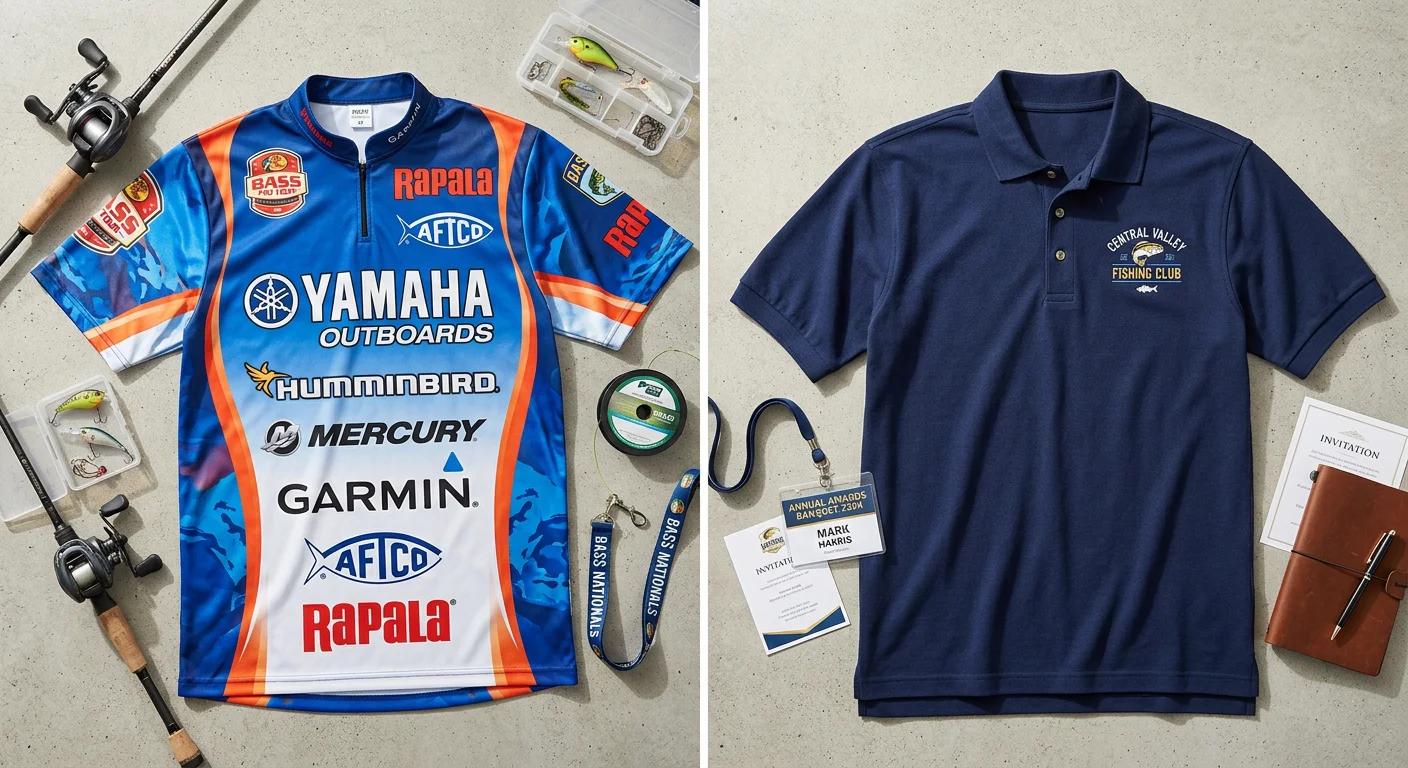
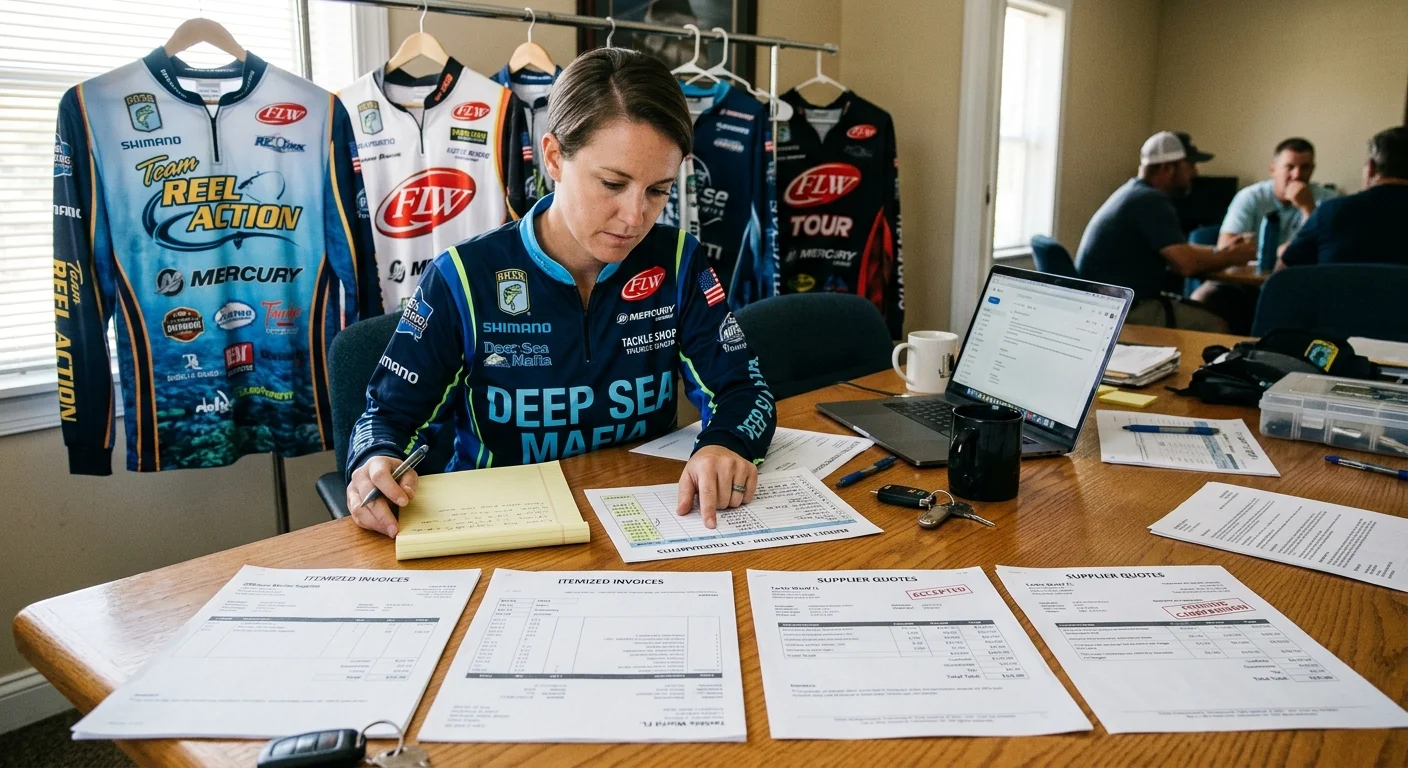
Ordering tournament fishing apparel for a full team — with no try-on session — is a pressure test most captains fail at least once. And it almost always happens right before a major tournament.
One wrong assumption about a brand's sizing. One teammate who "guesses medium" when he's a large. Now half the roster is fishing in jerseys that gap at the chest or bunch at the shoulders.
Getting tournament fishing apparel size right across 10, 15, or 20 different body types takes a process — not luck.
This guide gives you a field-tested team roster sizing workflow. You get brand-by-brand size comparisons across AFTCO, Drake, Rattlin Jack, Striker, and more. Plus, there's a simple team roster sizing order form your players can fill out right the first time.
Standardized Self-Measurement Protocol for Remote Team Sizing
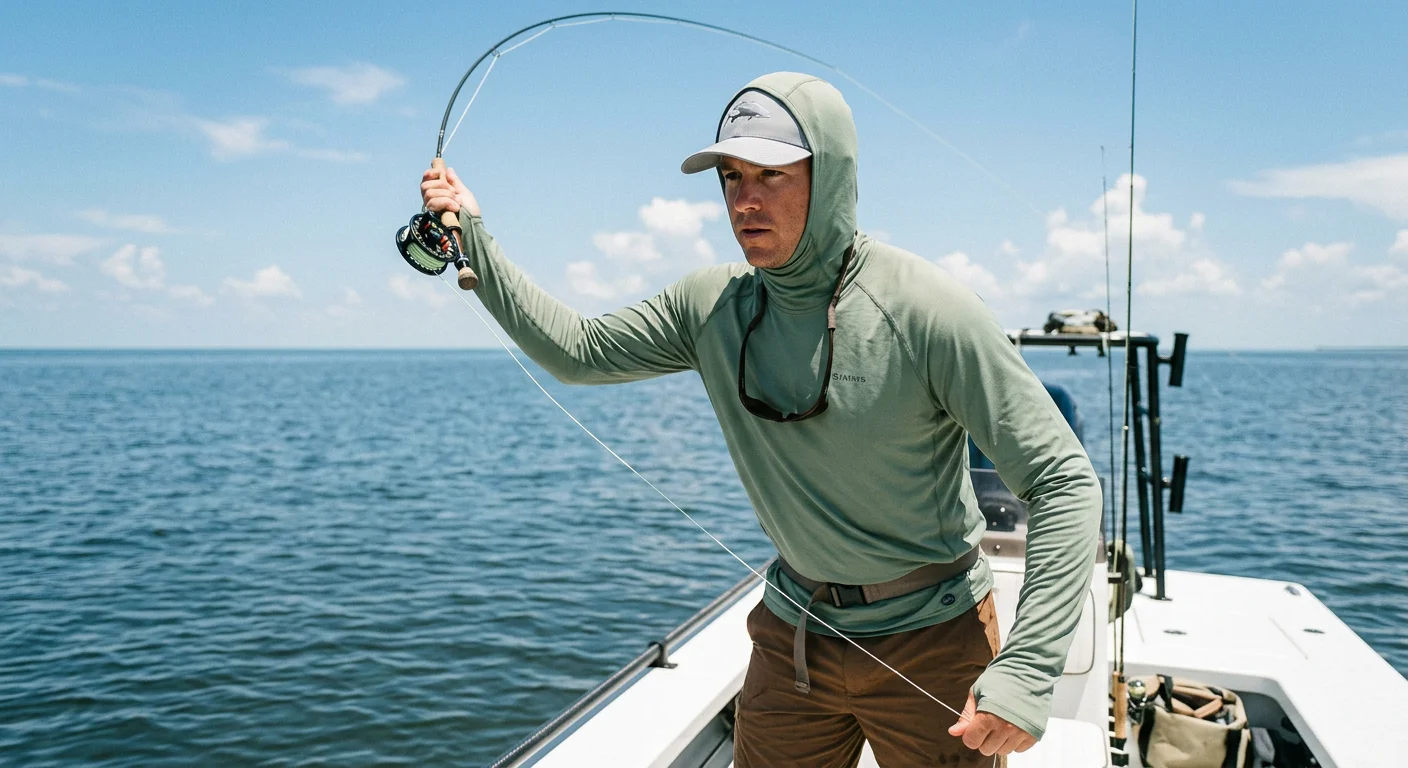
Seven measurements. That's all it takes to cut out most sizing errors before a single jersey gets made.
The problem with remote team sizing isn't that people lie about their measurements — it's that they've never taken them the right way. "I'm a large" is not a measurement. It's a guess based on the last shirt that fit, from a brand nobody on this order is buying.
Here's the protocol. Send this to every teammate before they submit anything.
The 7 Measurements Every Teammate Needs to Take
Have each player grab a soft tape measure, wear a fitted shirt or no shirt, and record all seven of these:
Chest — Wrap the tape 1" below the armpit. Breathe at rest. Don't flex. This is the most critical number for fishing apparel body measurements .
Body Length (HPS to Hem) — Start at the highest point of the shoulder. Measure straight down to where you want the shirt to end. Striker, TW, and Strike King sizing all reference this point.
Body Width (Garment Flat) — Measure a shirt you already own, seam to seam at the chest. This cross-checks well against AFTCO's garment-flat specs.
Sleeve Length — Start at the center back of the neck and measure to the sleeve edge, with the arm bent at a slight angle. This matters a lot for long sleeve fishing jersey size accuracy.
Neck Circumference — Base of the neck, relaxed. Drake, Simms, and Columbia orders use this number.
Waist — Natural waist, not belt line. Gill, Huk, StormR, and Under Armour fits all require this.
Fit Preference Tag — Each person picks one: Loose / Regular / Performance (skin-tight)
That last one matters more than people expect. A 42" chest teammate who fishes hard in the heat wants a different cut than one who runs the helm in a spray jacket. Fit preference ties straight to brand architecture:
Fit Type | Best Brand Match |
|---|---|
Loose | Bass Knuckles, Bassaholics |
Regular | Columbia, Simms, Huk, G. Loomis, Drake |
Performance / Skin-Tight | Under Armour, Huk Performance, TW Performance LS, Striker Performance |
Why Body Width and Chest Aren't the Same Number
This trips up most team roster sizing order form submissions. AFTCO publishes garment-flat body width specs — not body chest circumference. Their XL, for example, sits at 24.5" flat. Double that and add ease, and you get close to a 49" chest circumference. Your teammate submits a 48" chest. You order straight from the garment spec without converting. The shirt pulls across the back on the water. That's the mistake.
Collect both numbers any time the brand uses garment-flat specs. It takes 30 extra seconds and saves a return shipment.
runfishapparel.com
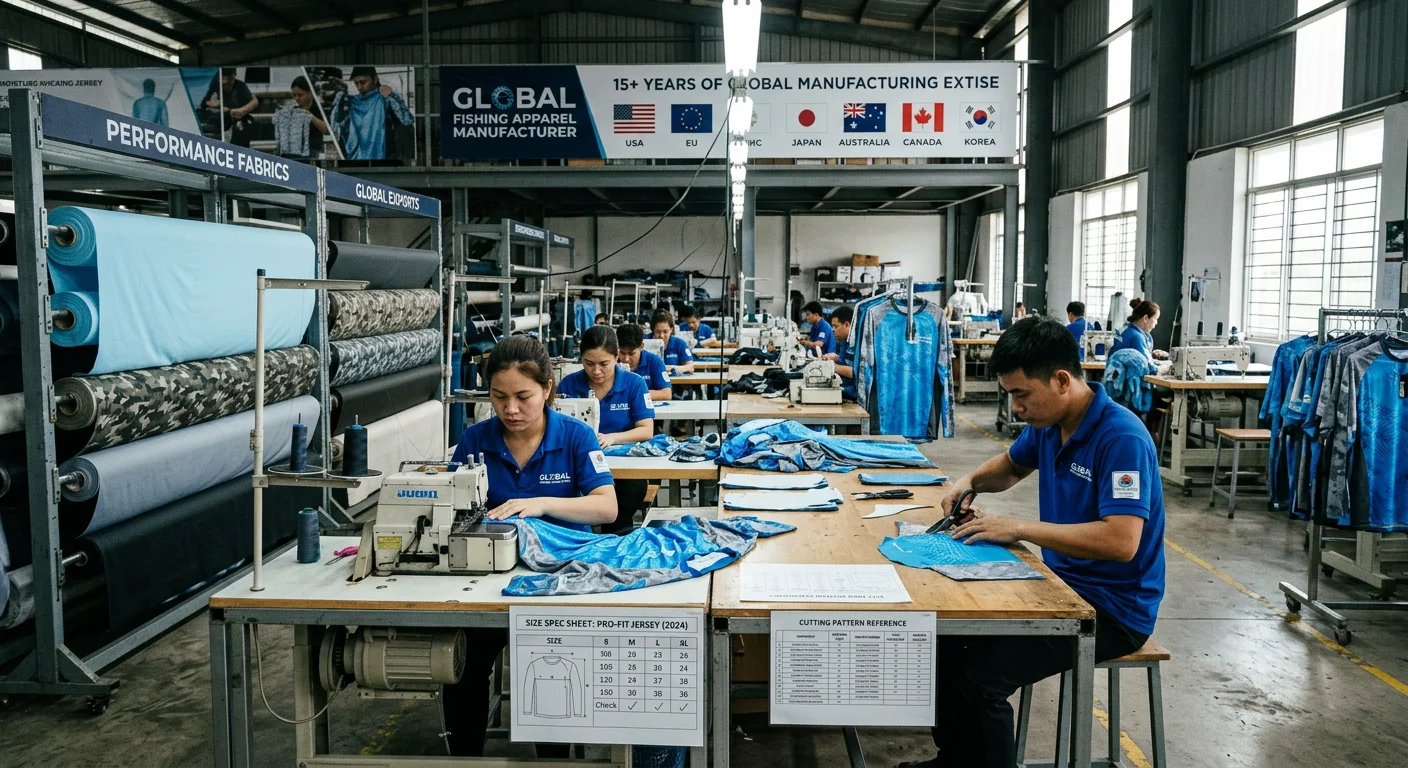
Runfishingapparel brings 15 years of manufacturing experience across 500+ brand partners in 50+ countries. That kind of data on sizing specs is something most domestic brands don't have — and you can see it in how their measurements are built.
Runfish runs as a direct OEM/ODM fishing apparel factory. Order custom tournament fishing gear here, and you work with the people who cut and sew the fabric. No middleman handling your team's measurements. No signal lost in a long chain. A dedicated account manager takes your roster from the first conversation to final delivery — not a shared inbox, not a rotating support queue.
For sublimated fishing jersey measurements and team uniform builds, their production pipeline supports low MOQ orders with fast sample turnaround. Chasing a tournament deadline? You can verify fit before locking in the full roster quantity.
Performance Specs Worth Knowing Before You Size
Runfish stands apart from generic wholesale suppliers of fishing apparel in the fabric data itself:
Specification | Runfish Standard | Industry Average |
|---|---|---|
UPF Rating | UPF50+ (98%+ UV blocked) | UPF 30–40 |
Dry Time (AATCC 79) | Under 20 minutes | 45–60 minutes |
Moisture Wicking Rate | Class 4–5 | Class 3 |
Wash Durability | Stable to 50+ washes | Fades after 20 washes |
Salt Residue Resistance | Tested to AATCC 107 | Not specified |
Moisture wicking fishing apparel fit also plays a direct role in sizing. Runfish uses a bi-component fiber structure — a hydrophilic inner layer pulls moisture away from skin, while a hydrophobic outer layer pushes it outward. This fabric behaves differently from a standard polyester weave. It drapes close to the body when dry. It doesn't cling when wet. Teammates deciding between Regular and Performance fit will find this fabric behavior tends to push toward sizing true rather than up.
All fabrics carry UPF50+ certification under AS/NZS 4399 and AATCC 183 standards — tested in-house, not self-declared. OEKO-TEX, ISO 9001, SGS, and BSCI certifications cover the full compliance stack for teams that need to verify standards before placing an order.
AFTCO, Drake & Rattlin Jack: Core Size Variance Analysis
Three brands. Similar sizing labels on the surface. Very different numbers underneath.
This is where bulk tournament orders go sideways. A team captain collects sizes from 15 anglers, maps them straight to a single brand's chart, and assumes a Large is a Large across the board. It isn't. AFTCO, Drake, and Rattlin Jack each run their own sizing system. The gaps between them are wide enough to cause real problems on a 20-jersey order with no try-on session.
Here's the actual variance, mapped across all three:
Size | AFTCO Chest Span | Drake Chest Span | Rattlin Jack Scaled | Overlap Risk |
|---|---|---|---|---|
M | 38"–41" | 37"–40" | 37"–39" base | Low |
L | 41"–45" | 41"–45" | 41"–45" (variants) | High |
XL | 45"–49" | 45"–48" | 45"–49" loose | Medium |
The Medium column looks clean. Low overlap risk, clear separation. But look at Large — that's where roster-wide fit errors stack up. A 42" chest teammate sits at the low end of an AFTCO Large and the mid-point of a Drake Large. Same measurement, same label, different shirt behavior on the water.
Rattlin Jack's Fit Multiplier Logic
Rattlin Jack doesn't just scale chest circumference. They add a fit multiplier that controls how much extra room gets built in above the base measurement. Starting from a Medium base of 37"–39" chest, the multipliers break down like this:
Regular fit : +2" above base → 39"–41" circumference
Performance / Skin-Tight : +4" → 41"–43"
Loose cut : +6" → 43"–45" (waist and hips mirror chest ±1")
That multiplier gap is significant. A teammate at 41" chest who prefers loose fit sits right in a Rattlin Jack Medium Loose. That same 41" chest in a Performance cut needs a Large. Two different sizes from one measurement — the only variable is fit preference. So the fit preference field on your team roster sizing order form is not optional. It's the variable that decides which size you order.
The Cross-Brand Overlap Problem at Large
One specific overlap drives the most returns in team orders: Salty Crew Medium (39"–42") runs right against AFTCO Large proxy (41"–44") . Anyone on your roster switching from a Salty Crew background who assumes their Medium carries over will end up with a shirt that gaps across the back.
For tournament fishing apparel size decisions at the Large boundary — where most adult male anglers fall — validate using a flat-lay chest measurement , not a stated size. Measure the garment seam-to-seam at the widest point. Add a ±1" tolerance for manufacturing drift. That one step cuts out the majority of fishing shirt chest width guide errors on bulk orders.
Four Rules for Ordering Across These Three Brands
Your roster spans all three labels, or you're picking one and mapping everyone to it. Either way, run these checks before you submit:
Flat-lay first. Collect body chest circumference from every teammate. Cross-check against garment-flat specs. AFTCO and Drake publish flat specs — double them and add ease before comparing to body measurements.
Add 0.5" sleeve buffer. Short sleeve baselines run 20"–22.5" across these brands. Sleeve length drifts in production. A 0.5" buffer on the long sleeve fishing jersey size spec keeps the shirt from riding up mid-cast.
Scale neck from chest. Drake-style sizing pairs a 15.5"–17" neck with a 40"–44" chest. The rough formula: neck circumference ≈ 10% of chest measurement. Flag anyone whose neck-to-chest ratio falls outside that band — they may need a different collar cut.
Build in a 5% size variance allowance. On a 50-shirt team order, that's two or three backup units in the most common sizes. It costs far less than a rush reorder the week before competition.
The goal isn't a perfect fit across every body type. It's catching the variance before it turns into a problem — and these three brands give you enough consistent structure to do that.
Striker & Tackle Warehouse: Performance Cut & Dimensional Mapping
Striker cuts its own way — and Tackle Warehouse's sizing data backs that up with hard numbers.
AFTCO and Drake build their fits from chest circumference outward. Striker flips that. It starts from the torso structure and works inward. That one difference changes how you map a 15-person roster to the right sizes. A teammate who fits well in a Drake Large may not land in the same spot with a Striker Large. Check the dimensional specs against actual body measurements first.
Here's what the dimensional range looks like across the Striker line:
Striker Model | Body Width (Flat) | Body Length | Depth/Ease | Size Proxy |
|---|---|---|---|---|
Cast (compact) | 3.0" flat base | 2.97" | 2.28" | S–M boundary |
Vivid 4cv | 3.9"–4.5" | 6.9" | 1.8" | S–M |
Vivid 5sv | 5.5" flat | scaled | 2.0" | M |
Vivid 9sv / 12sv | 6.5" flat | 11.1" | 2.3"–2.4" | L–XL |
The XL-equivalent chassis runs 9.3" x 5.5" x 2.3" . It's built around a tighter 50" chest proxy with sharp structural detail. The Cast compact sits at a more relaxed 48" chest scan . That 2" gap is real. It's the difference between a jersey that sits clean at the shoulders and one that pulls across the upper back on a long cast.
Athletic Taper vs. Relaxed Cut: Which Striker Profile Fits Your Roster
Striker's performance cut splits along one clear line: Vivid models taper for athletic builds. Cast models run relaxed.
For a tournament fishing apparel size decision, that breaks down like this:
Performance-fit teammates (38"–44" chest) — Go with Vivid 4cv or 5sv specs. The 3.9"–5.5" flat width range keeps fabric tracking the body. No bunching at the cast.
Standard-fit teammates (44"–48" chest) — Vivid 9sv is the right zone. Flat body width at 6.5" measures out to 47"–48" circumference with ease. True to size.
Loose-cut preference at 48"–50" chest — Striker Cast gives enough room here, but flag these teammates on the team roster sizing order form. The Cast's compact depth (2.28") means less vertical ease than the Vivid series. Tall teammates with a long torso will notice it.
Back Length and Torso Variance
Most captains skip one key measurement on sublimated fishing jersey orders: back length tolerance .
Striker's size range carries a 0.3"–0.6" body length variance for tuck compliance. On the water, that matters. A jersey that rides up mid-fight breaks focus. Teammates whose torso lengths sit at the top of a size bracket need that 0.6" buffer. Build it into the garment length spec on your custom tournament fishing gear order form.
Tackle Warehouse cross-references back length using a proxy benchmark: S = 18" torso equivalent, XL = 24" . Use those anchor points to check your roster's measurements before locking quantities. A teammate at 22.5" back length lands mid-range in a Striker L — that's your green-light zone. Push to 23.5" and you're at the edge of the size band. At that point, back-length variance starts affecting fit under a rain layer.
Run the flat-lay body width check on every Striker size you're ordering. Then cross-reference torso length against those anchor points. Two checks, two minutes per teammate — and the fishing shirt chest width guide errors that tend to show up on delivery day stay on the spreadsheet instead.
Body Type Adaptation & Fit Preference Calibration
Body type is the variable most team sizing workflows ignore — and it causes more fit failures at delivery than anything else.
Chest circumference gets you close. It doesn't get you there. Two teammates can share an identical 44" chest measurement and need totally different shirts. One is 6'2" with a long torso and narrow shoulders. The other is 5'9" and broad through the upper back. Same number. Different bodies. Different fits.
Here's how to calibrate by build — and what to collect beyond the tape measure.
Tall/Slim Builds
Back length is the controlling measurement here, not chest.
The standard size-up-for-chest approach backfires on tall, lean teammates. The chest fits, but the hem rides up during a cast. The sleeves run short. The shirt looks like it shrunk in the wash.
The fix: collect both chest and torso length. For a tall, slim teammate, size up one in the chest column — then specify an extended hem on any custom tournament fishing gear order. This matters on long sleeve fishing jersey size selections. Sleeve length scales from height, not chest. Get that wrong and the whole proportion breaks down.
Broad/Stocky Builds
Here the anchor point flips. Chest circumference drives the size decision , full stop.
On stocky builds, weight relative to height predicts how shoulder width and waist allowance will behave. Older teammates in this group tend to carry extra volume at the neck and waist — not just the chest. So check waist allowance against the brand's tolerance chart before finalizing any UPF fishing shirt order for this build. A shirt that clears the chest but pulls at the midsection mid-tournament is a distraction nobody needs.
Layering Allowance by Build
Any teammate fishing under a spray jacket or rain layer needs 1.5–2" added to the chest buffer on the base performance fishing shirt fit spec. Lightweight, stretch-woven fabrics handle this better on athletic builds. Bulkier builds need the extra room without the extra weight — skip heavy weaves in the base layer entirely.
Fit Preference Field: Make It Mandatory
Your team roster sizing order form needs a required fit preference field. Not optional. Required.
Here's why: fit preference decides which size a measurement maps to — not the measurement itself. A 41" chest teammate who wants a loose cut lands in a different size than a 41" chest teammate who wants performance fit. That gap can span an entire size category depending on the brand.
Use this table as your calibration guide once teammates submit their numbers:
Build Type | Priority Measurement | Fit Notes |
|---|---|---|
Tall / Slim | Torso length + chest | Size up chest; flag for extended hem |
Broad / Stocky | Chest circumference | Verify waist allowance; add neck buffer for older teammates |
Athletic / Tapered | Chest + shoulder width | Performance cut; size true |
Standard | Chest | Regular fit; standard size mapping |
Youth Roster | Height + chest | Use proportional chest-to-length ratio from adult Medium baseline |
For youth roster additions — youth league teams, family tournament divisions — adult sizing logic doesn't transfer. Height drives back and sleeve length. Weight and age predict chest and shoulder width. Start from an adult Medium as your proportional baseline and scale down from there.
One last check before you finalize: flag any teammate whose neck-to-chest ratio falls outside the standard 10% band. A 19" neck on a 44" chest is a good example. That person needs a separate collar assessment. Some brands offer alternate collar cuts on sublimated fishing jersey builds. It's a five-minute conversation — worth having before the order locks.
Team Roster Order Form & Bulk Submission Workflow
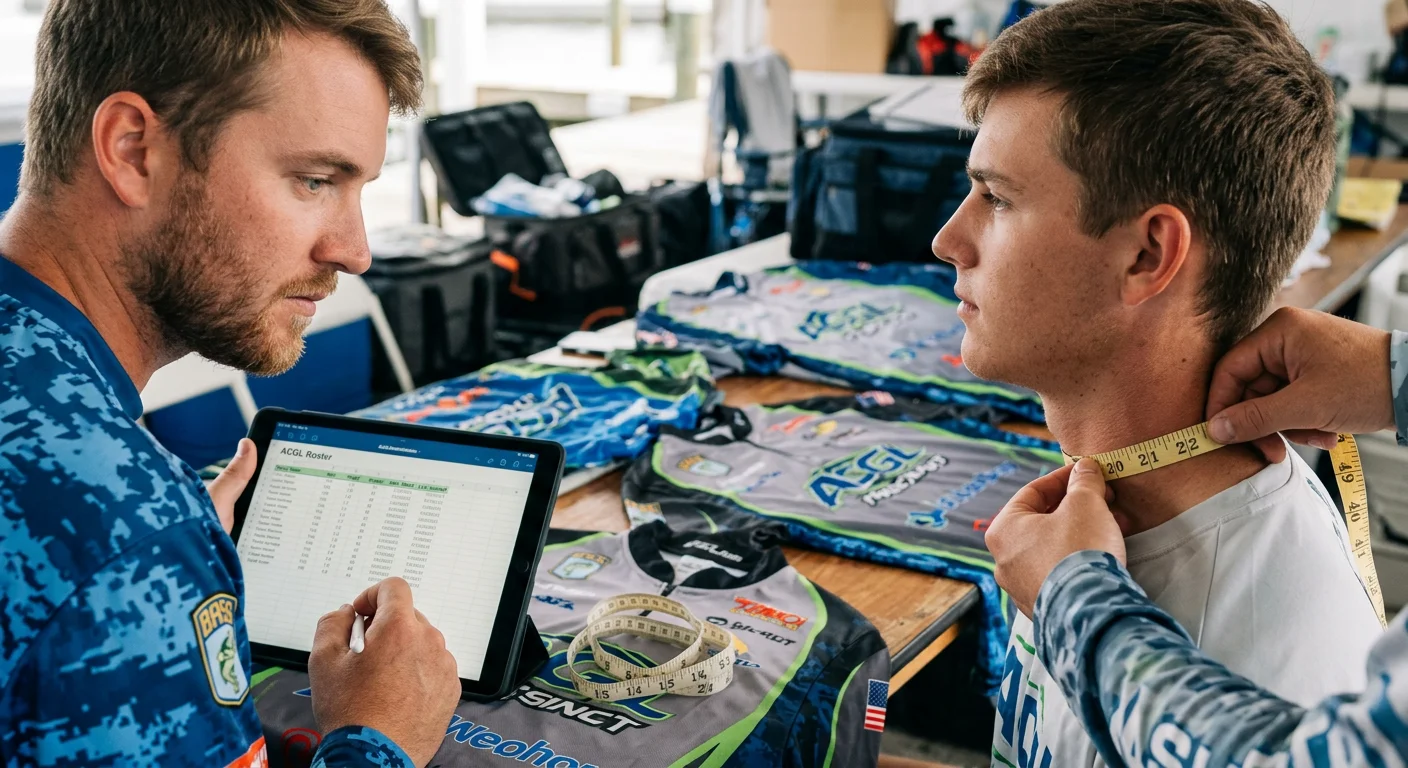
A disorganized size collection process is the real source of bulk order errors — not bad luck, not teammates with unusual builds.
The fix is structural. Build a form that captures every field that matters. Run it through a standardized workflow. Your sizing error rate drops below 5%. Skip the structure, and you're looking at the industry-standard 20–30% return rate. On a 20-jersey tournament order, that means six shirts going back and forth while your competition date creeps closer.
What Goes on the Form
Every team roster sizing order form needs these fields — no exceptions:
Full name and contact info (email + phone for follow-up)
Size selection (dropdown: S / M / L / XL / 2XL — no free-text guessing)
Jersey number and back name or alias
Uniform type (performance fishing shirt, long sleeve fishing jersey, hoodie, jacket)
Quantity per member
Gender / youth classification
Fit preference (Loose / Regular / Performance)
Layering note (fishing under a rain layer? Flag it here)
Those last two fields are the ones most captains drop. Don't.
The Spreadsheet Structure That Works
Use Google Sheets or Excel with a matrix layout: team members as rows, every field above as columns. Add conditional formatting with a simple IF formula. A submitted chest measurement that falls outside the brand's size tolerance range turns the cell red. That visual flag catches mismatches before you submit — not after delivery.
Google Forms feeds straight into a Sheet. One form, auto-populated roster, no retyping. Export to CSV for bulk submission to your fishing clothing supplier.
Submission Timeline
Lock your roster 4–6 weeks before the tournament date . That window covers:
Production: 2–4 weeks
Sample validation: 1 week
Freight: 1–2 weeks
Miss that window and you're negotiating rush fees or fishing in the wrong jersey.
Two Quality Checks Before You Submit
Request a physical sample before the full order locks. One captain reviews fit against the actual fabric and cut. That single step separates a clean delivery from a return shipment.
Cross-reference every submitted measurement against the fishing apparel manufacturer's size variance table — chest circumference, sleeve tolerance, back length. Flag anything that sits at a size boundary. Those teammates need a direct conversation before you finalize quantities.
Conclusion
Getting the right fit for your entire team doesn't have to be a pre-tournament gamble.
Start with standardized self-measurement instructions for every teammate. Learn how AFTCO, Drake, Rattlin Jack, and Striker each cut their performance fishing shirts — the sizing runs are not the same across brands. Fill out your roster order form before you hit "submit." Do those three things, and the guesswork disappears.
Here's what most team captains figure out too late: size charts are not universal, but your ordering process can be. Lock in your team roster sizing workflow now — not the week before the tournament.
Send your teammates the measurement guide early. Collect every chest width, shoulder span, and sleeve length before a single jersey gets ordered. Then check each measurement against the brand-specific columns in your sizing chart. One person, one row, one brand column — done.
That gives you:
- One clean submission
- No back-and-forth size swaps
- Every angler on the water in gear that fits right
That's not just smoother logistics. That's how a team shows up ready to fish.