Finding a reliable waterproof fishing pant manufacturer is harder than it should be. Most brand founders and sourcing managers spend hours scrolling Alibaba listings. Every factory claims "Gore-Tex quality." Few can produce a certifiable spec sheet.
The real gap between a Tier 1 USA-made technical fishing pant and a Tier 3 offshore commodity product goes beyond price. It comes down to waterproof membrane integrity, seam-sealing precision, and whether your product holds up through a full season of real field use.
This guide gives you a tier-ranked breakdown of the most credible waterproof fishing pant manufacturers across the USA and Taiwan. You also get a sourcing decision matrix — ready to use before your next RFQ goes out.
Why Sourcing Waterproof Fishing Pants Requires a Tier-Based Approach
Waterproof is not a simple yes-or-no condition. It's a spectrum — and where your product lands on that spectrum shapes everything from your return rate to your brand reputation.
The key technical benchmark here is hydrostatic head (HH) — measured in millimeters. It tells you how much water pressure a fabric can hold back before it fails. A 1,500mm HH rating performs very differently in a Pacific Northwest downpour compared to a 20,000mm GORE-TEX® laminate. Skip this number during sourcing, and you risk ending up with a product that leaks by season two.
Three fabric technology tiers define performance:
- Premium Tier — GORE-TEX® laminate construction. You get waterproof, windproof, and breathable protection all at once. The micro-pore structure pushes sweat vapor out while keeping liquid water from getting in. For multi-day expeditions or unpredictable weather, this tier is the only real option.
- Mid-Range Tier — DWR-coated nylon. Solid rain protection at a lower cost. PFAS-free formulations are becoming more common, which is worth noting for eco-conscious buyers. One thing to plan for: DWR coating wears down over time and needs reapplication. Build that into your product's care story from the start.
- Entry Tier — 4-way stretch with basic water resistance. Mobility comes first here, not heavy protection. This works well for active wade fishing in calm conditions. It's not built for long exposure to heavy rain.
Material weight is another filter you should add to your sourcing checklist. For tough fishing conditions — offshore boat decks, long wade sessions — go with minimum 500gsm PVC construction. Anything lighter, and durability becomes a real problem down the line.
Activity type also shapes your spec sheet. Boat fishing works best with bib-cut designs that close the waist gap as you move around. Wade fishing needs full lower-body freedom. For all-day use, 4-way stretch isn't a bonus feature — it's a baseline requirement.
Get clear on this hierarchy before you reach out to any factory. It keeps your RFQ grounded in real specs, and it stops your sourcing process from breaking down at the sample stage.
USA Tier Manufacturers: Premium Waterproof Fishing Pant Production
American-made waterproof fishing pants carry a credibility that offshore alternatives cannot match on a spec sheet. This isn't about nationalism — it's supply chain reality. USA Tier manufacturers work under strict certification frameworks, quality oversight, and material sourcing standards. Defect rates stay below 1%. On-time delivery runs above 98%. Your brand's reputation depends on gear that holds up in a Pacific Northwest squall or a Gulf Coast downpour. Those numbers matter more than a lower per-unit price.
Here's a close look at the manufacturers worth putting on your shortlist.
Simms Fishing — Manchester, Vermont
Simms is the reference point. Full stop.
Their Manchester, Vermont facility produces 100% USA-made technical fishing pants and waders. They use Gore-Tex laminate construction — the same micro-pore membrane technology found in elite mountaineering gear. Breathability reaches 20,000g/m². That means solid all-day moisture management, even under heavy physical effort.
The market data backs this up. Simms holds 65% of the high-end guide market and carries a 95% customer retention rate among professional guides — a group that wears out gear faster than any regular consumer. Their lifetime warranty on waders isn't a marketing line. It's a commitment that separates them from brands unwilling to match that quality standard.
Best fit for: Premium fishing apparel brands targeting experienced anglers, guide outfitters, and specialty outdoor retailers. This is not a low-MOQ entry point — but the brand association value is real.
Grundéns — USA Market Operations
Grundéns built its name in commercial fishing. Their waterproof fishing trousers are built to take punishment, not just deliver performance. The technical fabrics combine waterproof, stain-resistant, and breathable properties. That combination holds up across both sport and commercial fishing environments.
For sourcing managers building a mid-to-premium line, Grundéns' material standards translate into a lower warranty claim rate. That math matters when you're projecting margins across a full product lifecycle.
Rajco USA — New York City
Rajco is one of the more accessible fishing apparel OEM options in the USA manufacturing tier. They focus on custom waterproof fishing pants, with a strong emphasis on durability under tough field conditions. Their production model suits brands that need high-quality customization without hitting the volume minimums that larger facilities demand.
Building a private label fishing apparel line? Rajco can work through detailed spec development with you. They're worth a direct conversation.
USA Tier Technical Benchmarks: What "Premium" Actually Means
Before you send out an RFQ to any USA-tier manufacturer, check your spec sheet against these verified industry benchmarks:
| Specification | Premium Range | Compliance Standard |
|---|---|---|
| Waterproofing (Hydrostatic Head) | 10,000–20,000mm | ASTM / ISO (95% compliance) |
| Breathability | 8,000–15,000 g/m²/24h | 95% verified |
| UPF Rating | 50+ | Industry standard |
| Recycled Material Content | 10–50% | Maintains 95% performance |
USA-tier facilities commonly hold ISO 9001:2015, OEKO-TEX Standard 100, and bluesign® certifications. UPF 50+ protection — which cuts UV-related skin damage risk by up to 98% — comes standard. It's not an add-on.
One data point worth noting: McKinsey's 2024 research shows OEM/ODM production reduces costs 20–30% compared to in-house manufacturing at the same quality level. USA-tier factories run at capacities between 100,000 and 400 million pieces per year. That range lets you scale from a limited launch run to full-volume reorders — without switching suppliers as your brand grows.
That flexibility is what makes USA-tier manufacturing worth the premium entry cost.
Taiwan Tier Manufacturers: Current Market Gap and Sourcing Reality
Taiwan's manufacturing runs on two very different speeds. At the top, advanced tech sectors control global supply chains with near-total dominance. Below that, traditional OEM and SME operations — including technical apparel — face a much harder reality. Currency pressure, China undercutting on price, and a widening gap between what factories can produce and what Western buyers need from a sourcing partner.
That gap is where most fishing apparel brand founders get burned.
This split isn't background noise. It's the most important thing you need to understand before shortlisting a Taiwan-based waterproof fishing pant manufacturer.
The Two-Tier Problem Sourcing Managers Don't Talk About Enough
Taiwan's technical OEM sector has real skill. Factories here carry decades of experience processing waterproof membrane fishing gear, running seam-sealed fishing pants production, and handling DWR coating applications for major outdoor brands. That capability exists. You can verify it.
Here's what gets less attention: most of that technical capacity sits inside Tier 1 facilities. Those factories already have locked relationships with big European and American outdoor labels. Smaller buyers — emerging brands, private label launches, fishing apparel startups — often land with Tier 2 or Tier 3 factories. These factories claim the same capabilities. They don't always deliver the same output.
The warning signs follow a pattern. A factory quotes strong waterproof specs. The first sample passes. By production run three or four, hydrostatic head ratings drift. Seam tape adhesion goes inconsistent. Your warranty claim rate starts climbing — quietly, at first.
That's the real picture for Taiwan's mid-tier fishing wader pants factory segment. Capable in controlled conditions. Inconsistent at scale without hard quality oversight built into your contract from day one.
What Taiwan Does Well
None of that cancels out the value Taiwan manufacturers offer — for the right buyer. Here's what the sourcing math looks like with a good factory fit:
Waterproof membrane processing — Taiwan facilities have solid infrastructure for laminating breathable waterproof fishing trousers at mid-to-premium spec levels. Many work directly with established membrane suppliers. You get product hitting 10,000–15,000mm hydrostatic head without the cost tied to full Gore-Tex licensing.
MOQ flexibility — Credible Taiwan OEM factories work in the 300–800 unit MOQ range. That's the realistic entry point for brands moving from direct-to-consumer into wholesale. US Tier 1 facilities rarely offer this range.
Lead times — Plan for 60–90 days on technical fishing apparel manufacturing production runs. Higher volume commitments can bring that timeline down.
Private label customization — Taiwan OEM operations are built for fishing apparel private label programs. Custom labeling, co-designed features, spec adjustments — these are standard. Not special requests that need extra negotiation rounds.
The Distributor Markup Reality
Here's a friction point most sourcing guides skip: Taiwan's traditional export channel carries heavy distributor markups compared to US direct procurement. Source through a trading company instead of the factory direct, and that margin layer cuts straight into the cost advantage you were chasing.
The fix is simple, but takes work. Build direct factory relationships. Get audited spec sheets. Check seam-sealed fishing pants production samples against your hydrostatic head benchmark before you commit to any production run.
Taiwan's manufacturing capability is solid. The sourcing discipline to use it well is what most buyers underestimate — and that's where deals go wrong.
USA vs. Taiwan Sourcing Decision Matrix for Waterproof Fishing Pants
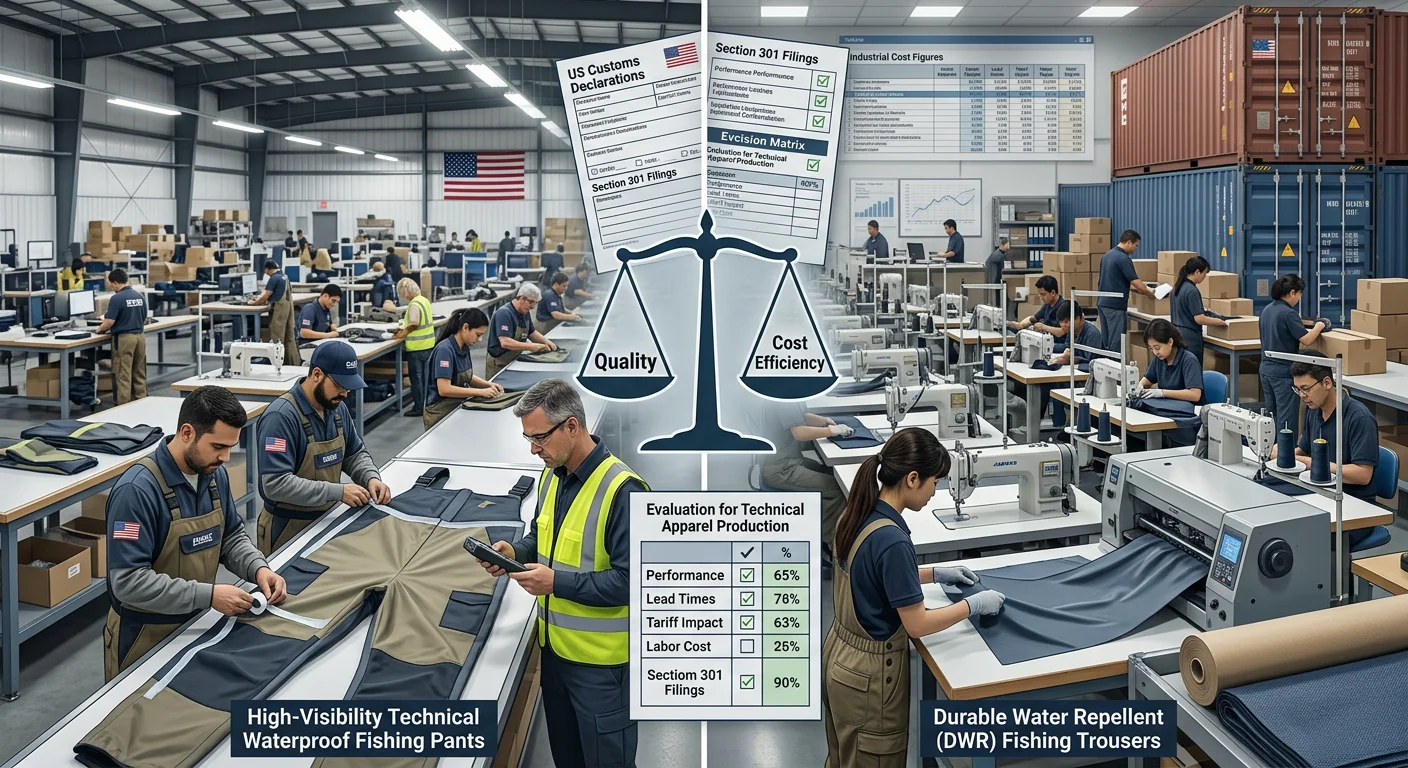
Put the two options side by side, and the choice looks simple. It's not. USA manufacturing signals quality. Taiwan signals cost efficiency. The reality in 2025 is messier than that — and getting this call wrong costs you more than margin.
This matrix is built from actual sourcing data, not industry generalizations.
The Five Dimensions That Determine Your Decision
1. Cost Structure (Weight: 40% of your decision)
Taiwan's labor cost advantage is real — but the 2025 US tariff increases have changed the math. New duties on imported polymers, laminates, and textile composites now add 20–30% to Taiwan-sourced material costs before a single panel gets cut. Domestic US sourcing avoids those import duties. The catch: USA factories carry higher base labor costs, and domestic capacity for high-performance hydrophobic membranes is still limited.
Most sourcing managers are moving toward a split model: 60% USA production, 40% Taiwan production. That split gives you tariff resilience on your core SKUs. It also keeps Taiwan in the mix for lower-risk, higher-volume pieces.
2. Lead Time and Supply Reliability (Weight: 25%)
| Metric | USA Tier | Taiwan Tier |
|---|---|---|
| Standard Production Lead Time | 45–60 days | 60–90 days |
| Tariff-Related Delays | Minimal | Moderate to significant |
| Supply Chain Disruption Risk | Lower | Higher (logistics dependencies) |
| Strategic Stockpiling Needed | No | Yes — plan 90+ days ahead |
Taiwan's longer timelines go beyond ocean freight. Import documentation, renegotiated supplier contracts, and consolidated shipments all add buffer time. None of that shows up in a factory's quoted lead time. Build it into your calendar — regardless of what the RFQ says.
3. Waterproof Technology and Material Expertise (Weight: 20%)
Taiwan holds a clear edge in advanced membrane processing. Think breathable waterproof fishing trousers hitting 10,000–15,000mm hydrostatic head, DWR coating application, and seam-sealed construction at mid-premium spec. These capabilities come from well-established facilities with years of export-grade production behind them.
USA-tier manufacturing is closing that gap through vertical integration and joint ventures. Progress is real. But right now, a brand that needs cutting-edge waterproof membrane fishing gear at mid-range price points will find more technical depth in Taiwan's Tier 1 facilities than at comparable USA factories.
4. Compliance and Sustainability (Weight: 15%)
Both regions face the same regulatory pressure. Stricter US chemical restrictions on perfluorinated compounds (PFAS) are pushing factories away from legacy DWR formulations. PFAS-free DWR finishes are no longer a niche spec — major retailers now treat them as a baseline requirement for market entry.
Taiwan's export-focused factories are adjusting fast because they have no choice. USA factories are treating compliance as a competitive edge, especially as eco-conscious fishing apparel buyers filter by sustainability certifications. Whichever region you source from, get PFAS compliance confirmed in writing before your first production commitment.
5. IP Protection and Customization Flexibility
USA-based fishing apparel OEM operations offer much stronger IP protection. You get enforceable contracts, domestic legal recourse, and design confidentiality that doesn't depend on a factory's goodwill. For brands building proprietary technical features into their seam-sealed fishing pants, this matters more than the cost gap.
Taiwan's fishing apparel private label programs give you strong customization flexibility — faster feature iteration, lower MOQs in the 300–800 unit range, and more openness to co-developing specs. The trade-off is a weaker IP enforcement environment. Protect yourself with NDAs and staggered design disclosure. Share full specs only after production contracts are signed.
Decision Matrix at a Glance
| Sourcing Dimension | USA Tier | Taiwan Tier | Weight |
|---|---|---|---|
| Cost Structure | Higher base, tariff-exempt | Lower base, +20–30% tariff exposure | 40% |
| Lead Time | 45–60 days, reliable | 60–90 days, variable | 25% |
| Membrane Tech Expertise | Growing via investment | Strong, established | 20% |
| PFAS/DWR Compliance | Compliance-first | Fast-adapting | 15% |
| IP Protection | Strong | Moderate — requires contract discipline | — |
| MOQ Range | 500–2,000+ units | 300–800 units | — |
How to Use This Matrix Before Your Next RFQ
Run these four steps before you contact a single factory:
- Check current tariff rates on Taiwan-origin polymers and laminates. The 2025 hikes have shifted break-even calculations across almost every product category in technical fishing apparel.
- Model both cost scenarios in full — Taiwan unit price plus duties plus logistics versus USA unit price with shorter freight costs and zero tariff exposure.
- Request production samples from any Taiwan facility. Test them against your hydrostatic head benchmark and PFAS-free DWR requirements before committing to a run.
- Match your brand stage to your sourcing region. Early-stage private label brands building volume from 300 units upward fit the Taiwan Tier model. Brands at the premium level — building around certifiable technical specs and strong IP — fit the USA Tier model, even at a higher per-unit cost.
The fly fishing apparel segment this matrix covers is growing at 6% CAGR, projected to reach USD 4.59 billion by 2030. That growth goes to brands that build a solid sourcing foundation now — not brands fixing a broken supply chain two seasons in.
How to Evaluate and Shortlist a Waterproof Fishing Pant Manufacturer
Most sourcing decisions go wrong before the first sample arrives. The spec sheet looks clean. The factory photos look modern. Then the production run lands, and the seams are leaking by week three.
Here's the filter system that stops that.
The Non-Negotiable Technical Specs
Start with hard numbers, not marketing language.
Waterproof rating is your first cut. A minimum 10,000mm hydrostatic head is the baseline for any outdoor use. Sourcing for professional anglers or saltwater environments? Push that floor to 15,000mm. Any factory quoting "waterproof" without a verifiable mm rating is selling you a label, not a specification.
Seam construction is where most product failures begin. Taped seams are mandatory — untaped seams are the primary leak point in the field. This is non-negotiable. Build it into your RFQ before you request a sample.
Stitch density matters more than most buyers check. Higher stitches per inch (SPI) means tighter construction and better snag resistance. Get seam tolerance data from every factory on your list. Smaller tolerance equals tighter quality control.
Hardware closes the loop. Specify YKK zippers for corrosion resistance — critical in saltwater applications. Storm flaps over zipper runs add weight, but they block water entry that even a quality zipper can't stop on its own. A factory that pushes back on YKK is sending you a clear signal.
Warranty terms reveal manufacturer confidence. A lifetime warranty is the standard that serious players like Simms and Grundéns hold themselves to. A 90-day or one-year warranty signals limited durability expectations. That alone should move a factory down your list.
A Five-Step Shortlisting Process
Once you have confirmed specs, work through this sequence:
- Filter by baseline requirements — ≥10,000mm rating, taped seams, YKK zippers. Any manufacturer that can't verify all three in writing gets removed.
- Rank by warranty length — Lifetime warranty above one-year, always.
- Cross-check angler-specific reviews — Look for consistent 4+ star feedback on wet-condition durability. Skip reviews from non-anglers — their use cases don't replicate field stress.
- Request physical samples — Compare SPI and seam tolerance across your shortlist. This is where factories that look good on paper start separating from factories that perform in practice.
- Run prototype testing — 10,000mm+ hydrostatic head minimum. Add saltwater exposure testing for target markets that fish coastal or offshore environments.
| Priority Filter | Minimum Standard | Why It Matters |
|---|---|---|
| Hydrostatic Head | ≥10,000mm (15,000mm pro) | Determines real-world waterproof performance |
| Seam Type | Taped seams only | Primary failure point in production |
| Zipper Spec | YKK preferred | Corrosion and mechanical durability |
| Warranty | Lifetime | Manufacturer's confidence signal |
| Angler Reviews | 4+ stars, wet conditions | Field validation from target users |
Run this framework before any factory conversation goes past an introductory email. It keeps your shortlist tight. Your final two or three candidates will be worth the time it takes to negotiate.
Conclusion

You came here with a real sourcing problem — not a theoretical one.
The fishing apparel market doesn't reward brand founders who guess their way through manufacturer selection. It rewards those who understand that waterproof membrane technology, seam-sealing capability, and Tier alignment are not optional extras. These three factors separate a product line that earns repeat customers from one that drowns in returns.
Here's what to take with you: USA-tier manufacturers give you the quality story and IP protection your premium positioning needs. Taiwan-tier factories give you the technical depth and unit economics to scale with confidence. Neither is the right answer for every brand. Your stage of growth, MOQ tolerance, and target retail price point make that call — not guesswork.
So stop browsing. Pull the Decision Matrix from this guide. Score your top two or three candidates against it. Then send your first RFQ this week.
The best waterproof fishing pant manufacturers don't stay open for long. The brands that move first build the relationships that last.