Eleven Bassmaster Angler of the Year titles. Four Classic championships. Over $6 million in career earnings. Kevin VanDam didn't stumble into becoming the greatest tournament bass angler who ever lived. He built it — one decision at a time, with discipline and drive. But here's what most people miss when they study KVD's record: the trophies aren't the story. The system behind the trophies is.
Chasing your first tournament win? Or just trying to read water the way the pros do? Either way, the same five factors that drove VanDam's 27-year dominance are available to you right now. Not as abstract inspiration — as a concrete, repeatable blueprint. What follows breaks down how he did it, and how you can put it to work.KVD's influence extends beyond tournament strategy, inspiring fishing apparel manufacturer partners to develop high-performance gear for competitive anglers who demand reliability on the water.
Hook: Why KVD Is the Gold Standard in Professional Bass Fishing
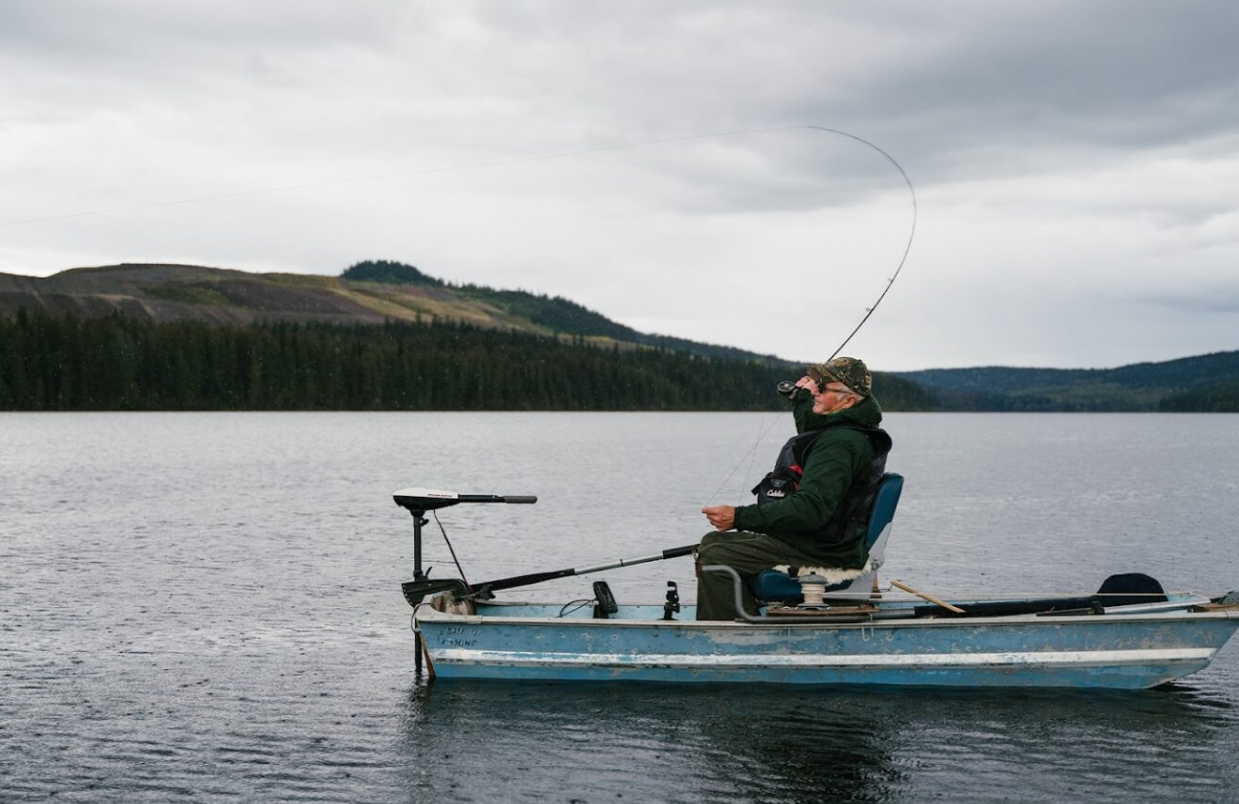
The final tournament of a 30-year career. Every eye on the water. Kevin VanDam pulls up a 7-pound, 12-ounce largemouth — worth $100,000 in prize money — on his last cast in professional competition.
That's not luck. That's a system still running at full power on its final day.
The numbers back it up. Across 320+ BASS events , VanDam finished in the money 78% of the time . That's nearly 8 out of every 10 tournaments he entered. He cracked the Top 10 in 35% of all starts . He won 25 BASS events and 4 MLF titles . His total career earnings crossed $7 million . That makes him the all-time money winner in professional bass fishing history.
Most anglers chase highlight moments. KVD built something different. He created a repeatable performance standard that held for three decades. It stood up across multiple circuits, rule sets, and conditions.
That gap — a great day on the water versus a great career — is what separates legends from the rest. The next five sections break down how he did it.His legacy has also encouraged clubs and tournament teams to invest in custom fishing apparel that reflects their identity while meeting the practical demands of competitive fishing.
Factor 1: Obsessive Passion — The Fuel That Drives 27+ Years of Dominance
Kevin VanDam doesn't lead with trophies. He leads with fish.
"I love competitive bass fishing," he's said in multiple interviews. Not the prize money. Not the sponsorships. The competition itself — the puzzle of the water, the hunt, the execution. Most people miss how much that distinction matters.
His mother said it straight: all of her sons loved fishing. Kevin was the one who turned that love into four Bassmaster Classic titles and seven Angler of the Year awards. The raw material was the same. The intensity was not.
What Obsessive Passion Looks Like in Practice
Passion without structure is just enthusiasm. KVD's version had both structure and measurable output.
A full tour season runs 8–10 major events per year . Each tournament already demands 2–3 competition days plus one official practice day. VanDam added 1–3 extra days of self-funded practice on top of that — every single event. Add it up: over 350–400 hours of on-water work per season , plus an estimated 30,000–40,000 kilometers of road travel across the country. That level of output holds only when the process itself feels worth it.
In his final seasons on the MLF Bass Pro Tour, he said flat out that he was still preparing at 120% effort . No coasting on reputation. No leaning on instinct built over decades. Pre-tournament desktop research alone ran 10–15 hours per event .
That's not habit. That's identity.Behind durable tournament apparel is a dependable bass fishing apparel factory capable of delivering consistent quality for anglers who spend long hours in changing weather conditions.
His career ended — and he didn't step away from fishing. He launched The VanDam Experience , a teaching platform, because, as he put it, "I have a passion to teach people how to be more successful on the water."
How to Apply This as an Everyday Angler
You don't need to fish 400 hours a year. You do need to be deliberate about where your passion goes .
Build a structured fishing log. After every session, record water temperature, visibility, weather, lure type, line weight, and key locations. Track your largest single fish per outing. Review the data each month. Patterns will start to show up — and your enthusiasm turns into a real performance system.
Set aside practice days. At least 2–4 days per month , go out with zero catch goals. Pick one or two specific skills — casting accuracy, reading sonar returns — and give them measurable targets. For casting, aim for 80%+ accuracy across 100 consecutive casts to a fixed target. Seeing real progress keeps passion alive far longer than wins alone.
Track three metrics every quarter:
- Average weight of your largest catch per session
- Bites per hour on the water
- Casting error rate
Plot them on a simple chart. Watching your own numbers climb is the most reliable fuel there is.
One last thing worth saying directly: sustaining 8–12 hours on the water per day — the standard for serious tournament prep — takes physical endurance, not just mental drive. The right gear matters here. High-UPF, moisture-wicking fishing apparel (rated UPF 30–50+) extends your focus time on hot days. It cuts down skin fatigue and heat buildup, so your attention stays on the water instead of your own discomfort.
Passion is the starting point. The anglers who build careers — or even just keep getting better — are the ones who engineer systems around that passion. That's what makes it compound over time.
Factor 2: The Mental Edge — How KVD's Confidence,Decision-Making Separate Him From the Field
Eleven Angler of the Year titles don't come from confidence alone. They come from a specific kind of confidence — one built on process, not outcomes.
Most anglers step onto the water thinking, "I want to win today." VanDam stepped onto the water with a different question: "What is the best decision I can make right now, with the information I have?" That one shift in thinking is the foundation of his mental edge.
Process-Driven Confidence: The Real Source of KVD's Belief
KVD's confidence didn't come from yesterday's trophies. It came from a library — decades of patterns built across water types, seasons, weather conditions, and fish behaviors. Not one or two signature moves. Dozens of repeatable, field-tested frameworks he could pull out on any given day.
Here's what that looks like in practice. During a single competition day, VanDam makes dozens of small decisions. Boat position. Lure entry angle. Retrieve depth adjusted by 0.3–0.5 meters . Cast accuracy within ±0.5 meters of the target. Each decision produces feedback. Each piece of feedback sharpens the next decision. The loop runs without stopping — decision → feedback → adjustment — from the first cast to the last.
That's not a mental trick. It's a performance system.As competitive fishing continues to grow worldwide, many outdoor brands are expanding their product lines through OEM/ODM fishing apparel services to introduce specialized apparel for different fishing environments.
The real output: VanDam didn't measure success by "how many fish did I catch today." He measured it by "how well did I execute high-quality decisions with limited information?" That shift keeps confidence steady even when the fish aren't biting.
How to use this: Replace result-based goals with process targets before every session.
- Commit to ≥120 quality casts per hour rather than a catch number
- At each new spot, test at least 3 retrieve depths (e.g., 1.5 m, 2.5 m, 3.5 m) and 2 distinct rhythms before moving on
- Ask yourself after each decision: Did I make the best choice available with what I knew at that moment? Say yes, and the confidence account gets a deposit — no matter the result
The AOY Mindset: Playing the Long Game Under Pressure
VanDam had one mental tool that almost nobody talks about. He didn't see tournament scores as wins or losses. He saw them as data points in a long statistical sample .
The Bassmaster AOY title is a season-long points race. First place earns about 100 points. Each position lower cuts a fixed amount. A bad tournament — finishing 40th to 60th — isn't a disaster. It's a one-time point deduction. Keep the surrounding tournaments in the top 10–20 range , and the season total stays in the fight.
VanDam understood this clearly. So a bad tournament didn't trigger panic. His focus shifted from "how do I win this event" to " how do I limit the damage on this data point? " Loss-limiting, not panic-chasing.
The outcome: emotional stability where other anglers fell apart. Competitors tore apart their entire strategies mid-tournament out of desperation. VanDam made calm, step-by-step adjustments instead.
A simple AOY framework for tournament anglers:
- Set a season target: finish in the top 25% of the field in ≥70% of your events
- After any poor result, write one page: current finish and points, gap from your target points, and the "correction target" for the next two events (e.g., back-to-back top-20 finishes)
- Reframe the bad tournament in writing: "This is one low sample point. My season trend holds as long as I stay consistent across the next two starts."
Decision-Making Under Pressure: The 30–45 Minute Rule
Conditions can turn fast — sudden wind, temperature drops, water color changes. VanDam didn't freeze. He didn't thrash around either. He ran a structured switching protocol.
His rule, pulled from years of interviews and competition patterns: no bite for 30–45 straight minutes means one structured adjustment. Not a gut-feel scramble. One clear variable change, in a fixed order:
First no-bite window: Change location or structure type (e.g., main river channel → tributary mouth, hard structure → soft)
Second no-bite window: Change lure type or retrieve method (e.g., fast hard bait → slow soft-plastic bottom drag)
Third no-bite window: Adjust depth range or boat angle (e.g., move 10–20 meters shoreward or offshore, alter cast trajectory)
After each adjustment, log the time, what changed, and whether a bite came in the next 15–30 minutes. Do this enough times, and you're not guessing anymore — you're running real experiments.
His mental script during bad weather: "My job is to find today's answer — not to confirm yesterday's practice conclusion." That one sentence cut the anxiety that breaks most tournament anglers down.
Your pre-tournament mental checklist:
- The night before, write three goal categories on paper:
- Process goals (controllable): total quality casts, lure rotations per spot, zero negative self-talk about weather or competitors
- Tactical goals : 3 prepared backup patterns ready to deploy
- Emotional goals : keep self-assessed intensity on a 1–10 scale between 4 and 6 ; it hits 7 or above, run a 2-minute reset — deep breaths, posture adjustment, one short directive to yourself
The mental edge isn't mystical. It's a set of repeatable systems running in the background underneath every cast. That's what VanDam built. Any serious angler can build the same thing, one decision at a time.
Factor 3: Efficiency and Organization — The System That Maximizes Every Minute on the Water
Time on the water is fixed. What you do with it is not.
Every serious tournament angler faces the same hard limit: the competition day ends at weigh-in. The clock doesn't negotiate. KVD didn't out-fish the field by staying longer. He just wasted less. His efficiency wasn't some natural personality quirk. It was a built system — designed to turn every minute on the water into a real result.
The "Cover Water" Philosophy: Search Fast, Then Commit
VanDam ran on one core rule: don't stay where the fish aren't . He split every day into two clear modes — Search and Milk.
During the Search phase , the trolling motor runs on high. The job is simple: scan big sections of water fast, find the high-density zones, and keep moving. For spinnerbaits, he ran the boat parallel to steep shorelines and shadow lines. He made long parallel casts — not perpendicular fan casts. That difference is huge. A parallel cast keeps the lure inside the strike zone for the full retrieve. A perpendicular cast gives you maybe 20% of the retrieve in the zone.
Depth control during Search was just as precise. He kept lures high in the water column . Fish had to look up at the bait. That angle limits their ability to inspect it up close. It also raises the odds of a hard, committed strike on the first pass.
For crankbaits, KVD followed a tight depth rule: run the lure one foot deeper than the fish . At Toledo Bend, fish held at 19 feet. He ran his crankbait to 20 feet — not 25. Going too deep kills the lure's action. The bounce-and-deflect motion that triggers strikes stops working once the bait drags bottom. He managed depth with three tools:
Cast length — longer cast = deeper run
Boat position — farther from structure = more depth
Line diameter — 10 lb fluorocarbon runs deeper than 17 lb
Once a fish — or a school — showed up , the mode switched. He called it "milking" a spot. Sonar showing baitfish with bass arches below? He didn't throw two casts and leave. He stayed for up to 20 minutes . He cycled through angles, depths, retrieve speeds, and lure swaps until the school fired up or the bites dried out.
The rule for switching was clear: no bite in 30–45 minutes = one structured adjustment . Location first. Then lure type. Then depth and angle. Not a full teardown. One variable. Change it. Record the result.This focus on systematic improvement has also inspired many retailers to launch private label fishing apparel tailored to tournament anglers and dedicated outdoor enthusiasts.
Tackle Organization: Eliminating Dead Time
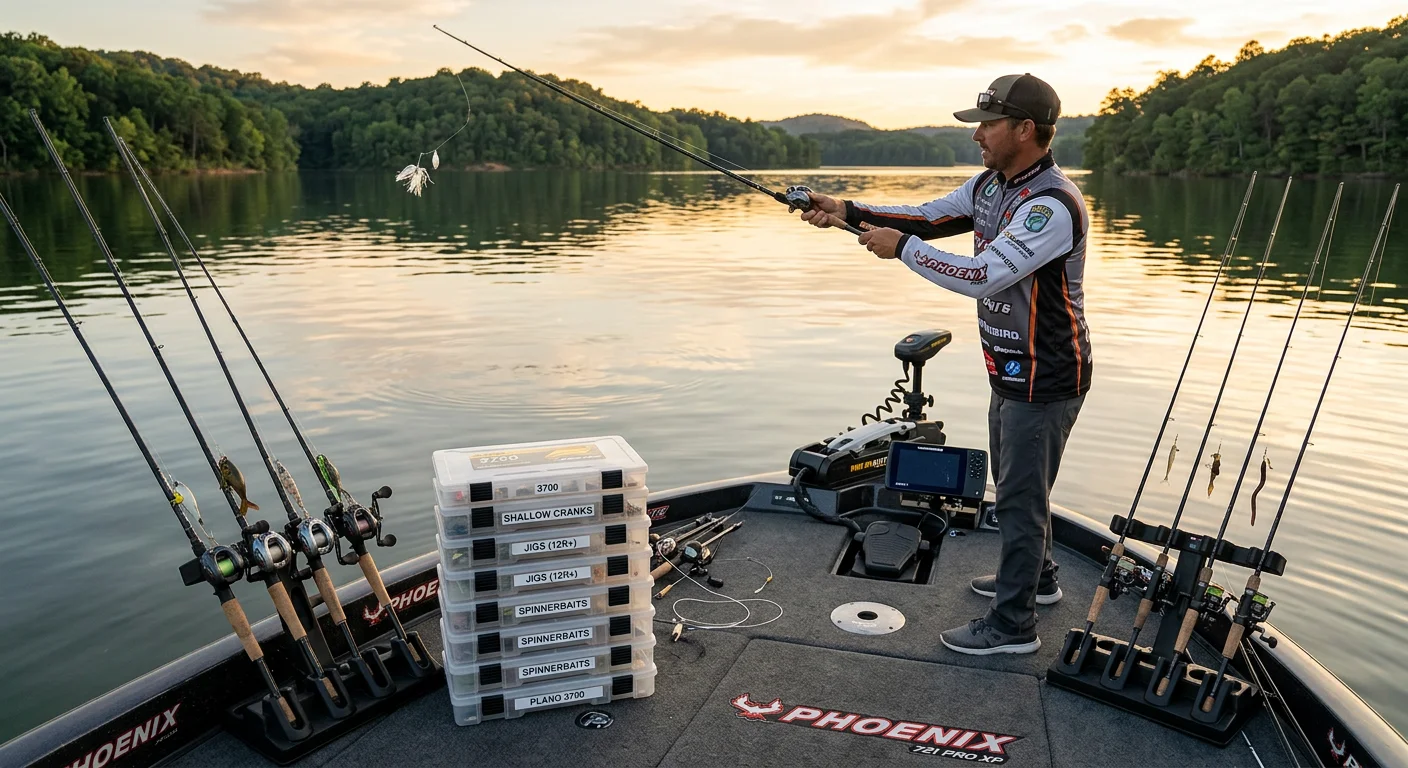
Before competition, KVD staged 10–20 rods on deck . Each rod was pre-rigged for a specific job. Deep crankbaits on 10–12 lb fluorocarbon. Spinnerbaits on 17–20 lb. Jigs for flipping. Every rod ready to go. No re-tying mid-competition. No hunting for the right setup at noon.
His tackle boxes followed the same logic — sorted by depth zone, not by lure type :
Box A (0–3 ft): Shallow cranks, buzzbaits, small spinnerbaits
Box B (3–8 ft): Mid-depth cranks, swimbaits, heavier spinnerbaits
Box C (8–20+ ft): Deep cranks (3XD, 5XD), heavy jig heads
Box D: Flipping and pitching — Texas rigs, jigs, dock and timber setups
Every box was labeled by technique and depth range . The target: grab the right box in under 10 seconds, no thought needed. Thinking costs time. Time costs fish.
Color selection ran on a pre-set decision tree too. At Toledo Bend: sexy blue back herring in low-light or wind; bar fish in bright, calm conditions. Rattling versions first for search and reaction. Silent versions to re-activate the same school once bite frequency dropped. Both versions sat together in the same box compartment — ready to swap in under 10 seconds.
Your Executable Framework: Search–Then–Milk
Here's the system broken down for your next outing.
Phase 1 — Search: Give each stretch of bank 5–10 minutes max . Use one or two clean, efficient lures — a 1/2 oz spinnerbait on 17 lb line for shallow-to-mid depth, or a mid-diving crankbait on 12–15 lb fluorocarbon for deeper structure. No bite, no follow, no sonar activity? Move. Now.
Phase 2 — Milk: Two bites from the same zone — or a visible school on sonar — means full commitment. Work the spot from at least three different angles — upstream, downstream, parallel, diagonal. Cycle through retrieve speeds. Swap rattling for silent. Give it 15–20 minutes before you call the school gone.
Pre-rig your rods the night before. Label your boxes. Know which box you're grabbing before you ever need it.
The best competitive bass fishing prep isn't only about skill. It's about cutting out friction so your skills can run clean. That's what KVD built. A machine with almost zero wasted motion.
Factor 4: Power Fishing Foundation + Finesse Adaptation — The Two-Weapon System Wins Modern Tournaments
Most anglers pick a side. Power fishing or finesse. Aggressive or precise. KVD never picked. He built a system that uses both — and he was clear about how they work together.
The core idea is simple: power fishing finds the fish, finesse closes the deal . VanDam didn't shift to finesse because he got older or the sport got harder. He added it because modern tournaments demanded a second weapon. One tool wins rounds. Two tools win championships.
The Four Finesse Tools He Uses
VanDam cut his finesse arsenal down to four rigs — drop-shot, Neko rig, shaky head, and Ned rig. Not a rotating cast of dozens. Four. Each one has a specific job.
Drop-shot: His go-to for precision depth work. He uses a ½ oz sinker and bombs it — long casts, fast drop, immediate reaction bite on the initial fall. Along ledges and structure, he lets the bait sink to 40 feet. Then the final 10 feet slide into position on their own. This isn't slow. It's surgical.
Neko rig: Open water, long casts, subtle presentation. It pairs with a 7'2"–7'4" medium-action spinning rod for maximum casting distance and feel.
Shaky head: His direct answer to "power fishing stopped working." High-pressure water. Fish that won't eat fast baits. This is the rig he grabs after the lake has been hammered.
Ned rig: Same open-water logic as the Neko. Use it when fish go light and need a smaller profile to commit.
His line setup stays consistent across all four: 10 lb braid + 8 lb fluorocarbon leader, connected with an FG knot . No reinventing the system each time. One trusted setup, ready on command.Fishing clubs and tackle retailers often partner with a reliable fishing apparel wholesaler to source technical clothing for tournaments, team events, and seasonal promotions.
Making the Switch
The signal isn't a feeling. It's a checklist.
VanDam cuts from power to finesse with at least two of these conditions present:
Clear water (fish can inspect the bait)
High fishing pressure on the body of water
Power baits producing zero bites over 30–45 minutes
Target structure is precise but fish won't chase
Bites are coming on the fall or pause — not the retrieve
Any two of those together? The finesse rod comes out.
How to Build Your Own Two-Weapon System
The tournament sequence VanDam runs is clear and repeatable:
Power first — cover water, locate fish, define the zone
Finesse second — work the fish that won't react to speed
Drop-shot for long-distance precision strikes
Ned/Neko for open water and light-bite corrections
Shaky head for "I know they're here, but they won't open their mouth" situations
For your setup: keep one medium-heavy fast-action power rod on deck for search and reaction. Add one 7'2"–7'4" medium-action spinning rod rigged with 10 lb braid and an 8 lb fluoro leader for finesse work. Pre-rig both before you leave the dock. The switch should take under 15 seconds — not a decision, just a reach.
Power fishing builds the foundation. Finesse fishing finishes the job. The anglers who win aren't better at one — they're faster at reading which one the moment calls for.
Factor 5: Lifelong Learning and Technology Adoption — Why GOAT Never Stopped Being a Student
Here's a number worth sitting with: in the NBA, fewer than 40% of veteran players make real changes to their shot selection in their final years. The rest stick with what made them great. That's not laziness — that's the pull of proven success. Something works, so the brain stops questioning it.
KVD never let that happen.
The Finesse Conversion: A GOAT Rewriting His Own Playbook
VanDam built his career on power fishing. Heavy line, big baits, aggressive retrieves. It worked. Then the data showed something he couldn't ignore: in high-pressure, clear-water conditions, power techniques produced 30–50% fewer bites. Finesse tactics, in those same environments, pushed catch rates up by 20–40%.
That gap was too large to ignore.
So he rebuilt. He didn't swap out his entire system overnight. He ran a step-by-step adoption process. Each season, he added one or two new finesse rigs. He logged cast counts and compared catches against his power setups. He tracked which conditions triggered the shift. Over time, finesse techniques grew from a 10–20% share of his tournament strategy to 40–60%. In critical moments — final rounds, high-pressure venues, post-cold-front days — finesse rigs made up an estimated 60–70% of his key fish.
That's not a stylistic tweak. That's a full strategic shift, built one season of careful data collection at a time.
Technology as a Competitive Weapon
Modern sonar systems have 50–100+ settings you can adjust. High-resolution mapping with one-foot contour accuracy takes 20–40 hours of focused learning to use well. Most experienced anglers pick one or two default modes and move on.
VanDam treated new electronics like a new fishing spot — something to explore step by step, not take for granted. New equipment arrived, and he booked 10+ on-water sessions within the first month. Each session focused on just one or two functions. He logged everything: water depth, clarity, bottom composition, sensitivity settings, contrast levels, and actual fish identification results. He wasn't just learning the technology. He was building his own performance database.
The Practical Framework: 10% Experiment Time
The system VanDam used is something you can copy. Here's the structure:
Reserve 10% of every outing for new techniques. An 8-hour day gives you 50 minutes of focused testing — one new variable at a time. A new lure, a new retrieve depth, a new sonar setting. Not three things. One.
Define success before you start. "At least one confirmed bite or structure find using the new method" is a clear, measurable outcome. A vague feeling that it "went okay" is not.
Run a seasonal skills audit. Each spring, list your top 10 go-to techniques. Flag the ones with the lowest results over the past two years — the 20–30% that have silently stopped producing. Those become your must-challenge targets for the coming season.
The math on lifelong learning pays off in a big way. In a 20-tournament season, switching to finesse tactics in just 10 high-pressure events — where they outperform power by a solid 25% — adds about 20 extra fish to your yearly total. Scale that across a full career, and the gap between the angler who kept adapting and the one who didn't grows enormous.
KVD didn't win 25 BASS events because he was the most talented angler on the water. He won because he stayed the most curious one.
The KVD Blueprint: How to Apply All 5 Factors to Your Own Bass Fishing Journey
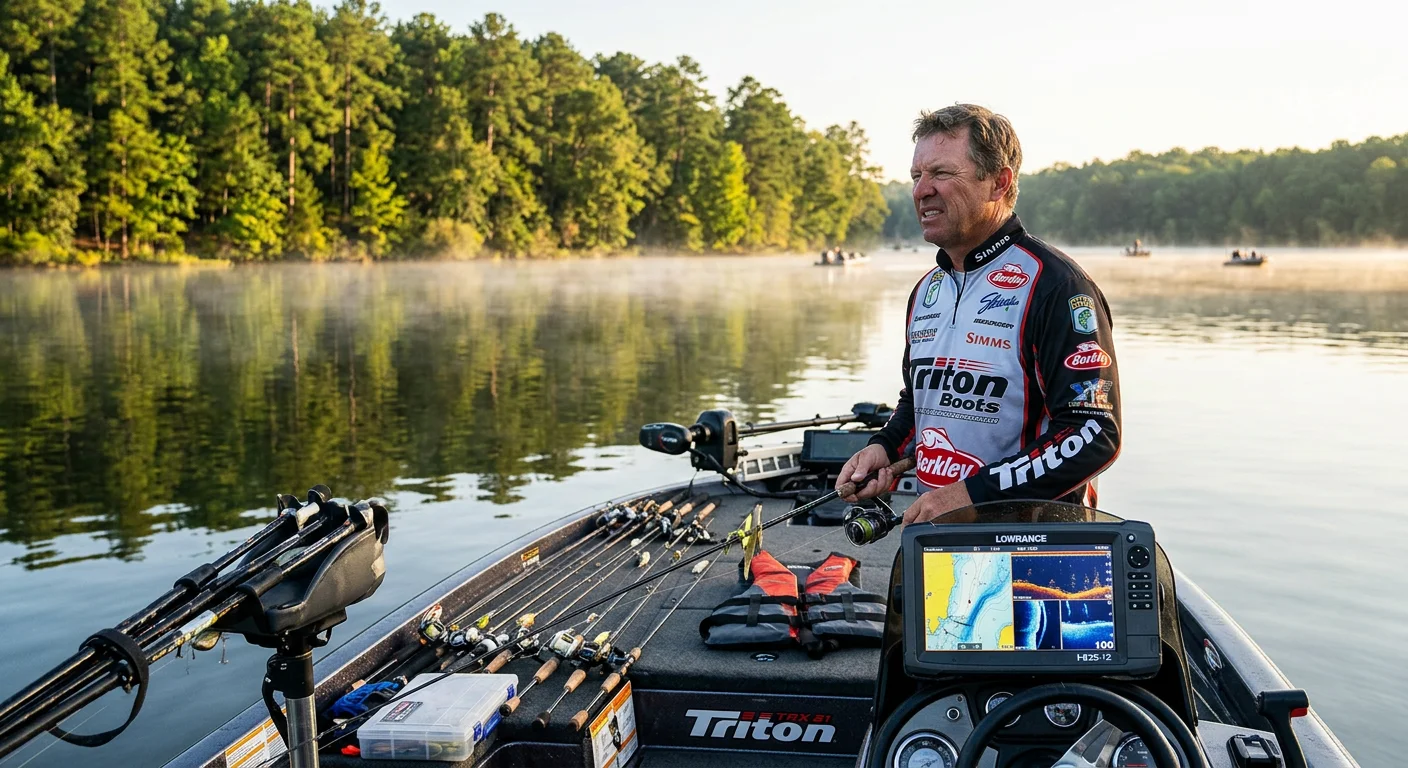
Five factors. One operating loop. Every decision KVD made on the water traced back to the same tight sequence: read the conditions, identify the structure, match the seasonal pattern, cover water with purpose, and adjust off every piece of fish feedback.
That loop is learnable. Here's how to run it at your own level.
Start with five questions before you ever make a cast:
What type of water am I fishing? River, reservoir, natural lake, or tidal system — the pattern changes by system. Name it first.
Where is the most productive structure? Channels, ditches, points, grass edges, bottlenecks, bluffs. Pick the spot with the highest odds. Go there first.
Where are the bass in the seasonal cycle? Winter fish sit on main-lake structure. Pre-spawn fish move shallow — start at five feet and less. Fall fish follow baitfish into creek arms. Season sets the depth.
What are the conditions telling me? Clarity, temperature, wind, current, rising or falling water. These factors drive your bait choice and retrieve speed. Sort them out before anything else.
What are bass eating, and how do I need to present it? Cover water fast with reaction baits when conditions allow. Drop to finesse when fish push you there.
Answer all five before the first cast. Most anglers skip steps one through four without a second thought.
The Pre-Fish → Execute → Review Loop
Before the tournament or session: Study maps first. Mark key depths. Scan the whole lake for grass, funnels, channels, and transition zones. Then narrow your focus to two or three high-percentage spots.
On the water: Run the ten-minute rule — KVD's own standard. No bite, no follow, no sonar activity after ten minutes? Move, change baits, or change presentation. Don't waste time on water that isn't producing.
After every fish: Go back to that exact spot with fresh eyes. Was it sunny or shady? Wind-exposed or protected? What depth, and how was the fish sitting relative to the bottom feature? That one fish is a data point. Build your next decision around it — not around yesterday's pattern.
Match Your Level to the System
The five-factor framework scales to any skill level. You don't have to run the full elite version on day one.
Beginner: Focus on water-type identification and structure spotting. Practice the ten-minute rule every outing. In spring, default to water five feet and shallower on any protected bank.
Intermediate: Add forage matching and condition-based lure selection. Track what cover produced each bite — stump, dock edge, dark bottom, rock transition. The small details pay off more than you'd think.
Advanced: Sharpen the feedback loop. Every fish gives you a data point on depth, position, current, shade, and cadence. Build a bait rotation by condition: moving baits in breeze and ripple, finesse and bottom-contact rigs when the water flattens out and fish go tight.
Gear as Part of the Performance System
KVD's lure selection had nothing to do with brand loyalty. It was about matching the tool to water clarity, depth, season, cover, and current. The right setup keeps your bait in the strike zone longer. You cover water faster. You cut time lost on dead casts.
The same logic applies to what you wear. Staying sharp for eight to twelve hours on the water takes physical stamina. High-UPF, moisture-wicking apparel — rated UPF 30–50+ — cuts heat buildup and skin fatigue. Your focus stays on the feedback loop, not on how uncomfortable you feel. More quality decisions per hour is what moves the needle. Your gear either backs that up or chips away at it.
The KVD blueprint isn't a collection of tips. It's a system. Run the five questions. Execute the loop. Review every fish. Repeat it until the process runs on its own — and the results follow.
Conclusion
Kevin VanDam didn't win four Bassmaster Classic titles by accident. He built a system — obsessive passion, an unshakeable mental game, relentless preparation, a versatile fishing arsenal, and a student's hunger for growth. Then he ran that system day after day, tournament after tournament, for close to three decades.
The good news? None of these factors are reserved for the gifted few.
Every element of the KVD blueprint is learnable. Passion can be cultivated. Decision-making gets sharper with consistent practice. Patterns show up for anglers who stay curious and stay present on the water.
Start small. Pick one factor from this list and focus on it hard before your next tournament. Master the mental game. Tighten your pre-fish system. Commit to learning one new technique this season.
The gap between a good angler and a great one isn't talent — it's intention.
Now get on the water and fish like you mean it.For brands planning to expand their fishing apparel collections, balancing product performance with competitive fishing apparel wholesale price strategies can help attract both professional anglers and recreational fishing enthusiasts.