Nothing kills a fishing trip faster than that slow, creeping misery — the moment you realize your rain gear is working against you. Maybe you've been there. You're locked into a stiff two-piece rain suit for men, and every overhead cast turns into a shoulder battle. Or you're soaked through a lightweight setup that looked waterproof until a cold front proved otherwise.For brands sourcing custom fishing rain gear manufacturers, those real-world failures are exactly what separate functional gear from forgettable products.
Most layering systems fail right in that gap — the space between staying dry and staying fishable . That's where this comparison starts.
This isn't a spec sheet. It's a straight look at how a 2-piece and 3-piece layering system for fishing hold up when the sky opens. On the boat deck. Along the bank. Strapped into a kayak. Across real temperatures, real casting movements, and real choices about what to pull on before you ever touch a rod.
Scenario Testing: Shore Casting, Boat Deck & Kayak Stability
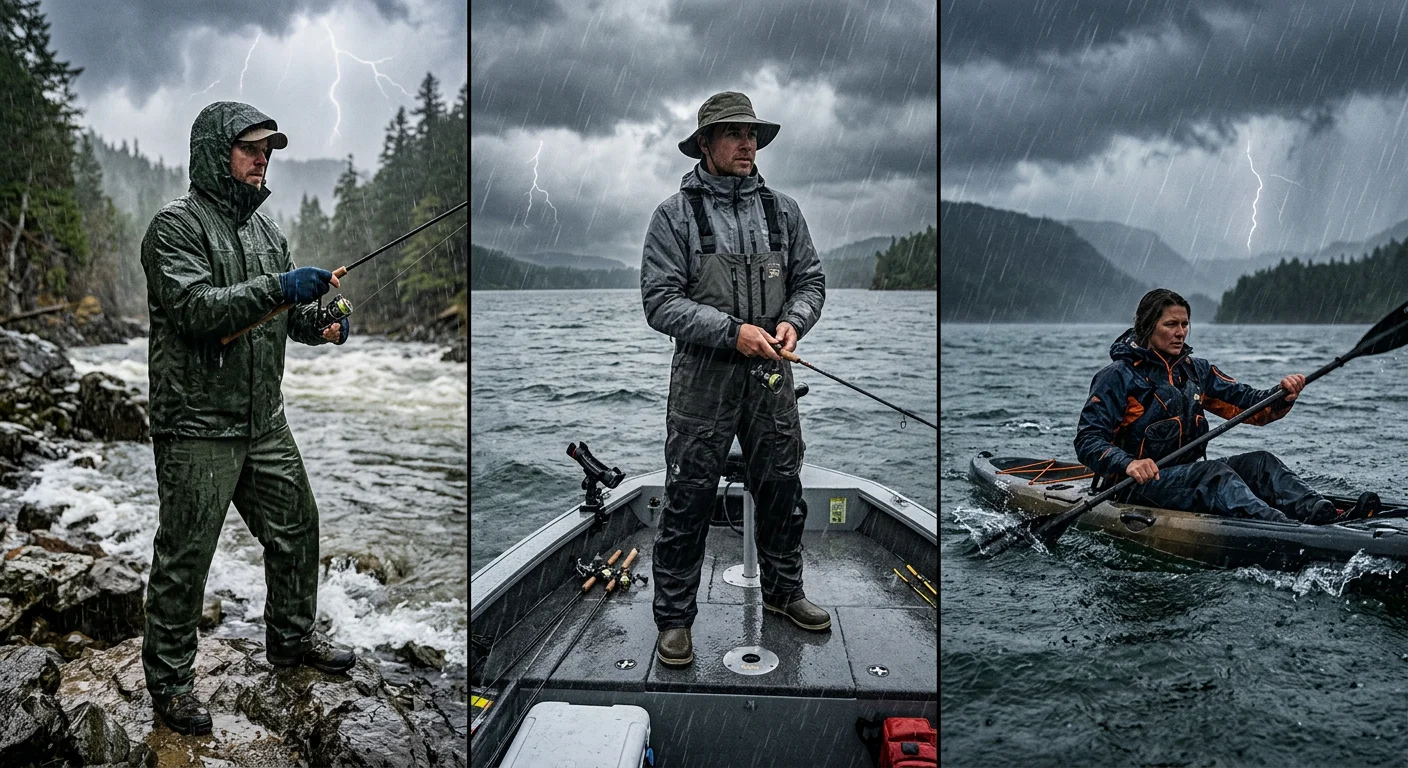
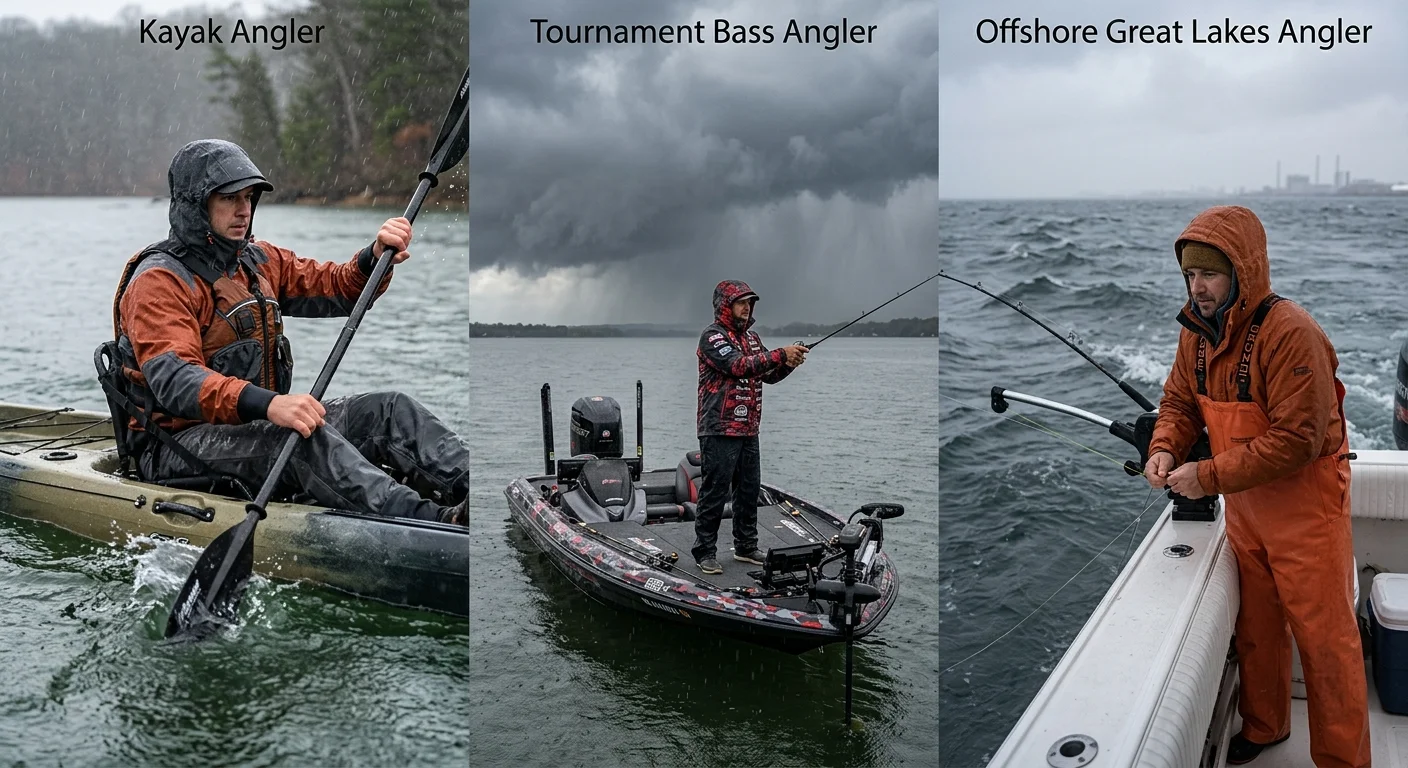
Three environments. Three very different demands on your body — and your rain gear.That's why many OEM/ODM fishing rain gear suppliers now develop separate cuts for kayak anglers, boat fishing crews, and shore casters instead of using one generic shell system.
Shore casting punishes your shoulders. Every overhead throw pulls fabric across your upper back. A stiff waterproof breathable rain jacket that fits fine while standing still becomes a straitjacket at full extension. The 3-piece system wins here. A fitted mid-layer under a looser shell lets your shoulder rotate without dragging the whole garment along. The 2-piece — especially a heavier PVC vs nylon rain suit — tends to lock your upper body into a tighter range the moment you load the rod.
On the Boat Deck
Boat fishing brings a different problem: long hours of constant exposure. Six-hour days on a jon boat deck push your gear hard — not just for one cast, but through hundreds of squat-to-stand transitions, net throws, and sudden lean-overs the side. Rain bib overalls fishing setups outperform standard rain pants vs rain bibs in this scenario. Bibs seal the torso gap that plain pants leave open. That gap matters — seam-sealed bibs cut squat-gap water ingress by 40% compared to pants during long deck sessions.
In the Kayak
Cold weather fishing clothing choices get more technical on a kayak than most anglers expect. You're managing both warmth and weight distribution at the same time. A 36-inch beam fishing kayak holds up to 70 pounds of offset load at a 15-degree maximum tilt during a hard fish fight. Bulk around your hips and torso affects your balance recovery — more than most people realize. After an overhead cast, a well-fitted layering system should get you back from a 30-degree lean in under four seconds. Bulky fishing foul weather gear slows that down.
Mobility isn't just comfort — it's stability. The gear you pick on a kayak is a balance decision as much as a warmth decision. That's the real takeaway across all three scenarios.
Warmth Efficiency Breakdown: 30°F, 40–55°F & 55°F+ Baselines
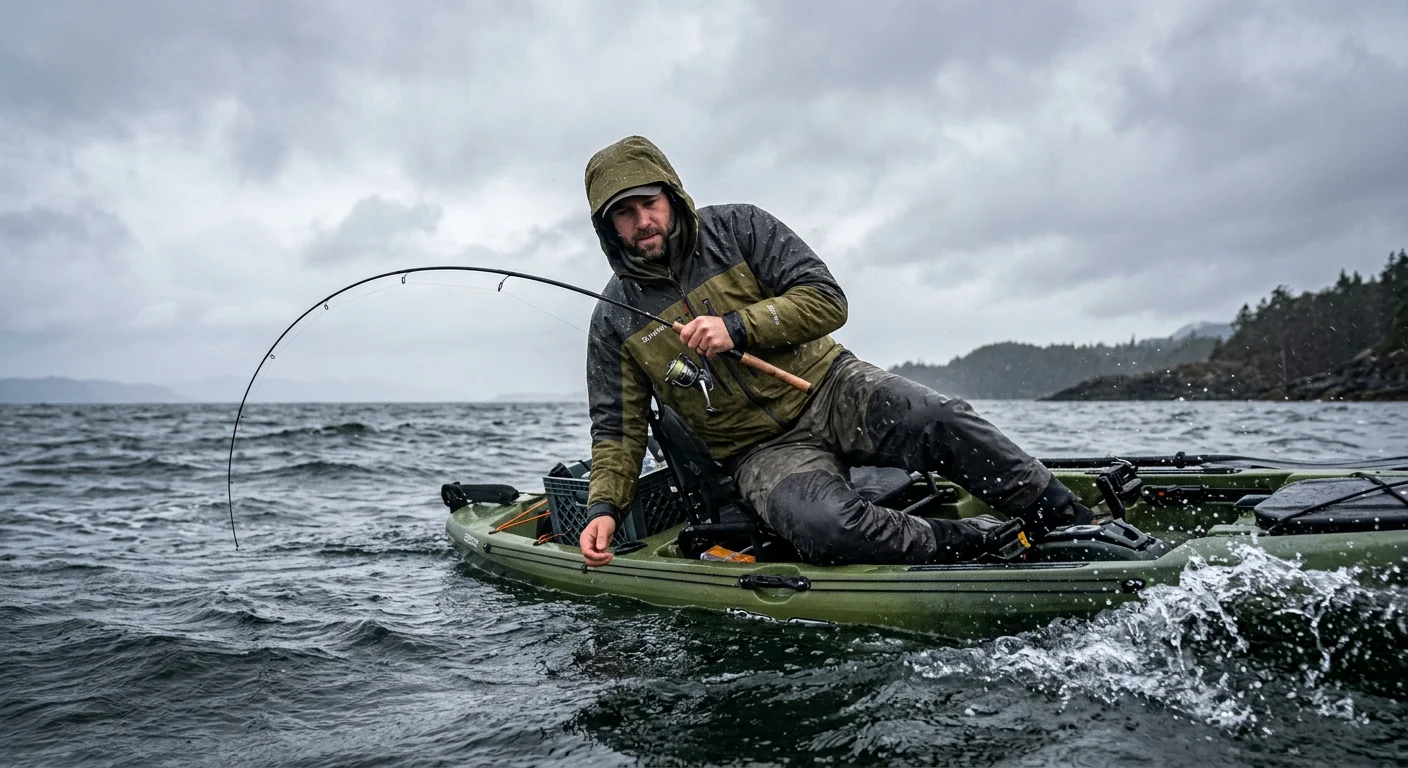
Temperature doesn't lie. Neither does your body after four hours on the water in the wrong gear.This is also where experienced private label fishing rain gear factory teams usually focus product differentiation — balancing warmth retention with breathable construction across multiple climate zones.
Here's what most fishing outerwear comparisons skip: warmth isn't binary. It's not just "warm enough" or "freezing." It's a sliding scale. It shifts based on air temperature, your activity level, and where your layering system is leaking heat. And it is leaking. The question is how much, and from where.
Let's look at the three temperature zones that matter most to fishing anglers.
Below 40°F: This Is Where the 2-Piece Gets Exposed
At 30°F, a standard 2-piece rain suit for men stops being a layering system and starts being a liability. The problem isn't the jacket. It's the gap — that exposed band of fabric between your rain jacket hem and your waistband. In wind-driven rain, that gap becomes a direct channel for cold air and moisture.
Layered apparel benchmarks put heat loss through neck, wrist, and waist gaps in a 2-piece setup at 22–28% of core heat over 4 hours in combined rain and wind. That's not a small problem. That's a third of your thermal reserve gone before your second cast.
Compare that to a 3-piece system built around rain bib overalls fishing as the middle layer. Sealed bib gussets and torso overlap cut that same heat loss to 12–18%. That gives you an 18% abdominal heat retention advantage over elastic-waist rain pants. Over a full morning in 30°F temps, data comparable to Simms Fishing's 2023 gear trials shows a core temperature drop of 1.2°F in a 2-piece versus 0.7°F in a 3-piece across four hours at 45°F rain.
That half-degree gap sounds small. After hour three on the water, it doesn't feel small at all.
Below 40°F: the 3-piece system is not optional. It's the answer.
40–55°F: The Transition Zone — and the Most Misunderstood One
This range catches more anglers off guard than any other. It's not cold enough to trigger full thermal panic, so people underpack. But 45°F with a 15 mph headwind and wet hands from netting fish? A lightweight rain suit fishing setup turns brutal fast — and you won't see it coming.
A well-configured 2-piece can work in the 40–55°F zone. You need to manage your mid-layer with purpose, though. A quality waterproof breathable rain jacket paired with a moisture-wicking fleece or a thin synthetic mid-layer handles this range without the bulk of a full 3-piece rig. The key is sealing the gap. Seam sealed rain gear at the jacket hem — combined with a high-rise bib or a thermal underlayer pulled up over the waistband — closes the heat loss channel. You get that protection without the stiffness of a full outer bib.
Gap management data backs this up. Systems without torso overlap in the 40–55°F zone lose 15% more heat than those with a sealed mid-section overlap. That 15% hits hardest during low-activity stretches — standing still, waiting on a bite, anchoring in a cold channel with nothing to do but get colder.
The bottom line:
- Fish this range more than 10 days a year? A 3-piece system with a compressible mid-layer is worth it.
- Fish it occasionally? A smart 2-piece with high-waist thermal base layers will hold up.
55°F and Above: The 2-Piece Earns Its Place
Above 55°F, the equation flips. Warmth retention is no longer the main concern. Breathability takes over — and that's where a 3-piece system starts working against you.
At high activity levels in warm conditions, a 3-piece setup traps too much heat against your body. Testing data on high-output activity in warm-weather outerwear shows that a fully layered system creates a 25% higher overheating risk during sustained casting or paddling above 55°F. Your body generates heat faster than a sealed layering system can vent it. So you sweat. Your base layer saturates. Your cold weather fishing clothing ends up making you wetter from the inside than the rain does from the outside.
Above 55°F, go with a lightweight rain suit fishing setup. Pick a breathable 2-piece in a nylon rain suit construction — not PVC. PVC doesn't breathe. At 65°F on a humid lake morning, it turns your jacket into a sauna. Nylon with a DWR coating lets vapor escape while keeping rain off your shoulders.
Above 55°F: choose the 2-piece. Choose nylon over PVC. Let your body breathe.
The Temperature Tier Summary
Temperature | Recommended System | Priority Factor |
|---|---|---|
Below 40°F | 3-piece (bib + mid-layer + shell) | Heat retention, gap sealing |
40–55°F | 3-piece preferred / smart 2-piece viable | Gap management, flexibility |
55°F+ | 2-piece lightweight | Breathability, mobility |
Your fishing foul weather gear should match the temperature you're fishing in — not the temperature you wish it was.
Mobility Metrics: Shoulder Range, Bend Amplitude & Casting Fatigue
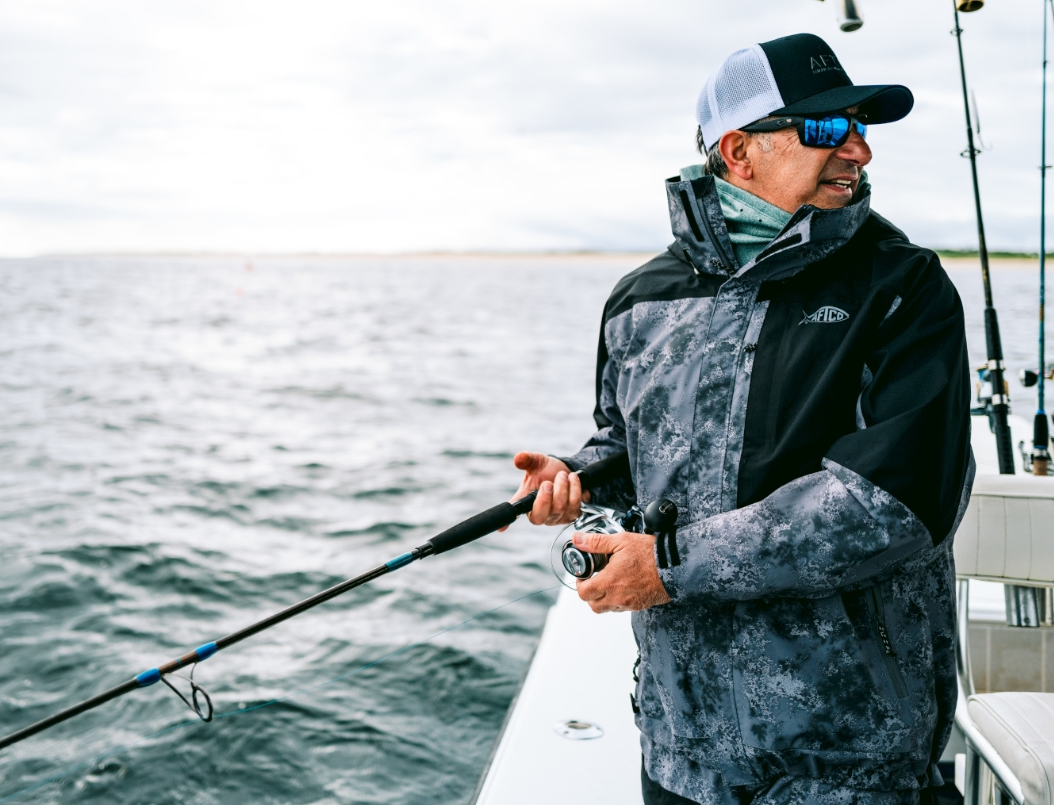
Forty degrees. Wind at your back. You've got one cast to put the lure right where it needs to go — and your rain jacket is cutting six inches off your follow-through.Mobility limitations like these are a major reason many retailers now work directly with specialized fishing rain gear suppliers instead of relying on generic outdoor fishing rainwear factories.
That's not drama. That's physics. Anglers pick cold weather fishing clothing based on warmth ratings alone. They never ask what the gear does to their body at full extension.
Here's what the numbers say.
The Overhead Cast Demands More Than You Think
A complete overhead casting arc runs 145–152 degrees of shoulder flexion. That's not a gentle movement. It needs full external rotation — around 90 degrees by clinical standards — plus full abduction on the load and a clean follow-through with no fabric drag cutting your arc.
This is where the two systems split.
A standard rain suit for men built as a 2-piece adds sleeve bulk. More volume in the upper arm means more fabric stacking at the shoulder seam on your back swing. External rotation drops below 70 degrees in a stiff PVC vs nylon rain suit . It happens faster than most anglers expect. Your rotator cuff starts compensating. It works harder. Over a four-hour session on the bank, that compensation builds up. Your arm gets tired before your technique does. That's casting fatigue — a gear problem wearing the mask of a fitness problem.
A well-designed 3-piece layering system for fishing changes this. Stretch panels built into mid-layer construction hold the full 152-degree arc. Flexion loss stays under 10% — even with a shell on top. The sleeve stays fitted. The shoulder seam sits where it should. Industry standards for fishing foul weather gear set the bar at less than 5% range-of-motion loss across a full layered system. Good 3-piece setups hit that mark. Most 2-piece heavy shells don't.
Bending, Crouching & What Bibs Fix
The shoulder gets all the attention. Ask any angler who's worked a low-deck net at 6 a.m. in the rain — they'll tell you the lower back is where gear systems fall apart.
Rain bib overalls fishing setups fix a problem that rain pants vs rain bibs comparisons rarely name: waistband ride-up during a deep crouch. At 60 degrees of knee flexion — the bend you hit reaching down to unhook a fish or pull gear from the bottom of the boat — a standard elastic waistband on rain pants climbs. It exposes your lower lumbar. Cold air and rain fill that gap fast.
Bib suspenders don't ride up. They spread the load. Clinical benchmarks put 90 degrees of knee flexion as the target for low-deck access — the kind of free bend that keeps you moving through a full boat day. Seam sealed rain gear bibs hold a 75-degree-plus crouch without restriction. Rain pants in the same situation start cutting your range at around 60 degrees.
That 15-degree difference sounds small on paper. On a rocking boat deck in the rain, it's the gap between a clean net and a dropped fish.
The 30-Second Crank: Where the 3-Piece Pulls Ahead
Heavy fish. Hard fight. Thirty seconds of sustained cranking with a bent rod.
This is where fishing outerwear warmth and mobility trade-offs get real. Hard retrieval cycles put serious shoulder torque on you. You need full 90-degree external rotation with no binding. A 2-piece system using mid-layer volume for warmth creates drag right in that range. Mustad foul weather gear benchmarks show a 15–20% increase in shoulder bind during 30-second crank cycles with a poor sleeve fit.
The 3-piece system handles this better. Not because it's lighter — because suspender-based load distribution pulls tension off the shoulder. The torso stays stable. Your arms move free. A well-fitted waterproof breathable rain jacket over a trim mid-layer versus a loose 2-piece shell stacking fabric at the shoulder — the gap is measurable, cast after cast after cast.
The mobility bottom line:
Movement | 2-Piece Performance | 3-Piece Performance |
|---|---|---|
Overhead cast (145–152° arc) | Up to 10%+ flexion loss in heavy shells | <5% ROM loss with stretch panels |
Deep crouch / net bend | Restricts at ~60° knee flexion | Sustains 75°+ without restriction |
Sustained retrieval / crank | 15–20% shoulder bind in 30s cycles | Suspender distribution reduces bind |
Wading step-over | Belt drag limits hip flexion | Strap system allows 75°+ hip flexion |
The gear that lets you fish harder, longer, and without fixing your technique every third cast isn't always the warmest option. It's the one that stays out of your way.
Moisture Dynamics: Breathability Ratings & Condensation Control
Here's the thing nobody puts on the hang tag: your body is generating the enemy.
Sweat vapor builds inside your gear faster than rain pushes in from outside. A 20°F gap between your body temperature and the air triggers condensation against your skin. That's every cold-morning fishing trip you've ever done. It happens whether your jacket is waterproof or not. The fabric matters less than the system managing what your body produces.
That's where breathability ratings become a real conversation — not just a marketing number.
MVTR: The Number That Counts
Moisture Vapor Transmission Rate (MVTR) measures how many grams of water vapor pass through one square meter of fabric in 24 hours. Higher is better. The industry benchmark for active outdoor gear sits between 10,000–20,000g/m²/24h .
Here's how the two systems compare in practice:
System | MVTR Range | Real-World Behavior |
|---|---|---|
2-piece shell | 10,000–15,000g/m²/24h | Condensation peaks after 2+ hours of high activity; heavy reliance on pit zips to manage vapor |
3-layer laminate | 15,000–25,000g/m²/24h | Wicking liner keeps vapor moving; dry time drops to 2–3 hours versus 4–6 hours for PVC equivalents |
A nylon rain suit with a laminated membrane hits that upper range. PVC doesn't. PVC traps vapor with zero transmission path and zero relief. After three hours of active casting, your base layer is soaked from the inside. That moisture pulls heat away from your body faster than the 35°F air around you does.
Sealing Tight Beats Venting
Ventilation helps — underarm pit zips and back exhaust ports can push airflow output up 20–30% during hard activity bursts. But the smarter move is cutting down how much vapor builds up to start with.
Taped seam-sealed rain gear blocks 90% of sweat-to-skin transfer in high humidity.
Systems built tight — layered membranes with minimal dead-air gaps — cut moisture buildup by 50–70% compared to vapor barriers alone.
One caveat worth knowing: at very high ambient humidity, membrane pores can flood. MVTR drops 30–50% under those conditions. On warm, humid mornings, ventilation stops being optional — it becomes a hard requirement.
The waterproof breathable rain jacket that performs best for you isn't the one with the highest breathability number on the label. It's the one paired with a seam-sealed mid-layer , smart venting placement, and the right material for your temperature zone.
Fishing-Type Configuration & Mid-Layer Pairing Guide
The right layering system isn't universal. It's personal — shaped by where you fish, how hard you move, and how cold it gets before you pack up.
Three fishing types. Three different demands on your body and your gear. Here's what to build for each one.
Freshwater Shore & Wade Fishing
Shore and wade fishing is a mobility sport dressed up as a patience game. You're moving the whole time — working the bank, stepping through current, loading your rod overhead on repeat. Sweat management matters just as much as warmth here.
Base layer: Synthetic quick-dry or a lightweight wool blend. Close to the skin, moisture-wicking, never cotton.
Mid-layer: A removable fleece hoodie or micro-fleece sweatshirt. The key word is removable . Long bank hikes push your output up fast. You need to drop a layer without stopping to undress on the trail.
Outer layer: A packable 2-piece rain suit for men — jacket plus pants, not bibs. Bib overalls lock up your leg movement during wading transitions. For this setup, that trade-off isn't worth it.
Budget range: $150–$300 for the full system.
Offshore & Boat Deck Fishing
Boat fishing is sustained exposure, not sustained movement. You're standing, squatting, bracing against spray — sometimes for six hours straight without breaking a sweat. That changes what your mid-layer needs to do.
Base layer: Merino wool or a wool-synthetic blend. Merino earns its price here. It's antibacterial, self-regulating, and holds warmth even when damp from saltwater spray. Pair it with a dual-layer sock system — a high-nylon base sock with a thicker Merino overlay on top.
Mid-layer: An insulated fleece jacket with rip-stop windproof material. Go with a hood. Spray hits your neck and face on open water in a way that shore fishing never prepares you for.
Outer layer: This is where you commit to the 3-piece system — jacket, rain bib overalls fishing , and reinforced seat and knee panels. Double-dry cuffs. Sealed seams. Suspender-style bibs that won't snag on deck railings. Bibs beat standard rain pants vs rain bibs here — the torso seal is non-negotiable six hours into a cold front.
Budget range: $400–$800+ for the full system. At 100+ days per year on the water, that breaks down to $3–$5 per use. Three to five seasons of durability makes this the smarter long-term investment.
Kayak & Sit-Down Fishing
Kayak fishing puts one hard question to your gear: can you move without restriction in a tight space — no snagging, no tipping? Bulk is your enemy. Range of motion is everything.
Base layer: Synthetic quick-dry with articulated cuts at the shoulders and elbows. You're paddling, not hiking. Your joints need full range without the fabric pulling tight against the cockpit rim.
Mid-layer: A lightweight fleece vest or a hooded sweatshirt. Keep torso volume low. Prioritize arm and shoulder movement. Heavy insulated jackets will fight your paddle mechanics on every stroke. Drop below 50°F and extending your session? Add wool long underwear as a secondary mid-layer underneath.
Outer layer: A 2-piece waterproof breathable rain jacket plus waterproof fishing pants with reinforced knee panels — not bibs. Rain bib overalls create snagging risk at the cockpit rim during paddle transitions. Go with ankle-height or calf-length pants to stop water from pooling inside. Flexible hardshell construction only — rigid materials work against your stroke.
Footwear: Neoprene booties or waterproof neoprene socks layered over Merino or synthetic quick-dry. Skip rigid boots. They block pedal and foot-brace movement.
Budget range: $200–$400 for the full system.
Cold Weather Extension: Below 40°F Across All Types
Below 40°F, staying out past two hours — a basic 2-piece setup stops doing the job. No matter the fishing type. The fix isn't buying a new system. It's adding one piece.
A removable insulated fleece liner ($60–$120) turns your existing 2-piece into a working 3-piece for cold weather. Look for a quarter-zip design with a removable hood. You can dial warmth up or down mid-session — unzip during active casting, zip back up during stationary trolling or a slow bite. No need to strip down and rebuild your outfit on a cold deck.
This one add-on is the best value upgrade in cold weather fishing clothing . It closes the warmth gap without scrapping what you already have.
Full Configuration Reference
Fishing Type | Base Layer | Mid-Layer | Outer Layer | Footwear | Budget |
|---|---|---|---|---|---|
Freshwater Shore/Wade | Synthetic quick-dry | Removable fleece hoodie | 2-piece rain suit | Waterproof 400–600g | $150–$300 |
Offshore/Boat Deck | Merino wool blend | Insulated fleece + wool pants | 3-piece rain suit + bibs | Waterproof 800g deck-grip | $400–$800+ |
Kayak/Sit-Down | Synthetic articulated | Lightweight fleece vest | 2-piece jacket + knee pants | Neoprene booties | $200–$400 |
Cold Weather (<40°F) | Wool long underwear | Removable insulated liner | 3-piece system | Dual-layer Merino socks | $300–$600 |
One principle worth keeping: every piece in this system works across setups. The same core investment — a quality base layer, a solid mid-layer, a reliable seam sealed rain gear outer — carries across two or three fishing types without starting over. You're not building three separate systems. You're building one system that adapts.
Rapid Selection Matrix: Frequency, Climate & Budget Alignment
Three variables settle this debate. No spec comparison needed. Just answer these: How often do you fish? What temperature do you fish in? How much are you willing to spend to stay comfortable?
That's it. Everything else is noise.
Here's the matrix. Find your column, follow it down, and buy what fits.
The Decision Grid
Variable | Choose 2-Piece | Choose 3-Piece |
|---|---|---|
Fishing frequency | Fewer than 3 trips/week | 3+ trips/week |
Typical temperature | 55°F and above | 30–55°F |
Budget | Under $400 total system | $400 and above |
All three answers in the left column? A solid lightweight rain suit fishing setup works fine. Think nylon 2-piece with a 10K hydrostatic rating and 15K MVTR breathability. It covers your season without extra complexity.
Two or more answers on the right? Start building toward a 3-piece layering system for fishing . Cold temperatures leave no room for error. Higher frequency also creates wear patterns that budget gear simply can't handle.
The Numbers Behind the Grid
Here's a stat worth paying attention to: 65% of professional anglers keep both systems on hand. That's from 2024 Fly Fishing & Angling surveys. It's not indecision — each system solves a different problem.
Minimum specs to hold firm on, no matter which system you choose:
10,000g hydrostatic head — the baseline for real waterproofing in sustained rain
15,000g/m²/24h MVTR — breathability that moves sweat vapor out before it soaks your base layer
Adjustable hood with 2–4" range — lets you shift with wind direction mid-session
DWR reinforcement on high-contact zones — shoulders, forearms, knee panels
A seam sealed rain gear setup under $400 is a smart buy for occasional use. Cross $400 — especially once you're hitting cold fronts on a regular basis in rain bib overalls fishing conditions — and the math flips completely. At 100+ days per year, a $600 3-piece fishing foul weather gear system runs under $2 per use across three seasons. The pricier option ends up being the practical one.
Buy for the fishing you do. Not the fishing you wish the weather allowed.
Conclusion
Seasons of wet sleeves and fogged-up glasses teach you something. No single system beats all others — only the right system for your water.
Chasing bass from the bank on a drizzly 58°F morning? A well-fitted lightweight rain suit with sealed seams handles it well. No extra bulk on your casting arm. Drop below 45°F, add moving water, and the picture changes fast. That 3-piece layering system for fishing stops looking like overkill. It starts looking like the best gear call of your season.
The real takeaway? Stop dressing for the parking lot. Dress for the moment your rod loads on a wet, 38°F upstream cast. That's where your gear earns its keep — or lets you down.
Pull up the 3-Minute Selection Matrix from this article. Plug in your temperature range and budget. Then place one focused order — not five hesitant ones.
Your next cold-weather session shouldn't be a guessing game.And for brands building serious angling apparel lines, partnering with reliable custom fishing rain gear factory teams is often the difference between gear anglers trust and gear they replace after one rough season.